VPNAVY VP-5 Mercury Capsule Recovery
http://www.vpnavy.org
VPNAVY Address

History VP-22 HistoryHistory

Circa 1999

Museum VP Aircraft"...On June 13, 1999, three former VPers of the late 60's vintage got to tour P-3A BUNO 150520 at the Western Aerospace Museum at the Oakland (CA) airport. Ken Kriner WOCOWBOY1@aol.com and Peter Lindberg plindberg@surfnetusa.com, formerly of VP-28 and VP-22 (1967-70) and Dennis Reilly Plumber869@aol.com of VP-9 (1966-69) joined ADC (Ret) Don Drake (VP-47, VP-91), who overseas the restoration of the aircraft for the museum. Don now works for Alaska airlines and has the "keys" for what could be one of the finest "museum" pieces around. In fact 150520 was the last P-3 to come through overhaul at Alameda depot maintenance before it was shut down. The aircraft was surplused to the museum despite the fact that it will be fully flyable. No rotting on a museum ramp for this bird; she's in fine original configuration, less a sono rack and some sensor gear. She currently sports green primer but will get original Navy colors soon. 150520 is special to Ken and Pete because it was a VP-31 training aircraft at the time they came through VP-31, and was from the same block of aircraft they flew in VP-28 (150512-150519, 150521-150523). Anyone out there in VP Navy Land who was destined for PACFLT P-3As in the late 60's would have at least a couple flights in this aircraft. After 30 years, it was like seeing an old friend..." Contributed by Peter Lindberg plindberg@surfnetusa.com [23JUN99]
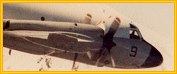
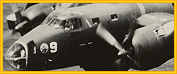
P-3 BUNO:150520(forward/side view of a/c)
P-3 BUNO:150520(head on view)
P-3 BUNO:150520(Ken & Don in cockpit)


Circa 1995

HistoryA BIT OF HISTORY: Naval Aviation News Magazine "...Deployments, Change-Of-Command, Awards, Records, Etc. - Naval Aviation News - July - August 1995.." WebSite: http://www.history.navy.mil/nan/backissues/1990s/1995/ja95.pdf [12NOV2004]

VP History ThumbnailCamera

Circa 1994

HistoryA BIT OF HISTORY: VP History ThumbnailCameraDEPARTMENT OF DEFENSE (GARY COPPAGE) "...VP-22 By Lieutenant Commander Rick Burgess, U.S. Navy (Retired)..." WebSite: Naval Institute http://www.usni.org/proceedings/articles05/pro03lwf.htm [08APR2005]

Waiting for permission to post entire article.

HistoryA BIT OF HISTORY: Naval Aviation News Magazine "...Awards, Major Deployments, Etc. - Naval Aviation News - July - August 1994.." WebSite: http://www.history.navy.mil/nan/backissues/1990s/1994/ja94.pdf [12NOV2004]

VP History ThumbnailCamera

HistoryA BIT OF HISTORY: Naval Aviation News Magazine "...Change-Of-Command, Rcords, Etc. - Naval Aviation News - March - April 1994.." WebSite: http://www.history.navy.mil/nan/backissues/1990s/1994/ma94.pdf [12NOV2004]

VP History ThumbnailCamera

Circa 1993

HistoryA BIT OF HISTORY: Naval Aviation News Magazine "...VP Deployments, Change-Of-Command, Etc. - Naval Aviation News - July - August 1993.." WebSite: http://www.history.navy.mil/nan/backissues/1990s/1993/ja93.pdf [12NOV2004]

VP History ThumbnailCamera

Circa 1992

HistoryA BIT OF HISTORY: Naval Aviation News Magazine "...Safe Flying, Change-Of-Command, and Rescues - Naval Aviation News - November-December 1992.." WebSite: http://www.history.navy.mil/nan/backissues/1990s/1992/nd92.pdf [11NOV2004]

VP History ThumbnailCamera

HistoryA BIT OF HISTORY: Naval Aviation News Magazine "...Patrol Aviation In The Pacific In WWII - Naval Aviation News - July-August 1992.." WebSite: http://www.history.navy.mil/nan/backissues/1990s/1992/ja92.pdf [11NOV2004]

History - Tap To Enlarge ThumbnailHistory - Tap To Enlarge ThumbnailHistory - Tap To Enlarge ThumbnailHistory - Tap To Enlarge Thumbnail

HistoryA BIT OF HISTORY: Naval Aviation News Magazine "...Base Closures, Change-Of-Command, Records, Etc. - Naval Aviation News - May-June 1992.." WebSite: http://www.history.navy.mil/nan/backissues/1990s/1992/mj92.pdf [11NOV2004]

VP History ThumbnailCamera

HistoryA BIT OF HISTORY: Naval Aviation News Magazine "...Change-Of-Command - Naval Aviation News - March-April 1992.." WebSite: http://www.history.navy.mil/nan/backissues/1990s/1992/ma92.pdf [11NOV2004]

VP History ThumbnailCamera

Circa 1991

HistoryA BIT OF HISTORY: Naval Aviation November-December 1991 "...This Is No Drill - Naval Aviation News - November-December 1991..." WebSite: http://www.history.navy.mil/nan/backissues/1990s/1991/nd91.pdf [25OCT2004]

History - Tap To Enlarge ThumbnailHistory - Tap To Enlarge ThumbnailHistory - Tap To Enlarge Thumbnail

HistoryA BIT OF HISTORY: Naval Aviation September-October 1991 "...The Pacific Neutrality Patrol - Naval Aviation News - September-October 1991..." WebSite: http://www.history.navy.mil/nan/backissues/1990s/1991/so91.pdf [24OCT2004]

History - Tap To Enlarge ThumbnailHistory - Tap To Enlarge ThumbnailHistory - Tap To Enlarge Thumbnail

Circa 1990

HistoryA BIT OF HISTORY: Naval Aviation November-December 1990 "...History - Change-Of-Command - Page 8, 9 and 32 - Naval Aviation News - November-December 1990..." WebSite: http://www.history.navy.mil/nan/backissues/1990s/1990/nd90.pdf [22OCT2004]

VP History ThumbnailCamera

HistoryA BIT OF HISTORY: Naval Aviation May-June 1990 "...History and Change-Of-Command - Page 6, 29 and 31 - Naval Aviation News - May-June 1990..." WebSite: http://www.history.navy.mil/nan/backissues/1990s/1990/mj90.pdf [22OCT2004]

VP History ThumbnailCamera

HistoryA BIT OF HISTORY: Naval Aviation March-April 1990 "...Modernization Under Way - Page 8 to 9 - Naval Aviation News - March-April 1990..." WebSite: http://www.history.navy.mil/nan/backissues/1990s/1990/ma90.pdf [22OCT2004]

History - Tap To Enlarge ThumbnailHistory - Tap To Enlarge Thumbnail

Circa 1987

HistoryA BIT OF HISTORY: Naval Aviation January-February 1987 "...Tracing Squadron Lineage - Page 22 to 26 - Naval Aviation News - January-February 1987..." WebSite: http://www.history.navy.mil/nan/backissues/1980s/1987/jf87.pdf [20OCT2004]

History - Tap To Enlarge ThumbnailHistory - Tap To Enlarge ThumbnailHistory - Tap To Enlarge Thumbnail
History - Tap To Enlarge ThumbnailHistory - Tap To Enlarge Thumbnail 

Circa 1984

HistoryA BIT OF HISTORY: Naval Aviation July-August 1984 "...History - Change-Of-Command - Page 37, 38 and 40 - Naval Aviation News - July-August 1984..." WebSite: http://www.history.navy.mil/nan/backissues/1980s/1984/ja84.pdf [17OCT2004]

VP History ThumbnailCamera

Circa 1982

HistoryA BIT OF HISTORY: History ThumbnailCameraID: DNST8601685 "...A Navy SH-3G Sea King helicopter from Fleet Composite Squadron Five (VC-5) takes off. Below (left) four P-3 Orion aircraft (VP-16 and VP-22) and (background) F-4 Phantom II aircraft are visible. Location: NAS Cubi Point, Philippines (PHL) - Camera Operator: PH1 DAVID C. MACLEAN Date Shot: 14 Jan 1982..." WebSite: Defense Visual Information Center http://www.dodmedia.osd.mil/ [07FEB2006]

HistoryA BIT OF HISTORY: Naval Aviation September 1982 "...Records - Change-Of-Command - Page 44 and 46 - Naval Aviation News - September 1982..." WebSite: http://www.history.navy.mil/nan/backissues/1980s/1982/sep82.pdf [16OCT2004]

VP History ThumbnailCamera

HistoryA BIT OF HISTORY: Naval Aviation August 1982 "...History - Change-Of-Command - Page 44, 45 and 46 - Naval Aviation News - August 1982..." WebSite: http://www.history.navy.mil/nan/backissues/1980s/1982/aug82.pdf [15OCT2004]

VP History ThumbnailCamera

HistoryA BIT OF HISTORY: Naval Aviation May 1982 "...History - Change-Of-Command - Page 45 and 46 - Naval Aviation News - May 1982..." WebSite: http://www.history.navy.mil/nan/backissues/1980s/1982/may82.pdf [15OCT2004]

VP History ThumbnailCamera

Circa 1981

HistoryA BIT OF HISTORY: Naval Aviation December 1981 "...Awards - Records - Change-Of-Command - Page 28 to 30 - Naval Aviation News - December 1981..." WebSite: http://www.history.navy.mil/nan/backissues/1980s/1981/dec81.pdf [14OCT2004]

VP History ThumbnailCamera

HistoryA BIT OF HISTORY: Naval Aviation August 1981 "...History - Change-Of-Command - Page 4, 44 and 47 - Naval Aviation News - August 1981..." WebSite: http://www.history.navy.mil/nan/backissues/1980s/1981/aug81.pdf [14OCT2004]

VP History ThumbnailCamera

Circa 1979

HistoryA BIT OF HISTORY: Naval Aviation May 1979 "...History - Awards - Page 3, 23, 26 to 27 - Naval Aviation News - May 1979..." WebSite: http://www.history.navy.mil/nan/backissues/1970s/1979/may79.pdf [10OCT2004]

VP History ThumbnailCamera

HistoryA BIT OF HISTORY: "01JAN79--Completing 25 Years of Accident-Free Flying...NAVY TIMES Page 26..." Contributed by Paul J. Waeghe, AFCM Retired pjwaeghe@bellsouth.net [01MAR98]

History
Phot by PH2 Steve Walters

Completing 25 Years of Accident-Free Flying

The Crews and two P-3B (D) Orion aircraft of Patrol Squadron 22 form a "25" on the runway at NAS Barbers Point, Hawaii, to symbolize the completion of VP-22's 25th consecutive year of accident-free flying. The "Blue Geese" of VP-22 flew more than 201,000 hours during the 25-year span, and garnered almost every aviation safety award the Navy has to offer. The squadron, which now is transitioning to the most modern "Super B" version of the P-3B Orion aircraft, believes it is the first combat squadron in aviation history to reach the 25-year safety milestone. Cmdr. Michael B. Hughes is skipper of VP-22. [01MAR98]

Circa 1978

HistoryA BIT OF HISTORY: Naval Aviation June 1978 "...History and Change-Of-Command - Page 22 and 25 - Naval Aviation News - June 1978..." WebSite: http://www.history.navy.mil/nan/backissues/1970s/1978/jun78.pdf [09OCT2004]

VP History ThumbnailCamera

HistoryA BIT OF HISTORY: Naval Aviation March 1978 "...History and Change-Of-Command - Page 16 and 19 - Naval Aviation News - March 1978..." WebSite: http://www.history.navy.mil/nan/backissues/1970s/1978/mar78.pdf [09OCT2004]

VP History ThumbnailCamera

Circa 1977

HistoryA BIT OF HISTORY: Naval Aviation October 1977 "...Change-Of-Command - Page 24 - Naval Aviation News - October 1977..." WebSite: http://www.history.navy.mil/nan/backissues/1970s/1977/oct77.pdf [08OCT2004]

VP History Thumbnail

HistoryA BIT OF HISTORY: Naval Aviation February 1977 "...South Pacific Saga - Page 32 to 27 - Naval Aviation News - February 1977..." WebSite: http://www.history.navy.mil/nan/backissues/1970s/1977/feb77.pdf [08OCT2004]

History - Tap To Enlarge ThumbnailHistory - Tap To Enlarge ThumbnailHistory - Tap To Enlarge Thumbnail

HistoryA BIT OF HISTORY: Naval Aviation January 1977 "...VP History - Page 29 - Naval Aviation News - January 1977..." WebSite: http://www.history.navy.mil/nan/backissues/1970s/1977/jan77.pdf [08OCT2004]

VP History ThumbnailCamera

Circa 1976

HistoryA BIT OF HISTORY: Naval Aviation December 1976 "...CNO Safety Awards - Page 5 - Naval Aviation News - December 1976..." WebSite: http://www.history.navy.mil/nan/backissues/1970s/1976/dec76.pdf [07OCT2004]

VP History ThumbnailCamera

HistoryA BIT OF HISTORY: Naval Aviation June 1976 "...Trophy - Page 36 - Naval Aviation News - June 1976..." WebSite: http://www.history.navy.mil/nan/backissues/1970s/1976/jun76.pdf [06OCT2004]

VP History Thumbnail

HistoryA BIT OF HISTORY: Naval Aviation April 1976 "...VP-22 - Page 22 - Naval Aviation News - April 1976..." WebSite: http://www.history.navy.mil/nan/backissues/1970s/1976/apr76.pdf [05OCT2004]

VP History Thumbnail

Circa 1975

HistoryA BIT OF HISTORY: Naval Aviation November 1975 "...VP-22 - Page 25 - Naval Aviation News - November 1975..." WebSite: http://www.history.navy.mil/nan/backissues/1970s/1975/nov75.pdf [04OCT2004]

VP History Thumbnail

HistoryA BIT OF HISTORY: Naval Aviation May 1975 "...VP-22 - Page 30 - Naval Aviation News - May 1975..." WebSite: http://www.history.navy.mil/nan/backissues/1970s/1975/may75.pdf [02OCT2004]

VP History Thumbnail

HistoryA BIT OF HISTORY: Naval Aviation May 1975 "...CNO Golden Wrench Award - Page 28 - Naval Aviation News - May 1975..." WebSite: http://www.history.navy.mil/nan/backissues/1970s/1975/may75.pdf [02OCT2004]

VP History Thumbnail

Circa 1974

HistoryA BIT OF HISTORY: Naval Aviation December 1974 "...Aviation Awards - Page 3 - Naval Aviation News - December 1974..." WebSite: http://www.history.navy.mil/nan/backissues/1970s/1974/dec74.pdf [01OCT2004]

VP History ThumbnailCamera

HistoryA BIT OF HISTORY: Naval Aviation July 1974 "...The Chair Moves To Adjourn - Page 32 to 35 - Naval Aviation News - July 1974..." WebSite: http://www.history.navy.mil/nan/backissues/1970s/1974/jul74.pdf [01OCT2004]

History - Tap To Enlarge ThumbnailHistory - Tap To Enlarge ThumbnailHistory - Tap To Enlarge ThumbnailHistory - Tap To Enlarge Thumbnail

HistoryA BIT OF HISTORY: Naval Aviation May 1974 "...Safe Flying - Page 5 - Naval Aviation News - May 1974..." WebSite: http://www.history.navy.mil/nan/backissues/1970s/1974/may74.pdf [01OCT2004]

VP History ThumbnailCamera

HistoryA BIT OF HISTORY: "...The "Klingon" Goose was also refer'd to as a "Speed" Goose. Patches differed and the degree that the wings were laying back brought about the speed idea. This was the common nomenclature from the Cubi '74 thru '76 deployments...P. J. Waeghe, AFCM" pjwaeghe@bellsouth.net


Circa 1973

HistoryA BIT OF HISTORY: Naval Aviation May 1973 "...Fleets Announce Battle E Winners - Page 3 - Naval Aviation News - May 1973..." WebSite: http://www.history.navy.mil/nan/backissues/1970s/1973/may73.pdf [28SEP2004]

VP History ThumbnailCamera

Circa 1972

HistoryA BIT OF HISTORY: Naval Aviation June 1972 "...On Patrol - Page 18 - Naval Aviation News - June 1972..." WebSite: http://www.history.navy.mil/nan/backissues/1970s/1972/jun72.pdf [27SEP2004]

VP History ThumbnailCamera

HistoryA BIT OF HISTORY: VP-22 P3 Thumbnail "...VP-22-QA4 (154594) getting some needed maintenance in the VP hanger at Naha Air Base during our 1972 deployment. QA4 was known as ZIPPO by two different VP-22 crews that experienced an engine fire on #2. I was on the Aug 2, 1972 QA4 flight when about 30 minutes out of Naha we had an oil leak on #2. Upon routine shut down it flammed up, bad. We made an emergency landing at Miyako Jima, safely, due to PPC Mike Lewis' cool management of the situation..." Contributed by Larry Forney (AW3) doghntr22@yahoo.com [09JAN99]

HistoryA BIT OF HISTORY: VP-22 P3 Thumbnail "...Sample of our primary mission was during the 72 Naha Deployment, Ocean Surveilance and Patrol (OSAP) in the South China Sea. This one looks like a "Mast, kingpost, mast, funnel... Something Maru". Gee, only 200 more contacts left to rig! Flight-Radar, come to a heading of 220, range 69 miles... One of the pilots asked me one day if those were true or magnetic headings I was giving him. I said True but didn't think it made any difference because he didn't fly that accurately anyway. He was not impressed with my humor!..." Contributed by Larry Forney (AW3) doghntr22@yahoo.com [09JAN99]


Circa 1971

HistoryA BIT OF HISTORY: Naval Aviation December 1971 "...Total Force - Page 30 - Naval Aviation News - December 1971..." WebSite: http://www.history.navy.mil/nan/backissues/1970s/1971/dec71.pdf [26SEP2004]

VP History ThumbnailCamera

HistoryA BIT OF HISTORY: Naval Aviation November 1971 "...FY-1971 Safety Awardees Named - Naval Aviation News - November 1971..." WebSite: http://www.history.navy.mil/nan/backissues/1970s/1971/nov71.pdf [25SEP2004]

VP History ThumbnailCamera

HistoryA BIT OF HISTORY: Naval Aviation August 1971 "...On Patrol - Page 34 - Naval Aviation News - August 1971..." WebSite: http://www.history.navy.mil/nan/backissues/1970s/1971/aug71.pdf [23SEP2004]

VP History ThumbnailCamera

Circa 1970

HistoryA BIT OF HISTORY: History ThumbnailCameraVP-4 and VP-22 History "...Bottom left is P-3A BuNo 151393, VP-22 QA-45, and bottom right is P-3B BuNo 151393, VP-4 YD-3. About 1970..." Contributed by MOTTERN, AW1 Carl Retired cfmottern@yahoo.com [10NOV2005]

HistoryA BIT OF HISTORY: Naval Aviation October 1970 "...On Patrol - Page 33 - Naval Aviation News - October 1970..." WebSite: http://www.history.navy.mil/nan/backissues/1970s/1970/oct70.pdf [17SEP2004]

VP History ThumbnailCamera

HistoryA BIT OF HISTORY: Naval Aviation January 1970 "...On Patrol - Page 33 - Naval Aviation News - January 1970..." WebSite: http://www.history.navy.mil/nan/backissues/1970s/1970/jan70.pdf [17SEP2004]

VP History ThumbnailCamera

Circa 1969

HistoryA BIT OF HISTORY: Naval Aviation October 1969 "...On Patrol - Naval Aviation News - October 1969..." WebSite: http://www.history.navy.mil/nan/backissues/1960s/1969/oct69.pdf [17SEP2004]

VP History ThumbnailCamera

HistoryA BIT OF HISTORY: Naval Aviation June 1969 "...On Patrol - Page 30 to 31 - Naval Aviation News - June 1969..." WebSite: http://www.history.navy.mil/nan/backissues/1960s/1969/jun69.pdf [17SEP2004]

History - Tap To Enlarge ThumbnailHistory - Tap To Enlarge Thumbnail

HistoryA BIT OF HISTORY: "03OCT69--Cdr John F. Kneisl to Command Patrol Squadron 22 Blue Geese...Cdr John F. Kneisi will relieve Cdr James W. Cornwell as commanding officer of VP-22 Tuesday morning on the NAS parade ground, between the station Admin building and the Chapel. The 10 a.m. ceremony will be preceded by a personnel inspection. RAdm Donald C. Davis, ComFAirHawaii/ComHawSeaFron, and Capt Jens B. Hansen, ComFAW-2, will speak during the ceremonies. Cdr Kneisi has been executive of the "Blue Geese" squadron since November 1968, during the squadron's last deployment to Okinawa. A native of New York City, Cdr Kneisi graduated from the University of Rochester (New York) with a Bachelor of Science degree in psychology. He was commissioned an Ensign in the Navy. in 1954 and received his wings in 1956. His first duty assignment, from 1956 to 1959, was with VW-4, the Navy's famed Hurricane Hunter Squadron based at NAS Jacksonville, Florida. Following duty with air groups embarked aboard the USS Wasp (CVS-18) and USS Salisbury Sound, then flagship for ComPatForSeventh Fleet. Prior to reporting to VP-22, Cdr Kneisl served as maintenance officer for VP-9 at NAS Moffett Field, California. Cdr Cornwell, who has been with VP-22 since January 1968 and commanded it since last October, will report to the Joint Chiefs of Staff in Washington, D.C..." The Pointer Fri., Oct. 3, 1969 Contributed by Peter Lindberg plindberg@surfnetusa.com


Circa 1968

HistoryA BIT OF HISTORY: Naval Aviation September 1968 "...On Patrol - Page 30 to 31 - Naval Aviation News - September 1968..." WebSite: http://www.history.navy.mil/nan/backissues/1960s/1968/sep68.pdf [15SEP2004]

History - Tap To Enlarge ThumbnailHistory - Tap To Enlarge Thumbnail

HistoryA BIT OF HISTORY: Naval Aviation June 1968 "...On Patrol - Page 30 to 31 - Naval Aviation News - June 1968..." WebSite: http://www.history.navy.mil/nan/backissues/1960s/1968/jun68.pdf [15SEP2004]

History - Tap To Enlarge ThumbnailHistory - Tap To Enlarge Thumbnail

Circa 1967

HistoryA BIT OF HISTORY: "...VP-22 NAS Adak, Alaska deployment from November 1966 to June 1967. Photograph's probably taken in April 1967. I was a member of Crew 7 and the pilot that day was LCDR Pete Stogis (the best pilot I knew)..." Contributed by LaFLAM, Ray r.laflam@comcast.net [14MAR2009]

Left to Right: VP-22 P-3 (QA 6), VP-22 Hanger and Altitude 10 feet!

P-3 ThumbnailHistory - Tap To Enlarge ThumbnailHistory - Tap To Enlarge Thumbnail

HistoryA BIT OF HISTORY: Naval Aviation November 1967 "...Fleet Air Wings On Patrol - Page 30 to 31 - Naval Aviation News - November 1967..." WebSite: http://www.history.navy.mil/nan/backissues/1960s/1967/nov67.pdf [13SEP2004]

History - Tap To Enlarge ThumbnailHistory - Tap To Enlarge Thumbnail

HistoryA BIT OF HISTORY: Naval Aviation October 1967 "...Fleet Air Wings - Page 28 - Naval Aviation News - October 1967..." WebSite: http://www.history.navy.mil/nan/backissues/1960s/1967/oct67.pdf [12SEP2004]

VP History ThumbnailCamera

HistoryA BIT OF HISTORY: Naval Aviation August 1967 "...Fleet Air Wings On Patrol - Page 28 to 29 - Naval Aviation News - August 1967..." WebSite: http://www.history.navy.mil/nan/backissues/1960s/1967/aug67.pdf [11SEP2004]

History - Tap To Enlarge ThumbnailHistory - Tap To Enlarge Thumbnail

HistoryA BIT OF HISTORY: Naval Aviation June 1967 "...Fleet Air Wings On Patrol - Page 28 to 29 - Naval Aviation News - June 1967..." WebSite: http://www.history.navy.mil/nan/backissues/1960s/1967/jun67.pdf [10SEP2004]

History - Tap To Enlarge ThumbnailHistory - Tap To Enlarge Thumbnail

HistoryA BIT OF HISTORY: Naval Aviation May 1967 "...Fleet Air Wings On Patrol - Page 28 to 29 - Naval Aviation News - May 1967..." WebSite: http://www.history.navy.mil/nan/backissues/1960s/1967/may67.pdf [10SEP2004]

History - Tap To Enlarge ThumbnailHistory - Tap To Enlarge Thumbnail

HistoryA BIT OF HISTORY: Naval Aviation April 1967 "...Pacific, Atlantic 'E' Winnders Named - Page 3 - Naval Aviation News - April 1967..." WebSite: http://www.history.navy.mil/nan/backissues/1960s/1967/apr67.pdf [09SEP2004]

VP History ThumbnailCamera

HistoryA BIT OF HISTORY: Naval Aviation March 1967 "...Fleet Air Wings On Patrol - Page 28 to 29 - Naval Aviation News - March 1967..." WebSite: http://www.history.navy.mil/nan/backissues/1960s/1967/mar67.pdf [08SEP2004]

History - Tap To Enlarge ThumbnailHistory - Tap To Enlarge Thumbnail

HistoryA BIT OF HISTORY: Naval Aviation February 1967 "...Fleet Air Wings On Patrol - Page 30 to 31 - Naval Aviation News - February 1967..." WebSite: http://www.history.navy.mil/nan/backissues/1960s/1967/feb67.pdf [08SEP2004]

History - Tap To Enlarge ThumbnailHistory - Tap To Enlarge Thumbnail

Circa 1966

HistoryA BIT OF HISTORY: "...NAS Kwajalein, Marshall Islands Circa 1966..." Contributed by LaFLAM, Ray r.laflam@comcast.net [23JAN2009]

History - Tap To Enlarge ThumbnailHistory - Tap To Enlarge Thumbnail

HistoryA BIT OF HISTORY: Naval Aviation October 1966 "...Fleet Air Wings On Patrol - Page 28 to 29 - Naval Aviation News - October 1966..." WebSite: http://www.history.navy.mil/nan/backissues/1960s/1966/oct66.pdf [07SEP2004]

History - Tap To Enlarge ThumbnailHistory - Tap To Enlarge Thumbnail

HistoryA BIT OF HISTORY: Naval Aviation September 1966 "...Fleet Air Wings On Patrol - Page 28 to 29 - Naval Aviation News - September 1966..." WebSite: http://www.history.navy.mil/nan/backissues/1960s/1966/sep66.pdf [06SEP2004]

History - Tap To Enlarge ThumbnailHistory - Tap To Enlarge Thumbnail

HistoryA BIT OF HISTORY: Naval Aviation July 1966 "...Fleet Air Wings On Patrol - Page 28 to 29 - Naval Aviation News - July 1966..." WebSite: http://www.history.navy.mil/nan/backissues/1960s/1966/jul66.pdf [06SEP2004]

History - Tap To Enlarge ThumbnailHistory - Tap To Enlarge Thumbnail

HistoryA BIT OF HISTORY: Naval Aviation July 1966 "...VP-22 Man Talks So Others See - Page 29 - Naval Aviation News - July 1966..." WebSite: http://www.history.navy.mil/nan/backissues/1960s/1966/jul66.pdf [06SEP2004]

VP History ThumbnailCamera

HistoryA BIT OF HISTORY: Naval Aviation June 1966 "...Fleet Air Wings On Patrol - Page 36 - Naval Aviation News - June 1966..." WebSite: http://www.history.navy.mil/nan/backissues/1960s/1966/jun66.pdf [05SEP2004]

VP History ThumbnailCamera

HistoryA BIT OF HISTORY: Naval Aviation June 1966 "...VP-22's Own TACCO 'U' - Page 37 - Naval Aviation News - June 1966..." WebSite: http://www.history.navy.mil/nan/backissues/1960s/1966/jun66.pdf [05SEP2004]

VP History ThumbnailCamera

HistoryA BIT OF HISTORY: Naval Aviation April 1966 "...On Patrol With Fleet Air Wings - Page 22 to 23 - Naval Aviation News - April 1966..." WebSite: http://www.history.navy.mil/nan/backissues/1960s/1966/apr66.pdf [05SEP2004]

History - Tap To Enlarge ThumbnailHistory - Tap To Enlarge Thumbnail

HistoryA BIT OF HISTORY: Naval Aviation March 1966 "...Fleet Air Wings On Patrol - Page 36 to 37 - Naval Aviation News - March 1966..." WebSite: http://www.history.navy.mil/nan/backissues/1960s/1966/mar66.pdf [04SEP2004]

History - Tap To Enlarge ThumbnailHistory - Tap To Enlarge Thumbnail

Circa 1965

HistoryA BIT OF HISTORY: Naval Aviation December 1965 "...On Patrol With Pacific Air Wings - Page 26 to 27 - Naval Aviation News - December 1965..." WebSite: http://www.history.navy.mil/nan/backissues/1960s/1965/dec65.pdf [03SEP2004]

History - Tap To Enlarge ThumbnailHistory - Tap To Enlarge Thumbnail

HistoryA BIT OF HISTORY: Naval Aviation October 1965 "...ComNavAirPac E's Selected - Page 3 - Naval Aviation News - October 1965..." WebSite: http://www.history.navy.mil/nan/backissues/1960s/1965/oct65.pdf [02SEP2004]

VP History ThumbnailCamera

HistoryA BIT OF HISTORY: Naval Aviation October 1965 "...Orions In Williwaw Land - Page 17 to 19 - Naval Aviation News - October 1965..." WebSite: http://www.history.navy.mil/nan/backissues/1960s/1965/oct65.pdf [02SEP2004]

History - Tap To Enlarge ThumbnailHistory - Tap To Enlarge ThumbnailHistory - Tap To Enlarge Thumbnail

HistoryA BIT OF HISTORY: Naval Aviation April 1965 "...On Patrol With Pacific Air Wings - Page 26 to 27 - Naval Aviation News - April 1965..." WebSite: http://www.history.navy.mil/nan/backissues/1960s/1965/apr65.pdf [31AUG2004]

History - Tap To Enlarge ThumbnailHistory - Tap To Enlarge Thumbnail

Circa 1963

HistoryA BIT OF HISTORY: History ThumbnailCameraVP-22 History "..."Armchair" 3 (QA-3) hunting and tracking it's prey..." Contributed by COX, W. "Skip" skpcx@verizon.net [13SEP2007]

HistoryA BIT OF HISTORY: Naval Aviation News March 1963 "...VP-22 Excels In Safety - Page 26 - Naval Aviation News - March 1963..." WebSite: http://www.history.navy.mil/nan/backissues/1960s/1963/mar63.pdf [25AUG2004]

VP History Thumbnail

Circa 1962

HistoryA BIT OF HISTORY: Naval Aviation News October 1962 "...Eight Years Safe Flying - Page 38 - Naval Aviation News - October 1962..." WebSite: http://www.history.navy.mil/nan/backissues/1960s/1962/oct62.pdf [24AUG2004]

VP History Thumbnail

HistoryA BIT OF HISTORY: Naval Aviation News January 1962 "...Five Squadrons Patrol China Coast - Page 15 - Naval Aviation News - January 1962..." WebSite: http://www.history.navy.mil/nan/backissues/1960s/1962/jan62.pdf [22AUG2004]

VP History ThumbnailCamera

Circa 1960 - 1993

HistoryA BIT OF HISTORY: "..Navy Squadrons - Squadron Deployments.." WebSite: GoNavy.com http://www.gonavy.jp/ [24NOV2011]
Get Adobe Reader
Open VP History Adobe FilePatrol Squadron TWENTY-TWO (1960 - 1993) 18KB


Circa 1960

HistoryA BIT OF HISTORY: "...(FASRON-111, VP-6, VP-22, VP-28, VP-45 and VP-49) - Naval Aeronautical Organization OPNAV NOTICE 05400 for Fiscal Year 1960 dated 1 February 1960 is: DECLASSIFIED per Office of Chief of Naval Operations on 1 February 1965 by Op-501 - Atlantic Fleet Support Stations..." WebSite: Naval Historical Center http://www.history.navy.mil/a-record/nao53-68/fy1960-feb60.pdf [13MAR2007]

History - Tap To Enlarge ThumbnailHistory - Tap To Enlarge ThumbnailHistory - Tap To Enlarge Thumbnail

HistoryA BIT OF HISTORY: Naval Aviation News January 1961 "...Gold Aircrewmen Wings - Page 47 - Naval Aviation News - January 1961..." WebSite: http://www.history.navy.mil/nan/backissues/1960s/1961/jan61.pdf [19AUG2004]

VP History ThumbnailCamera

HistoryA BIT OF HISTORY: Naval Aviation News October 1960 "...Reserves - Naval Aviation News - October 1960..." WebSite: http://www.history.navy.mil/nan/backissues/1960s/1960/oct60.pdf [18AUG2004]

VP History Thumbnail

HistoryA BIT OF HISTORY: "...In 1960 a Warrant Officer presented our Skipper, J.L.Kauth, a live goose colored blue by some means (at quarters). The skipper had the goose kept in a cage outside the duty office at the old hangar we were in at the time with VP-6 and VP-28. A young Airman was assigned to clean the cage and one morning the goose was found hanging by the neck in his cage, dead. Cdr. Kauth directed the AIO, Ltjg Campbell to investigate and after some weeks he tendered his report, officially pronouncing as a result of his investigation that the goose had commited suicide. Mr. Campbell left the Navy as a Ltjg not too long afterward..." Contributed by Jim Lovely AMHC (RET) jlovely1@houston.rr.com [11JAN99]


Circa 1959

HistoryA BIT OF HISTORY: Naval Aviation News November 1959 "...35 Win Safety Plaques - Page 2 - Naval Aviation News - November 1959..." WebSite: http://www.history.navy.mil/nan/backissues/1950s/1959/nov59.pdf [16AUG2004]

VP History Thumbnail

HistoryA BIT OF HISTORY: VP-22 History ThumbnailVP-22 Blue Geese "...VP-22, QA-11, BuNo: 128357 Just in from a patrol. NAS Kodiak, Alaska early May 1959..." Contributed by CHASE, Art aem-vp-22@mlode.com [17SEP2002]

HistoryA BIT OF HISTORY: "...1959 VP-42 Cruisebook...[Squadron Designations: VP-42, VPB-22, and VP-MS-2]..." Contributed by Bruce Barth bbarth1@austin.rr.com, Director Mariner/Marlin Association [29NOV2000]

In the beginning there was nothing, not even the Pentagon. People believed that if it had been ordained that Man should fly, he would have been designed with feathers. Fortunately, although he had no feathers, Man did have a designing mind. It wasn't long after the invention of the wheel by some Neanderthal architect that James Watt developed the steam engine. Gustav Daimler found that by attaching four wheels he might make an automobile. Jack Daniels experiemented with a more highly refined fule, and in 1903 Orville and Wilbur Wright laid the ground work that eventually culminated in a small group of men converging on the NAAS Harvey Point, Hertford, North Carolina, on April...

Patrol Squadron Twenty, as it was called...training cycle at NAAS Harvey Point, Hertford, North Carolina, and Key West and then moved westward in their PBM...in the war being waged in the South Pacific. On the 1st....name was changed to Patrol Bombing Squadron Twenty-Two, stationed at Parry Island on Eniwetok Atoll, primarily ....in the nuisance bombing of Yap and Ngulu Islands, and supporting SAR and Dumbo...the area. While at Parry Island, one of the PBMs returned 560 miles to base on a single engine, navigated by one ENS C. L. Lambing.

In November, 1944, the squadron moved its base from Parry Ialand to Kossol Passage, in Palau, supported by USS Kenneth Whiting (AV-14) and continued its patrol and ASW work. On the 30th of November, they experienced their first air raid, one 1000-lb bomb dropped by one lone Japanese medium bomber it missed. Comemnts in the "Appreciable damage was inflicted on squadron aircraft by ship's boats in coming alongside the planes, thus adding to our maintenance problem. While operating from Kossol, our planes often had to return to base shortly after take-off due to discrepancies which were not remedied prior to take-off." But the chow was good.

In January the squadron packed up shop again and moved to Ulithi Atoll in the Carolines, working from the USS CUMBERLAND SOUND (AV-17), flying day and night long range patrols, special ASW patrols, and bombing missions against Yap Island. By March, 1945, VPB-22 had flown enough operational hours to have circled the globe 55 times. March and April concentrated on softening up Yap and Ngulu Islands for the final push, and the squadron's aircraft inflicted considerable damage on the islands' airstrips and facilities without sustaining a single casualty.

June, 1945, was rotation month, and by July all original personnel and aircraft had been relieved for a much-earned R & R in CONUS. Witht he final defeat of Japan in August, the squadron moved into Okinawa, still under the wing of the CUMBERLAND. But even tenders must get some rest, and by September the USS Norton Sound( AV-11) had relieved, and everyone settled down to the task of securing the peace.

Onward and upward they progressed, to Sasbo and the USS Pine Island (AV-12), to handle the increasing need for mail and passenger with an occasional patrol just for drill. And then, finally, on 15 November 1945, the long-awaited word came - "Yankee go home" - and all hands headed gratefully for NAS North Island, San Diego, California.

During the post-war shake-up, the squasdron...back to VP-22, and then to VP-MS-2 - until it became VP-42 on 1...found a detachment of SAR and DUmbo support...from NAS Kodiak, Alaska and Sand Point, Alaska.

The impending Korean conflict brought VP-42...with detachments at Oppama and NS Sangley Point, Philippines, acting as couriers and helping to ev... In August they transferred to NAS Iwakuni, Japan to begin combat operations, lending Anti-submarine support for Task Group..conducting weather...and surveillance patrols. During the summer of 1951 the squadron returned to NAS North Island, San Diego, California...PBM-5S2 aircraft, and returned to NAS Iwakuni, Japan in December. Operating from NAS Iwakuni, Japan and Chinhae, South Korea, VP-42 continued its routine operations, and sustained its only combat damage when one of the PBMs was attacked by a flight of MIG-15s over the Yellow Sea. Despite moderate damage, the plane returned to NAS Iwakuni, Japan safely.

On March 28, 1953 the squadron commenced its Alaskan deployment, long to be remembered by it...as the summer of...There were no ramps, there were no tenders. Aircraft operated from buyoys..Kodiak and flying patrols and ice reconnaissance missions. Support personnel weren't familiar with seaplane...and as an auxiliary site, was lowered 6 feet by the Army Engineers without notifying anyone, much to the dismay of ..boat's hull. By the Fall of 1953, everyone was happy to return to NAS North Island, San Diego, California. The Navy's newsest P5Ms were waiting, and in October the training cycle was begun for familiarization with the new planes. In October 1954, the first deployment to NS Sangley Point, Philippines began a tradition that has lasted until the present.

Now, as we approach the end of our last tour at NS Sangley Point, Philippines, we can look ahead by looking back at...and accomplishments of VP-42, continuing its greatness.

CHRONOLOGY

07APR44 VP-22 Commissioned at NAAS Harvey Point, Hertford, North Carolina
01OCT44 Redesignated VPB-22
15MAY46 Redesignated VP-22
15NOV46 Redesignated VP-MS-2
01SEP48 Redesignated VP-42

COMMANDING OFFICERS

LT Robert G. Meaden
LCDR Ross R. Jester
LCDR John Muson
CDR Dallas M. Lazure
CDR Gordon F. Small
CDR James L. Skinner
CDR John L. Gallahan
CDR John Azab
CDR Marion F. Barfield
CDR Lawrence B. Caine
CDR Rober T. Talleson
CDR Ben R. Tate, Jr.

AWARDS AND COMMENDATIONS

Navy Occupation Service Medal, Asiatic

  • VPB-22 30SEP45-30NOV45
  • VP-MS-2 (Yokosuka and Okinawa Detachments) 09NOV47-15JAN50
  • VP-42 (Japan Detachment) 15JUL49-15JAN50

    United Nations Medal
  • VP-42 11AUG50-12APR51 and 07DEC51-03JUN52

    Korean Service Medal
  • VP-42 11AUG50-12APR51, 07DEC51-03JUN52 - Engagements Stars: K-1, K-2, K-3, K-4, K-7, and K-8

    China Service Medal
  • VP-42 02DEC54-13FEB55

    Circa 1958

    HistoryA BIT OF HISTORY: "...Looking Back at June 17, 1958 - June 17, 2008 - 9:02am — Journal Staff..." WebSite: The Daily Journal [19JUN2008]

    50 YEARS AGO

    Rodger C. Hendrickson, son of Mrs. Dorothy Hendrickson, Apartment 8, Keyes Building and Oliver J. Hendrickson, Harvey, N.D., former Gamble Store manager here, has been promoted to aviation storekeeper second class, USN, while serving with Patrol Squadron 22.

    HistoryA BIT OF HISTORY: VP-22 History ThumbnailVP-22 Blue Geese "...Here is a nest full of VP-22 Blue Geese in NAS Kodiak, Alaska winter of 1958-1959..." Contributed by CHASE, Art aem-vp-22@mlode.com [17SEP2002]


    Circa 1956

    HistoryA BIT OF HISTORY: Naval Aviation News October 1956 "...Ice Floes Ahead! - Page 1 to 5 - Naval Aviation News - October 1956..." WebSite: http://www.history.navy.mil/nan/backissues/1950s/1956/oct56.pdf [09AUG2004]

    History - Tap To Enlarge ThumbnailHistory - Tap To Enlarge ThumbnailHistory - Tap To Enlarge ThumbnailHistory - Tap To Enlarge ThumbnailHistory - Tap To Enlarge Thumbnail

    HistoryA BIT OF HISTORY: "...Continuing information provided to me by my father, George A. Murphy, VP-42, from Far East Tour Jan-Aug 1956 - Skippers Note - "From the early days of the squadrons history to the present. VP-42's overseas operations have centered in the Philippines. At the outbreak of World War II, the squadron, then called VPB-22, was flying PBY's for the Asiatic fleet from Subic Bay. Forced to retreat to Australia by the onrushing enemy. VPB-22 left a trail of sunken ships throughout the Phillipines and the East Indies. The PBY boys flew constantly in the evacuation of allied troops and civilians from the islands north of Australia, and their reconaissance of the movements of the Japanes fleet were invaluable. The war took a heavy toll on the squadrons complement of men and aircraft; consequently, the group was reformed in 1944 under the title of VP-22. The squadron was furnished with PBMs and for its meritorious action in the South Pacific was awarded the Presidential Unit Citation." (to be continued) Roster of crew 1: CDR M. F. Barfield PPC, LTJG N. E. Groff PPC, LTJG E. L. Stern PP2P, ENS D. B. Pitts PP3P, J. M. Sauer AD1, L. E. Auker AD2, D. J. Naylor AT1, L. F. Wissink AL1, R. Kurz AT2, W. D. Clark AT3, W. D. Reed AT3, J. L. Gage AO1..." Contributed by Glen A. Murphy GMURPGYESQ@aol.com [18JUN98]


    Circa 1955

    HistoryA BIT OF HISTORY: "...As a member of Crew-12 - I submiting a list of white hats which were on patrol in Formosa Straight and the East China Sea in the year 1955. I also have the cruisebooks for the Alaska campaign in 1954 and one for Okinawa. If anyone would like additional information - please don't hesitate to contact me..." Contributed by AO3 Richard H. Fogo richfogo@comcast.net [02SEP2011]

    History - Tap To Enlarge ThumbnailHistory - Tap To Enlarge Thumbnail

    HistoryA BIT OF HISTORY: Naval Aviation News July 1955 "...VP-22 Pilots Commended - Page 14 - Naval Aviation News - July 1955..." WebSite: http://www.history.navy.mil/nan/backissues/1950s/1955/jul55.pdf [04AUG2004]

    VP History Thumbnail

    HistoryA BIT OF HISTORY: Naval Aviation News July 1955 "...Pacific Unit Gets P2V-5F's - Page 25 - Naval Aviation News - July 1955..." WebSite: http://www.history.navy.mil/nan/backissues/1950s/1955/jul55.pdf [04AUG2004]

    VP History Thumbnail

    Circa 1954

    HistoryA BIT OF HISTORY: Naval Aviation News November 1954 "...VP-22 Flies Mercy Mission - Page 24 - Naval Aviation News - November 1954..." WebSite: http://www.history.navy.mil/nan/backissues/1950s/1954/nov54.pdf [02AUG2004]

    VP History Thumbnail

    Circa 1953

    HistoryA BIT OF HISTORY: "...Peril on the sea - Wings of Gold, Spring 2000 by Schultz, Melvin Ray..." [01APR2005]

    It was Sunday, January 18th, 1953 and Crew Seven of VP-22 was in a P2V Neptune at 1,000 feet patrolling off the China coast heading toward the Formosa Strait. They were to make a single photo pass over reported Red Chinese anti-aircraft emplacements in the vicinity of Swatow. The crew was about to break out the box lunches when all hell broke loose. Ground fire from ashore struck the Neptune behind the cockpit on the port beam.

    The port engine was aflame and losing fuel and the port wing was on fire, its flaps gone. The radar was out, a main landing wheel gone, the vertical and horizontal stabilizers air-conditioned by one and two large holes, respectively. The crew now sought any friendly field on Formosa. But the port engine quit, emergency procedures did not arrest the fires which had been sucked into the after station and at 1230 the crew issued an SOS and said it would ditch the P2V. The radio transmitter key was tied down.

    The second engine began smoking, the left wing was about to fall off and the fires were still burning. LT Clement R. Prouhet preapred to ditch as the waves rose to 15 feet in the 30-knot winds with crests running every 200 feet. Water temperature was estimated at 62F. The aircraft slammed onto the sea fifteen minutes of ter it was hit by ground fire. All 13 crewmembers managed to get out as the patrol plane sank.

    Only one burned and partially inflatable, eight-foot, seven-man life raft was launched. AT3 Byars, wounded by the AAA and ENS Angell, the navigator, deathly seasick, were placed in the raft. PH1 McClure and AD2 Smith were last seen being washed toward shore. The remaining crewmembers clung to the raft, trusting their Mae Wests to keep them afloat.

    Another VP-22 P2V, patrolling a dif ferent sector, diverted to the ditching position, eventually sighted the survivors, radioed for help and dropped a raft that could not be retrieved due to the rough seas.

    A U.S. Coast Guard PBM Mariner based at NS Sangley Point, Philippines arrived at the crash site at 1630. The pilot, LT John Vukic, assessed the sea and wind state as darkness approached. The survivors had been in the water for nearly five hours.

    Vukic landed successfully between crests and taxied toward the raft, ensuring the propellers weren't endangering the survivors. The third effort at securing a rescue line worked. Survivors of Crew Seven were hauled aboard the Mariner and wrapped in blankets. Many of the Coast Guard crewmen removed their Mae Wests to provide medical and other assistance more effectively to the injured Navy personnel. The PBM taxied in the cresting waters for 30 minutes but failed to locate Smith and McClure. The swells began to increase as night descended upon them. Vukic decided to take off.

    The PBM lifted off and the pilot actuated the JATO bottles to enhance climb-out. But the starboard engine suddenly quit. The dipping right wing was caught by a swell which swept into the hull, heaved the plane upwards and caused it to cart wheel. The PBM exploded and struck the water, burning. All hands were blown from the Mariner into a burning oil slick. Those who had removed their Mae Wests had extra difficulty. Only ADC J. Miller and Radioman French recalled exiting the aircraft, French, vividly, to this day. Killed by the impact were copilot LTJG Stuart, ATC Hammond, AOl Bridge, AT1 Tornell and AD3 Tracy Miller of the PBM crew. Missing were Angell, AN Beahm, Airman Morley and Byars from Crew Seven.

    Two more P2Vs arrived and dropped a raft each to the survivors. An Air Force Albatross from Clark Field and a British Sunderland from Hong Kong joined the vigil. Throughout the ordeal, rescue aircraft were fired upon by shore batteries as well as by enemy aircraft. LT Vukic retrieved one raft and was able to pick up AD 1 Ballenger and A03 Brown. J. Miller and AM3 Hewitt retrieved the second raft which accommodated Prouhet, Varney, Ludena, McDonald and French who was badly burned. The rafts never did join despite courageous efforts.

    Ships were dispatched to assist. Patrol aircraft continued the watch and were relieved by fresh crews after 10 hours of flight time. The destroyer, USS Halsey Powell, traveled at flank speed to the site, arriving when the downed flyers had been in the water for seven and a half hours.

    A second Coast Guard PBM arrived after dark and dropped 34, one million candlepower parachute flares to assist the destroyer in navigating through the Chinese coastal waters. Squalls increased in intensity and visibility was now less than 700 feet. The survivors in one raft had used all but one of its few signal flares. The last one successfuly signalled their position for the destroyer. Eventually, as the ship approached, two swimmers from Powell proceeded to the raft and secured a line. As the raft was being towed to the destroyer, it broke. A third attempt at securing a line succeeded. Stripped to his skivvies, an ensign from Powell swam a line to the raft with French on board who was unconscious and delirious. This raft was tethered to the ship. The survivors were pulled aboard and provided blankets, hot coffee, food, sedatives and medicinal brandy.

    Meanwhile, the first raft had drifted to within 200 yards of Namoy Island. Powell found itself in less than six fathoms of water, navigating over uncharted barrier reefs. She had to back off from a near grounding. The skipper, demonstrating superlative seamanship, maneuvered the destroyer around the reef so that the ship sailed parallel to the coastline with less than 200 yards margin for error. The three men in the first raft were finally rescued from the treacherous shoals just before midnight. The search went on for the missing well past that.

    Coast Guard survivors were returned to Sangley Point. The Navy crew was taken to Naha, Okinawa. Of the original 21 men, 10 survived, three Coast Guard and seven Navy. Six men were killed in the two crashes. Five were missing. Two of the missing were believed to have made it to the island. Rumors had them in Canton in February 1953. A press report claimed that two were captured and taken to Swatow and eventually killed.

    All Coast Guard personnel involved in this episode were awarded the Gold Life Saving Medal. The enlisted members of both crews were inducted into the Enlisted Combat Aircrew Roll of Honor aboard USS Yorktown in Charleston, South Carolina in November 1997.

    (Editor's Note: CAPT Schultz oversees the Enlisted Combat Aircrew Roll of Honor. He leads the effort to seek out aircrewmen deserving of induction into this prestigious organization, such as the men described in this article. The following is from a letter by Thomas V. Mullen who was an earlier inductee into the Roll of Honor. His remarks reflect the pride of his achievement and of his fellow Enlisted Combat Aircrewmen.).

    "I must tell you how much 1 appreciate all that you did for me. You will never know how much I was in heaven. Nothing ever happened to me that was really exciting until now. My children and grandchildren really were very proud of me. They put me on a pedestal and brag to everyone. I thank you with my whole hear"

    HistoryA BIT OF HISTORY: Naval Aviation News September 1953 "...VP-22 Scores Maintenance Record - Page 31 - Naval Aviation News - September 1953..." WebSite: http://www.history.navy.mil/nan/backissues/1950s/1953/sep53.pdf [31JUL2004]

    VP History ThumbnailCamera

    HistoryA BIT OF HISTORY: Naval Aviation News July 1953 "...VP-22 Check System Efficient - Page 37 - Naval Aviation News - July 1953..." WebSite: http://www.history.navy.mil/nan/backissues/1950s/1953/jul53.pdf [30JUL2004]

    VP History ThumbnailCamera

    HistoryA BIT OF HISTORY: "...18 JAN 53 - A P2V of VP-22, conducting patrol of Formosa Strait, was shot down off Swatow, China, by Communist Chinese antiaircraft fire. Rescue operations were hampered by shore battery gunfire and high seas, the latter causing the Coast Guard rescue plane to crash on takeoff. Total losses from the incident were 11 men, 7 of them from the P2V crew..." http://www.history.navy.mil/avh-1910/PART07.PDF [28MAY2003]

    HistoryA BIT OF HISTORY: "...18JAN53 - A US Navy P2V-5 (BuNo 127744) of VP-22 was damaged by Chinese anti-aircraft fire over Swatow China, but was able to ditch in the Formosa Strait. Eleven of thirteen crewmen were rescued by a US Coast Guard PBM-5, under fire from Chinese shore batteries on Nan Ao Tao island. Attempting to takeoff in 8-12 foot swells, the PBM crashed. Ten survivors out of nineteen total (including five from the P2V-5) were rescued by the destroyer USS Halsey Powell (DD 686). During the search effort a PBM-5 from VP-40 received fire from a small-caliber machine gun and the destroyer USS Gregory (DD 802) received fire from Chinese shore batteries..." Website: Aircraft Downed During the Cold War and Thereafter http://www.silent-warriors.com/shootdown_list.html [20FEB2003]

    HistoryA BIT OF HISTORY: "...From 1945 to 1969, U.S. Navy aircraft were involved in a number of aerial incidents with forces of the Soviet Union, People's Republic of China, North Korea, and Czechoslovakia. These incidents resulted in the loss of eight Navy aircraft and one Coast Guard aircraft, eighty-one Navy, Marine Corps, and Coast Guard aviators and crewman, and several aircraft damaged and crewmen wounded and injured. The list below, compiled from official and unofficial sources, does not include aircraft lost in direct action in the Korean and Vietnam wars, nor aircraft shot down by Chinese forces in the vicinity of Vietnam in connection with that war..." Naval Historical Center, Department Of The Navy, Washington, D. C http://www.history.navy.mil/branches/dictvol2.htm [06MAY2001]

  • 18 Jan 1953 P2V-5 VP-22
    P2V-5 (BuNo 127744) was shot down by Chinese anti-aircraft fire near Swatow, and ditched in the Formosa Strait. Eleven of thirteen crewmen were rescued by a Coast Guard PBM-5 under fire from shore batteries on Nan Ao Tao island. Attempting to takeoff in eight-twelve foot swells, the PBM crashed. Ten survivors out of nineteen total (including five from the P2V) were rescued by Halsey Powell(DD 686). During the search effort a PBM-5 from VP-40 received fire from a small-caliber machine gun, and Gregory (DD 802) received fire from shore batteries.

    HistoryA BIT OF HISTORY: "00JAN53--When the P2V from VP22 was shot down by the Chicoms in Jan 1953 my crew was on a scheduled patrol. As we were very close when it happened we flew cover waiting for the CG PBM, which dipped a float and crashed on take off. We lost an engine that day and had to land at a field on Formosa and a new engine was flown to us to hang. That was a busy day. Billy B. Buckley ATC USN (RET)1941/1963" silverbullit@earthlink.net

    HistoryA BIT OF HISTORY: "18JAN53--A P2V of VP-22, conducting patrol of Formosa Strait, was shot down off Swatow by Red Chinese AA fire. Rescue operations were hampered by shore battery gunfire and high seas, the latter causing the Coast Guard rescue plane to crash on takeoff. Total losses from the incident were 11 men, seven of them from the P2V crew..." http://www.history.navy.mil/branches/avchr7.htm

    HistoryA BIT OF HISTORY: "18JAN53--US Korean War MIA/POW--Airman William E. McClure - was on display in a bamboo cage along with Lloyd Smith Jr. They were crew members of a US Navy Patrol Squadron 22 plane with 13 aboard, shot down on 18 January, 1953. A Navy rescue plane was also shot down. A total of 10 Amerians are presumed captured alive. ..." http://www.kimsoft.com/korea/mia-us.htm


    Circa 1952

    HistoryA BIT OF HISTORY: "...FASRON-110, FASRON-112, FASRON-114, FASRON-117, FASRON-118, FASRON-119, FASRON-120, FASRON-885, FASRON-895, VP-1, VP-2, VP-4, VP-6, VP-9, VP-22, VP-28, VP-29, VP-40, VP-42, VP-46, VP-47, VP-731, VP-772, VP-871, VP-892 and VP-931) - Naval Aeronautical Organization OPNAV NOTICE 05400 for Fiscal Year 1953 dated 1 October 1952 is: DECLASSIFIED per Office of Chief of Naval Operations on 1 February 1965 by Op-501..." WebSite: Naval Historical Center http://www.history.navy.mil/a-record/nao53-68/fy1953-oct52.pdf [14MAR2007]

    History - Tap To Enlarge ThumbnailHistory - Tap To Enlarge ThumbnailHistory - Tap To Enlarge Thumbnail

    HistoryA BIT OF HISTORY: "...FAW-1, FAW-2, FAW-4, FAW-6, FAW-14, VP-1, VP-2, VP-4, VP-6, VP-9, VP-22, VP-28, VP-40, VP-42, VP-46, VP-47 and VP-871) - Naval Aeronautical Organization OPNAV NOTICE 05400 for Fiscal Year 1953 dated 1 October 1952 is: DECLASSIFIED per Office of Chief of Naval Operations on 1 February 1965 by Op-501..." WebSite: Naval Historical Center http://www.history.navy.mil/a-record/nao53-68/fy1953-oct52.pdf [14MAR2007]

    History - Tap To Enlarge ThumbnailHistory - Tap To Enlarge ThumbnailHistory - Tap To Enlarge Thumbnail

    HistoryA BIT OF HISTORY: Naval Aviation News December 1952 "...VP Commanding Officers - Page 16 - Naval Aviation News - December 1952..." WebSite: http://www.history.navy.mil/nan/backissues/1950s/1952/dec52.pdf [28JUL2004]

    VP History Thumbnail

    HistoryA BIT OF HISTORY: Naval Aviation News September 1952 "...Junior College In Far East - Page 24 - Naval Aviation News - September 1952..." WebSite: http://www.history.navy.mil/nan/backissues/1950s/1952/sep52.pdf [27JUL2004]

    VP History Thumbnail

    HistoryA BIT OF HISTORY: Naval Aviation News August 1952 "...'Doggy' Fliers Log Many Hours In Air - Page 20 to 21 - Naval Aviation News - August 1952..." WebSite: http://www.history.navy.mil/nan/backissues/1950s/1952/aug52.pdf [26JUL2004]

    History - Tap To Enlarge ThumbnailHistory - Tap To Enlarge Thumbnail

    Circa 1951

    HistoryA BIT OF HISTORY: Naval Aviation News May 1951 "...Planes Aid Tree Planting - Page 34 - Naval Aviation News - May 1951..." WebSite: http://www.history.navy.mil/nan/backissues/1950s/1951/may51.pdf [24JUL2004]

    VP History ThumbnailCamera

    HistoryA BIT OF HISTORY: Naval Aviation News May 1951 "...New 'Seabees' With Wings - Page 32 - Naval Aviation News - May 1951..." WebSite: http://www.history.navy.mil/nan/backissues/1950s/1951/jun51.pdf [24JUL2004]

    VP History ThumbnailCamera

    HistoryA BIT OF HISTORY: Naval Aviation News May 1951 "...Planes Aid Tree Planting - Page 34 - Naval Aviation News - May 1951..." WebSite: http://www.history.navy.mil/nan/backissues/1950s/1951/may51.pdf [23JUL2004]

    VP History ThumbnailCamera

    Circa 1950

    HistoryA BIT OF HISTORY: "...USS Salisbury Sound (AV-13) - Circa 1950. Squadrons Mentioned: FAW-1, FAW-6, VP-1, VP-2, VP-4,VP-42, VP-46 and VP-47..." WebSite: USS Salisbury Sound http://www.salisburysound.com/index_Page555.htm [07JAN2007]

    She tended planes of VP-42 at that port until 6 February 1950, then shifted to Subic Bay in the Philippine Islands. She resumed duty at Hong Kong on 12 April and cleared port on 11 May for exercises off Sangley Point, Luzon before loading aircraft at Guam (27-29 May 1950). She put to sea on the latter day and steamed by way of Pearl Harbor for return to San Diego on 13 June 1950. After voyage repair in the San Francisco Naval Shipyard, she embarked passengers, including men of VP-42, and sailed from San Diego on 26 July bound for the Far East. She debarked her passengers at Pearl Harbor on 1 August and to sea the next day, carrying some 700 passengers destined for the VP-1, VP-2, and VP-4 of Fleet Air Service Squadron and Army units in Japan. Four helicopters and an equal number of SNBS of the Fleet Air Service Squadron were loaded on her seaplane deck. She reached Yokosuka on 11 August 1950, debarking her passengers and their equipment, and took on new aviation cargo and passengers for transport to Apra Harbor, Guam. She arrived at the latter port on 20 August, debarked her passengers, then loaded patrol bomber spare parts and eight jet fighters for delivery to Naha Harbor, Okinawa, 25 August 1950. She reported to Commander Seventh Fleet for duty that day and shifted to Buckner Bay for operations under Commander Service Squadron Three (Commander Task Group 70.7). On 3 September she serviced seven Mariners of VP-46 and two Sunderlands of the 88th Royal Air Force Squadron, which had sortied on typhoon evacuation from their base at Iwakuni, Japan.

    On 6 September 1950, Salisbury Sound arrived at Iwakuni, Japan, and reported for duty to Commander FAW-6. She commenced service to VP-42 and VP-47, which had eleven Mariners present on that day plus three Sunderlands of the 88th Squadron of the Royal Air Force. These units comprised the seaplane and reconnaissance of Task Force Ninety-Six supporting the operations of Task Force Seventy-Seven and Task Group 96.5. Four additional Mariners had arrived on 9 September 1950 when Salisbury Sound became Flagship of Commander Fleet Wing SIX. She now became the operating base for all seaplanes in the Patrol and Reconnaissance Force (*Task Force 99) tending eight Sunderlands of the 88th Squadron of the Royal Air Force, seven planes of VP-47 and nine planes of VP-42. On 16 September Commander FAW-6 shifted his Flag, along with pilots and crew of VP-47, to sea plane tender USS Curtiss (AV-4), controlling all flights from that ship. Salisbury Sound continued seadrome control until 18 September, then took on aviation fuel at Kure, returning to Iwakuni on 21 September 1960. She reported for duty to Commander Air Wing One (task Group 70.6) on 23 September and shifted to base at Buckner Bay, Okinawa, on the 26th. She laid 18 buoys in the seaplane anchorage and on 2 October five Mariners of VP-46 (Southern Search and Reconnaissance Force), arrived from the Pescadores Islands to escape the fury of a typhoon. These planes conducted nightly reconnaissance and patrol flights of the Formosa Straits from the Salisbury Sound until 10 October, when they again terminated their flights in the Pescadores. Meantime she had hoisted the flag of Commander FAW-1 on 5 October 1950. Winds and heavy seas again threatened the seadrome in the Pescadores on 19 October, and Mariners of VP-46 there once again shifted gradually to base from Salisbury Sound. On 2 November 1950 she entered the harbor of Naha, transferring 30,000 gallons of gasoline to Y-53 for delivery to the Naval Base before return to Buckner Bay the same day. She continued direction and tending of the Mariners' search and reconnaissance flights until 27 November 1950 when Commander Fleet Wing ONE- shifted his flag to USS Gardiners Bay (AVP-39).

    Salisbury Sound arrived at Iwakuni, Japan 20 November 1950, and hoisted the flag of Commander Air Wing Six. She relived USS Curtiss (AV-4) of seadrome control and began tending nine Mariners of VP-42 and four Royal Air Force Sunderlands, operating from Iwakuni. On 1 December, seven Mariners of VP-47 arrived, and on the 21st, Commander FAW-6 transferred his flag to Curtis. On 15 December 1950, Salisbury Sound returned to Buckner Bay and relieved Gardiners Bay (AVP-39) as flag ship of Commander FAW-1. She now commenced service for the detachment of five Marines of VP-46, stationed at Buckner Bay, and three Mariners of the same squadron, stationed at Sangley point, Luzon, Philippine Islands. These units conducted search and reconnaissance flights out of Buckner Bay and completed courier flights between Sangley Point and Hong Kong. Commencing 6 January 1951, she supported Anti-Submarine Warfare Training Element 7016 comprising a Land Plane Air Search and Attack Unit (9 P2V4s of VP-22); a Seaplane Air Search and Attack Unit (9 Mariners of VP-46); and Fleet Submarine Besugo (SS-321). This duty terminated on 16 January 1951 and Salisbury Sound resumed her daily direction of reconnaissance flight and tender services.

    HistoryA BIT OF HISTORY: Naval Aviation News September 1950 "...P2V's Replace The Privateer - Page 24 - Naval Aviation News - September 1950..." WebSite: http://www.history.navy.mil/nan/backissues/1950s/1950/sep50.pdf [21JUL2004]

    VP History Thumbnail

    HistoryA BIT OF HISTORY: Naval Aviation News August 1950 "...VP-22 Wins Safety Trophy - Page 20 - Naval Aviation News - August 1950..." WebSite: http://www.history.navy.mil/nan/backissues/1950s/1950/aug50.pdf [21JUL2004]

    VP History Thumbnail

    HistoryA BIT OF HISTORY: Naval Aviation News June 1950 "...PB4Y's FInd Disabled Ship - Page 18 - Naval Aviation News - June 1950..." WebSite: http://www.history.navy.mil/nan/backissues/1950s/1950/jun50.pdf [20JUL2004]

    VP History ThumbnailCamera

    HistoryA BIT OF HISTORY: Naval Aviation News March 1950 "...'Weathercock Tiedown' Used - Page 39 - Naval Aviation News - March 1950..." WebSite: http://www.history.navy.mil/nan/backissues/1950s/1950/mar50.pdf [19JUL2004]

    VP History Thumbnail

    HistoryA BIT OF HISTORY: Naval Aviation News February 1950 "...VP-22 Scores 100% In Test - Page 8 - Naval Aviation News - February 1950..." WebSite: http://www.history.navy.mil/nan/backissues/1950s/1950/feb50.pdf [19JUL2004]

    VP History ThumbnailCamera

    HistoryA BIT OF HISTORY: "14NOV50--KOREA--ARRIVED: 14NOV50 DEPARTED: 30MAY53 TAIL CODE: CE AIRCRAFT: P2V-3/4/5" http://www.history.navy.mil/branches/koreaob.htm


    Circa 1949

    HistoryA BIT OF HISTORY: Naval Aviation News November 1949 "...Guam fliers Track Typhoons - Page 29 - Naval Aviation News - November 1949..." WebSite: http://www.history.navy.mil/nan/backissues/1940s/1949/nov49.pdf [13JUL2004]

    VP History Thumbnail

    HistoryA BIT OF HISTORY: Naval Aviation News April 1949 "...Out In The Balmy Pacific - Page - 26 - Naval Aviation News - April 1949..." WebSite: http://www.history.navy.mil/nan/backissues/1940s/1949/apr49 [14JUL2004]

    History - Tap To Enlarge ThumbnailCamera

    HistoryA BIT OF HISTORY: Naval Aviation News February 1949 "...33 AF Men Saved By Navy - Page 10 - Naval Aviation News - February 1949..." WebSite: http://www.history.navy.mil/nan/backissues/1940s/1949/feb49.pdf [16JUL2004]

    HistoryCamera

    HistoryA BIT OF HISTORY: "00JAN49--... In January 1949 we (VP-28)were deployed to NAS Agana, Guam for six (6) months, relieving VP-22, one of our sister squadrons at our home base of NAS Kaneohe Bay, Pearl Harbor, Hawaii..." Contributed by James C. Miller, Sr. Patron 28@aol.com


    Circa 1948

    HistoryA BIT OF HISTORY: "...VP-25 was designated a "Bat" squadron and received their PB4Y-2B "Privateers" in early 1948 at NAS Kaneohe Bay, Hawaii. Equipped with Bat racks outboard of numbers 1 and 4 engines, the squadron was able to "attack" shipping and other targets from about 7 miles distant with the 1600 pound ASM-2 glide bomb which directed itself to the target using a small radar in its nose. VP-25 was disestablished in the fall of 1949 by mistake! VP-22, its companion squadron at was supposed to receive the ax but sloughed the blow off on VP-25! I joined the squadron in the fall of ‘48 as a freshly winged Aviation Midshipman and was commissioned in April 1949. We deployed to NAS Agana, Guam, NAF Naha, Okinawa, Japan, MCAS Tsingtao, China, and NS Sangley Point, Philippines. CDR Norris A. Johnson was C. O., LCDR George Ghesquirre was Exec, and LCDR Bill Luce was Ops Officer. The squadron won the Pacific VP "Meatball" which recognized its proficiency in all VP missions and, as well, its guided missile role in which the squadron scored in excess of 80% direct hits with inert missiles...." Charles H. Welling Jr. wellingco@earthlink.net [27APR99]

    HistoryA BIT OF HISTORY: UNIT: VP-22 PREVIOUS DES: VP-HL-2 NAME: Blue Geese TAIL CODE: HC/LH ACTIVATED: 9-1-48 DEACTIVATED: TYPICAL LOCATION(S): NAS Barbers Point, Hawaii
    Books"Title: Lockheed P2V Neptune An Illustrated History by Wayne Mutza wmutza@wi.rr.com...A Schiffer Military History Book...ISBN: 0-7643-0151-9...286 pages full of pictures and history!


    Circa 1945

    HistoryA BIT OF HISTORY: "...WWII US NAVY Aviators (LT(jg) W. G. Booze) FLight Logbook - VPB-22 July - September 1945..." WebSite: EBay http://www.ebay.com [30DEC2011]


    History - Tap To Enlarge Thumbnail History - Tap To Enlarge Thumbnail History - Tap To Enlarge Thumbnail History - Tap To Enlarge Thumbnail History - Tap To Enlarge Thumbnail History - Tap To Enlarge Thumbnail History - Tap To Enlarge Thumbnail History - Tap To Enlarge Thumbnail

    HistoryA BIT OF HISTORY: "...US Navy WW II Pilot's (LT Wayne G. Booze) Flight Log Plus Collection of Personal Papers Records. Photographs: LEFT: VP-22 00OCT1945 RIGHT: VP-209 00MAY1944..." WebSite: EBay http://www.ebay.com/ [30NOV2011]

    History - Tap To Enlarge ThumbnailHistory - Tap To Enlarge Thumbnail

    HistoryA BIT OF HISTORY: Naval Aviation News Magazine "...28 Units Receive Commendation - Naval Aviation News - October 1945.." WebSite: http://www.history.navy.mil/nan/backissues/1940s/1945/15oct45.pdf [10NOV2004]

    VP History ThumbnailCamera

    HistoryA BIT OF HISTORY: "...USS Salisbury Sound (AV-13)...Squadrons Supported: VP-1, VP-2, VP-4, VPB-21, VP-22, VPB-26, VP-40, VP-42, VP-46, VP-47, VP-48, VP-50, FAW-1 ..." Contributed by Patrick Clancey Pat.Clancey@central.sun.com, WebMaster The HyperWar Project [30NOV2000]

    USS Salisbury Sound (AV-13)
    http://www.ibiblio.org/hyperwar/USN/ships/dafs/AV/av13-history.html


    USS Salisbury Sound (AV-13), a Seaplane Tender, is named for Salisbury Sound, Alaska, a strategically located basin near Sitkawitch, which forms a natural harbor especially suited for seaplane base operations.

    Salisbury Sound was built by the Los Angeles Shipbuilding and Drydock Company of San Pedro, California, which became Todds, San Pedro shipyard before her completion. Her keel was laid 10 April 1943 and she was launched 18 June 1944, under the sponsorship of Mrs. John D. Price, wife of Rear Admiral Price, Commander of Fleet Air Wing Two, Air Forces US Pacific Fleet. The Seaplane Tender was placed in commission on 26 November 1945, Captain Doyle G. Donaho, USN, in command.

    Salisbury Sound is capable of supporting two (2) fifteen plane squadrons of the Mariner type, both in material upkeep and repair and personnel subsistence. Her facilities include engine repair, hydraulic repair, carburetor repair, metal, parachute, and photographic shop. In addition to her own officers and crew she is able to billet over 120 squadron officers and 200 crew members. Her most striking feature is her large after-deck where two huge seaplanes can be hoisted aboard and serviced at the same time. Two enormous cranes, one on her after-deck and one on her superstructure, can lift the planes with ease. Her hospital ward is fitted with 18 beds and a great number can be made available in event of emergency. high speed boats can be lowered over her sides by cranes and dispatched to refuel planes or boats at sea, and if necessary, tow them to safety. Supplies, trained mechanics, and medical rescue teams stand by ready to the blown over vast ocean reaches and parachuted to me immediate relief of planes or vessels in distress.

    Salisbury Sound got underway from San Pedro on 27 December 1945 for training out of San Diego. She cleared port on 12 February 1946 and arrived at Pearl Harbor on the 20th. After final exercises in the Hawaiian area, she sailed on 1 March to load 6 fighter planes and a torpedo bomber at Guam (13-15 March), then reported for duty to Commander Air Wing One at Buckner Bay, Okinawa, 19 March 1946. After conducting familiarization flights and gunnery tracking drills for planes of Patrol Squadron Twenty-One, she got underway on 8 June for tender service of Patrol Bombing Squadron Twenty-Six at Shanghai (11 June-5 July); Tsingtao (6-17 July), returning to Buckner Bay on 10 July to resume duties at that base. She again sailed on 13 September to tend planes of Patrol Bombing Squadron Twenty-Six at Tsingtao, returning to 6 October 1946. Having repaired some 26 planes and directed several air-sea search and rescue missions which saved the life of a number of men, she put to sea on 4 November 1946 for return to the United States. Steaming by the way of the Philippines ports of Puerto Princessa, Manila and Guiuan, she arrived at San Diego on 23 December 1946. After upkeep and local training exercises, she cleared San Diego on 29 March 1947 again bound for Buckner Bay, Okinawa. She arrived at the latter base on 18 April 1947 to commence a second tour of duty as a mobile repair and seadrome control unit for the maintenance of patrol planes at that port, Tsingtao, China and Apra Harbor, Guam. She departed Buckner Bay on 27 July for another stay of service at Tsingtao until 30 August, then loaded planes and aviation cargo at Manila for delivery to Apra Harbor on 9 September 1947. She then set course for return to San Diego, 22 September 1947.

    Salisbury Sound underwent overhaul in the Hunters Point Naval Shipyard 26 September 1947 to 16 February 1948, then shifted to her base at San Diego for refresher exercises in the area off San Clemente Island. She cleared San Diego on 12 March 1948 and steamed by the way of Pearl Harbor to deliver aviation cargo at Apra Harbor, Guam, and Manila, Philippine Islands, before arrival at Buckner Bay, Okinawa, 7 April 1948. After off-load of aviation cargo, she got underway the following day for similar deliveries at Tsingtao and Yokosuka. She returned to Buckner Bay on 30 April and got underway for tender services at Yokosuka (18 May-2 July); Tsingtao (5-21 July); and Shanghai (23-26 July). She resumed duty at Buckner Bay on 20 July 1948 and returned to Tsingtao on 14 August to tend patrol planes of Fleet Air Wing One. On 5 September 1948, at Tsingtao, she acted as conference ships for Rear Admiral R.P. McDonnell (Commander Fleet Air Wing One); Captain J.B. Taylor (Commander Destroyer Division (One); Vice Admiral Oscar C. Badger (Commander Naval Forces, Western Pacific); and Dr. Stuart (American Ambassador to China). Having embarked passengers, she got underway from Tsingtao on 22 September to load aviation cargo at Apra Harbor, Guam, then picked up an amphibious plane and passengers at Ponape in the Caroline Islands on 1 October 1948. She put to sea on the latter date and embarked more passengers at Pearl Harbor before arrival at San Diego on 15 October 1948. Upkeep at San Pedro (18 October 1948-10 January 1949), was followed by training in local areas out of San Diego.

    Salisbury Sound cleared San Diego on 15 January and arrived at Port Hueneme, California, the following day to embark men of the Naval Schools Construction Battalion Center and their snow-removal equipment before her arrival at Seattle, 19 January 1949. She became the Flagship of Commander Fleet Air Wing Four, 27 January, and got underway for Takutat, Alaska. She arrived at the latter port on 30 January, debarking her student passengers and their equipment for special exercises ashore until 6 February, when the last of her student passengers and their equipment were again aboard. She put to sea the following day for Kokiak, where Commander Air Wing Four hauled down his flag on 15 February 1949. After touching at Seward, Alaska (17-21 February); and Seattle (25-26 February), she debarked her student passengers at Port Hueneme on 3 Mar, returned to her base at San Diego the following day. She became the Flagship of Vice Admiral G.F. Bogan (Commander First Task Fleet) on 25 March 1949. Training in local waters off San Diego and off San Clemente Island were conducted until 17 June, when Vice Admiral Bogan departed the ship. She entered the Hunters Point Shipyard for upkeep and repairs on 29 June and returned to San Diego on 10 September 1949 for a busy schedule of refresher training off Coronado Roads and San Clemente Island.

    Salisbury Sound departed San Diego on 24 November 1949 and reached Pearl Harbor six days later. She got underway on 4 November and anchored two miles off Kussie Island, East Carolines, 13 Nov. She embarked a Congressional party of 10 persons and Rear Admiral L.S. Fiske, Deputy Commissioner of Trust Territories, along with his staff for an inspection tour of Kussie and Mokil Islands. She debarked the party at Ponape Island on 17 November 1949 and steamed by way of Guam and Manila to arrive at Hong Kong on 1 December 1949. She tended planes of Patrol Squadron Forty-Two at that port until 6 February 1940, then shifted to Subic Bay in the Philippine Islands. She resumed duty at Hong Kong on 12 April and cleared port on 11 May for exercises off Sangley Point, Luzon before loading aircraft at Guam (27-29 May 1950). She put to sea on the latter day and steamed by way of Pearl Harbor for return to San Diego on 13 June 1950. After voyage repair in the San Francisco Naval Shipyard, she embarked passengers, including men of Patrol Squadron Forty-Two, and sailed from San Diego on 26 July bound for the Far East. She debarked her passengers at Pearl Harbor on 1 August and to sea the next day, carrying some 700 passengers destined for the Patrol Squadron One, Patrol Squadron Two, and Patrol Squadron Four of Fleet Air Service Squadron and Army units in Japan. Four helicopters and an equal number of SNBS of the Fleet Air Service Squadron were loaded on her seaplane deck. She reached Yokosuka on 11 August 1950, debarking her passengers and their equipment, and took on new aviation cargo and passengers for transport to Apra Harbor, Guam. She arrived at the latter port on 20 August, debarked her passengers, then loaded patrol bomber spare parts and eight jet fighters for delivery to Naha Harbor, Okinawa, 25 August 1950. She reported to Commander Seventh Fleet for duty that day and shifted to Buckner Bay for operations under Commander Service Squadron Three (Commander Task Group 70.7). On 3 September she serviced seven Mariners of Patrol Squadron Forty-Six and two Sunderlands of the 88th Royal Air Force Squadron, which had sortied on typhoon evacuation from their base at Iwakuni, Japan.

    On 6 September 1950, Salisbury Sound arrived at Iwakuni, Japan, and reported for duty to Commander Fleet Air Wing Six. She commenced service to Patrol Squadron Forty-Two and Forty-Seven, which had eleven Mariners present on that day plus three Sunderlands of the 88th Squadron of the Royal Air Force. These units comprised the seaplane and reconnaissance of Task Force Ninety-Six supporting the operations of Task Force Seventy-Seven and Task Group 96.5. Four additional Mariners had arrived on 9 September 1950 when Salisbury Sound became Flagship of Commander Fleet Wing Six. She now became the operating base for all seaplanes in the Patrol and Reconnaissance Force (*Task Force 99) tending eight Sunderlands of the 88th Squadron of the Royal Air Force, seven planes of Patrol Squadron Forty-Seven and nine planes of Patrol Squadron Forty-Two. On 16 September Commander Fleet Air Wing Six shifted his Flag, along with pilots and crew of Patrol Squadron Forty-Seven, to sea plane tender Curtis (AV-4), controlling all flights from that ship. Salisbury Sound continued seadrome control until 18 September, then took on aviation fuel at Kure, returning to Iwakuni on 21 September 1960. She reported for duty to Commander Air Wing One (task Group 70.6) on 23 September and shifted to base at Buckner Bay, Okinawa, on the 26th. She laid 18 buoys in the seaplane anchorage and on 2 October five Mariners of Patrol Squadron Forty-Six (Southern Search and Reconnaissance Force), arrived from the Pescadores Islands to escape the fury of a typhoon. These planes conducted nightly reconnaissance and patrol flights of the Formosa Straits from the Salisbury Sound until 10 October, when they again terminated their flights in the Pescadores. Meantime she had hoisted the flag of Commander Fleet Air Wing One on 5 October 1950. Winds and heavy seas again threatened the seadrome in the Pescadores on 19 October, and Mariners of Patrol Squadron Forty-Six there once again shifted gradually to base from Salisbury Sound. On 2 November 1950 she entered the harbor of Naha, transferring 30,000 gallons of gasoline to Y-53 for delivery to the Naval Base before return to Buckner Bay the same day. She continued direction and tending of the Mariners' search and reconnaissance flights until 27 November 1950 when Commander Fleet Wing One shifted his flag to Gardiners Bay (AVP-39).

    Salisbury Sound arrived at Iwakuni, Japan 20 November 1950, and hoisted the flag of Commander Air Wing Six. She relived Curtis (AV-4) of seadrome control and began tending nine Mariners of Patrol Squadron Forty-Two and four Royal Air Force Sunderlands, operating from Iwakuni. On 1 December, seven Mariners of Patrol Squadron Forty-Seven arrived, and on the 21st, Commander Fleet Air Wing Six transferred his flag to Curtis. On 15 December 1950, Salisbury Sound returned to Buckner Bay and relieved Gardiners Bay (AVP-39) as flag ship of Commander Fleet Air Wing One. She now commenced service for the detachment of five Marines of Patrol Squadron Forty-Six, stationed at Buckner Bay, and three Mariners of the same squadron, stationed at Sangley point, Luzon, Philippine Islands. These units conducted search and reconnaissance flights out of Buckner Bay and completed courier flights between Sangley Point and Hong Kong. Commencing 6 January 1951, she supported Anti-Submarine Warfare Training Element 7016 comprising a Land Plane Air Search and Attack Unit (9 P2V4s of Patrol Squadron Twenty-Two); a Seaplane Air Search and Attack Unit (9 Mariners of Patrol Squadron Forty-Six); and Fleet Submarine Besugo (SS-321). This duty terminated on 16 January 1951 and Salisbury Sound resumed her daily direction of reconnaissance flight and tender services.

    Commander Fleet Air Wing One departed Salisbury Sound on 30 day emergency leave on 2 March 1951, and her Commanding Officer assumed the flag duties until the 9th when she arrived at Sangley Point, Luzon, Philippine Islands. She got underway on 11 March for return to the west coast of United States, touching at Guam and Pearl Harbor before her arrival at San Diego, 31 March 1951. She conducted training exercises out of that port with visits to Monterey and San Francisco. On 24 May 1951 she broke the flag of Vice Admiral A.D. Struble, Commander First Fleet, who departed the ship on 3 June. Five days later she embarked men of Patrol Squadron Forty-Seven, then sailed for Whidbey Island, Washington, where operational readiness was completed on the 18th for the Mariners who took off for return to the Naval Air Station at Alameda. Salisbury Sound returned to San Diego where on 26 June she embarked the Chief of Staff of Fleet Air Wing Fourteen and stood out to sea for operational readiness inspection, terminated 28 June 1951. She completed a similar inspection on 23 July and cleared San Diego on 1 August 1951 for another tour of duty in the Far East. Steaming by way of Pearl Harbor, she arrived at Boko Ko, Pescadores Islands, 22 August 1951. That same day she relieved Pine Island as Flagship of Commander Fleet Air Wing One and became the base for Mariner planes of Patrol Squadron Forty-Seven. She departed Boko Ko 10 October 1051 and sailed by way of Hong Kong to base at Buckner Bay, Okinawa (18 October 1951-21 February 1952). On the latter date she was relieved as Flagship of Commander Air Wing One by Pine Island (AV-12).

    Salisbury Sound served as flagship of Commander Fleet Air Wing Six at Iwakuni, Japan (24 February-31 March 1952), and hauled down his flag at Yokosuka on 2 April. She put to sea the same day for return to San Diego, 16 April 1952. She entered the Hunter's Point Shipyard on 29 April for overhaul until 16 July 1952, followed by refresher training out of San Diego. She sailed from Long Beach on 15 August 1952 and reached Yokosuka, Japan, on 2 September. Clearing that port on the 5th, she arrived at Buckner Bay on 7 September 1952. The next day she broke the flag of Rear Admiral T.B. Williamson, Commander Task Force Seventy-Two. The Mariner planes of Patrol Squadron Forty came to base aboard, temporarily, on 10 September for repairs and service, and Salisbury Sound arrived at Keelung, Formosa, 8 October 1952. While in that port on 11 October, Rear Admiral Williamson held conference on board with the Honorable Karl Ranking, United States Minister to China; and Major General Chase, Chief of the Military Assistance Advisory Group. After visits to Takao, Formosa (220-22 October) and Hong Kong (23-28 October), she commenced tending Mariners of Patrol Squadron Forty at Buckner Bay. She got underway from the latter port on 30 November to base at Subic Bay in the Philippine Islands (3-20 December), then touched at Kaohsiung, Formosa (22 December) before resuming operations at Buckner Bay on the 24th. On 28 February 1953 the Mariner planes of Patrol Squadron Forty were relieved by planes of Patrol Squadron Forty-Six. Commander Task Force Seventy-Two transferred his flag to Pine Island on 7 March and detachments of Patrol Squadron Forty-Two also left the Salisbury Sound for that Seaplane Tender. That same day Task Force Seventy-Two was established as the Formosa Patrol Force under Rear Admiral Williamson in Pine Island.

    Relieved of her duties in the Far East, she sailed by way of Guam and Pearl Harbor to reach Alameda, California, 25 March 1953. She underwent overhaul in the Hunter's Point Shipyard (31 March-27 April 1953). She put into the harbor of Long Beach on 28 April, embarking Commander Mine Squadron Five, and got underway on the 30th with other ships of Task Unit 11.7 for landing assault exercises of Ayliso Beach, California. This duty terminated on 7 May and the ships underwent alternations in the Hunter's Point Shipyard (11 May-30 June), followed by gunnery exercises in local areas from the naval Air Station at Alameda. She cleared the latter port on 21 July and arrived at Boko Ko, Pescadores Islands, 12 August 1953. On that day she became the flagship of Rear Admiral Truman J. Hedding, Commander Formosa Patrol Force (Task Force Seventy-Two) and Commander Fleet Air Wing One. Tending the planes of Patrol Squadron Forty-Eight, she departed Boko Ko on 26 August to base at Buckner Bay until 12 September 1953. Thereafter, she based her operations at Boko Ko (14-19 September); Keelung, Formosa (20-25 September); Kaohsiung, Formosa (29-30 September); Keelung, Formosa (8-14 October); Buckner Bay (15-29 October); Hong Kong (1-7 November); Buckner Bay (11-28 November); Kaohsiung, Formosa (30 November); and Manila (1 December-6 January 1954). She arrived at Sangley Point on 13 January and Commander Task Force Seventy-Two (Formosa Patrol Force) shifted his flag to Pine Island on 18 February 1954. Salisbury Sound put to sea that day and steamed by way of Buckner Bay and Pearl Harbor to arrive at San Francisco, 11 March 1954. She shifted to the Naval Air Station, Alameda, the next day and entered the Mare Island Navy Yard on 8 April for overhaul until 28 June 1954.

    Salisbury Sound conducted refresher training out of San Diego and cleared Alameda on 3 August 1954 for another tour of duty in the Far East. She arrived at Yokosuka on 23 August and became the flagship of Rear Admiral F.N. Kivette, Commander of the Formosa Patrol Force (Task Force Seventy-Two) at Boko Ko, Pescadores Islands, 31 August 1954. In the following months she made repeated calls at Formosa port of Kaohsiung and Keelung; Yokosuka, Japan; and spent much of her time in operations while based at Buckner Bay, Okinawa. She was relieved as flagship of the Formosa Patrol Force at the latter port on 28 February 1955 and put to sea for return to Alameda on 19 March 1955.

    Salisbury Sound engaged in a rigorous schedule of training maneuvers off the California coast until 23 September 1955 when she cleared Alameda to arrive at Yokosuka, Japan, 13 October 1955. That same day she hoisted the flag of Rear Admiral G.W. Anderson, Jr., Commander of the Formosa Patrol Force and Fleet Air Wing One. She commenced duty at Buckner Bay, Okinawa on 20 October 1955, making frequent cruises to Manila Bay; Kaohsiung and Keelung, Formosa. The Formosa Patrol Force was redesignated Taiwan Patrol Force, effective 1 November 1955 and Salisbury Sound arrived at Manila on 9 February 1956 to participate in "Operation Firmlink" with Joint Task Force Nineteen. This operation was a joint maneuver of the SEATO (South East Asia Treaty Organization) forces to demonstrate their readiness to preserve the peace and ward off any aggressive action which might be taken against any of the member nations (Australia, France, New Zealand, Philippines, Thailand, United Kingdom, and United States). Units participating in this operation was USS Salisbury Sound, USS Princeton (CVS-37), USS McDermott (DD-667), HMS Newfoundland, HNS Comus, HMS Tobruk, and HMNZA Consort.

    Salisbury Sound embarked 9 official observers, 40 officers and 526 troops of the First Battalion, 9th Infantry Regiment, Third Division of the Philippine Armed Services and cleared Manila with the Joint Task Force which conducted tactical maneuvers and battle exercises enroute to Bangkok, Thailand. She arrived at Bangkok on 15 February 1956 and her passengers-troops went ashore to take part in a demonstration of readiness which included parachute demonstrations, helicopter landings, and equipment displays. The demonstration was completed by 18 February and Salisbury Sound debarked the Philippine Army Forces at Manila on the 23rd. She resumed operations at Buckner Bay on 6 March 1956 and was relieved as flagship of the Taiwan Patrol Force at Yokosuka, 23 March 1956. She cleared port the next day and returned to Alameda on 12 April 1956.

    Salisbury Sound remained at Alameda until 12 June 1956 when she steamed for visits to Astoria and Portland, Oregon. She entered the Mare Island Naval Shipyard on 14 June for overhaul until 29 August 1956. After refresher training she departed Alameda on 13 November 1956 for Yokosuka where she arrived 2 December 1956. The next day she became the flagship of Rear Admiral R.E. Dixon, Commander Taiwan Patrol Force. Mariners of Patrol Squadron Forty commenced operating from her seadrome at Buckner Bay on 12 December 1956 and rescued the crew of a United States Air Force seaplane from the sea on 5 January 1957. Intervening these operations were cruises for visits at Hong Kong; Manila, Kaohsiung and Keelung, Taiwan; and Apra Harbor, Guam. Mariners of Patrol Squadron Forty-Six commenced operations from her seadrome on 26 March 1957 and she conducted exercises in the area east of Tsugen Jima Island before clearing port of 17 April. She touched at Keelung (18-20 April), then visited Iwakuni, Japan before her arrival at Yokosuka on the 28th. Commander of the Taiwan Patrol Force hauled down his flag at Yokosuka on 6 May 1957 and Salisbury Sound sailed for return to Alameda on 23 May 1957. During the remainder of the year she participated in combined fleet maneuvers off the California coast, and engaged in refresher training exercises while operating from Alameda and San Diego.

    Salisbury Sound sailed from Alameda on 8 January 1958 and reached the British Crown Colony of Hong Kong on 4 February to become flagship of Rear Admiral F.E. Stoop, Commander Taiwan Patrol Force. Rear Admiral Stoop was relieved of his command 10 February by Rear Admiral P. Blackburn, Jr., who retained his flag in Salisbury Sound. She commenced operations in the Philippines area on 26 February, alternating between Dingalan, Subic and Manila Bays, then shifted to Buckner Bay, Okinawa on 18 March with occasional cruises for visits to Kaohsiung, Taiwan; Boko Ko, Pescadores Islands, and Hong Kong. She cleared Buckner Bay on 5 June 1958 and was relieved as flagship of the Taiwan Patrol Force at Sasebo on 13 June by USS Pine Island. She put to sea the following day and returned to Alameda on 3 July 1958. Upkeep in the Bethlehem Steel Shipyard of San Francisco (8 August-2 September) was followed by final overhaul period in the Todd Shipyard at Alameda (2 September-4 November 1958). After refresher training, she cleared Alameda on 27 December 1958 and arrived at Yokosuka on 13 January 1959.

    Salisbury Sound arrived at Buckner Bay on 25 January and the following day relieved Orca as flagship of Rear Admiral P.P. Blackburn, Jr., Commander Taiwan Patrol Force. Seadrome operations at that base were again intervened by visits to ports of the Philippines, Taiwan, and Japan. In addition to these ports, she visited Saigon, Viet Nam (1-4 June) and Jesselton Harbor, North Borneo (8-11 June). She departed Buckner Bay on 23 June and was relieved as flagship of the Taiwan Patrol Force at Yokosuka, 30 June 1959 by Pine Island. She sailed from Yokosuka on 2 July and reached Alameda, California on 14 July 1959.

    Following a leave and upkeep period in Alameda, Salisbury Sound conducted periods of ISE at sea off San Francisco. During the period from 14 November to 29 November, she was in San Diego for special weapons exercises. In early December, seadrome operations were conducted in Drakes Bay just northwest of San Francisco.

    Salisbury Sound got underway from Alameda on 11 January 1960 for her 15th deployment to the Western Pacific. arriving at Pearl Harbor on 18 January for a two-day stop over and then proceeding to Yokosuka, Japan. Following post-voyage repairs, she got underway for Kobe, where on 9 February 1960 the flag of Rear Admiral J.W. Cannon (Commander Taiwan Patrol Force) was shifted from the USS Frontier (AD-25). She then proceeded to Buckner Bay, Okinawa, where seadrome operations were conducted until 9 March. She arrived in Hong Kong on 12 March for a 5-day visit prior to departing for Kaohsiung, Taiwan where along with other Seventh Fleet units she participated in operation "Blue Star." After returning to Buckner Bay on 29 March, the Salisbury Sound was needed to assist a downed P5M Marlin at Fukuoka, Japan on 14 April. Almost a year to the day since an accidental emergency at Fukuoka necessitated transporting a disabled aircraft to Iwakuni, history repeated itself. The stricken aircraft was hoisted aboard and taken to Iwakuni via the Shimoniseki Straits. The ship returned to Buckner Bay on 23 April. Seaplane operations were conducted at Okinawa until 20 May when Salisbury Sound departed for refueling at Subic Bay then on to Sangley Point, R.P., arriving there on 23 May. She departed Sangley for Hong Kong on 26 May. After a brief visit to the British Crown Colony (28 May-2 June) she departed for Buckner Bay and seaplane operations. On 22 June she left Buckner for Yokosuka, arriving there on 25 June and after voyage repairs she headed for Alameda, California on 2 July 1960.

    The ship remained in EastPac during the remainder of 1960 and early part of 1961. Operations consisted primarily of independent ships exercises and type training. She underwent extensive overhaul at U.S. Naval Shipyard San Francisco, California from the last of September until December of this year.

    Salisbury Sound operated as a unit of the Seventh Fleet from 1 April 1961 until 17 July 1961. During this period, the ship performed her primary mission of providing an advanced base for seaplane squadrons and served as flagship for U.S. Taiwan Patrol Force. Most of the ship's operations were conducted in Buckner Bay, Okinawa where units of Patrol Squadron Forty and Fifty were supported for periods of short duration. In addition the ship visited the following ports while deployed: Hong Kong, Kaohsiung, Taiwan, Iwakuni, Kobe, Sasebo and Yokosuka, Japan. The ship departed WestPac on 17 July 1961 and arrived in San Francisco on the 31st of that month.

    On 21 August, the ship's mid-cycle overhaul period began in Williamette Shipyard at Richmond, California and continued until 22 September. After the yard period, the ship was engaged in type training and independent ship exercises while operating out of the Naval Air Station, Alameda, California.

    On 6 November 1961, Salisbury Sound established a seadrome at White Cove, Santa Catalina Island and operated with P5M aircraft from Patrol Squadron Forty-Two for three days. Other operational exercises of short duration were conducted with Patrol Squadron Forth-Eight. Type training and independent ship exercises were continued throughout the spring as the ship prepared for her next WestPac deployment. During the period the ship assisted in the Administrative Inspection of USS Currituck (AV-7), and was given an Operational Readiness Inspection.

    Salisbury Sound deployed to WestPac on 28 May 1962. She served as flagship for Rear Admiral B.M. Stran, USN, Commander Patrol Force Seventh Fleet/Commander Taiwan Patrol Force. While in port at White Beach, Buckner Bay, Okinawa, she continually maintained an operational seadrome which operated on a 24-hour, all-weather basis. While deployed, Salisbury Sound operated in support of scheduled exercises with Patrol Squadron Forty from 13 to 17 August and Patrol Squadron Forty from 13 to 16 September.

    The ship visited Yokosuka, Kagoshima, Iwakuni, Sasebo, and Kobe, Japan; plus Hong Kong, Kaohsiung, Taiwan, and Sangley Point, Philippine Islands. Significant contributions were made to the people-to-people program through blood, general visiting, and guided tours for special groups.

    The ship was relieved by Currituck (AV-7) on 14 November 1962, and sailed for Alameda, California the next day. A gala welcome awaited her arrival on 29 November. The remainder of 1962 was devoted to a leave period while the ship remained in Alameda, California.

    On 15 January 1963, Salisbury Sound entered Williamette Iron and Steel Company Shipyard at Richmond, California for her periodic major overhaul. In addition to routine overhaul and maintenance, the ship's wooden seaplane deck was renewed and several new radio antennas were installed. Included in the latter was a large "Decone Cage" antenna installed on the forecastle at frame 5. This added another feature to the silhouette. Dry-docking for cleaning and preserving the underside of the hull, was accomplished during the period 2 to 16 February.

    On 1 March 1963, a change of Command ceremony was held at which Capt. Hugh M. Durham, USN, relieved Capt. James L. Holloway, III, USN, as commanding officer. The yard period over and sea trials complete on 16 April, Salisbury Sound rejoined the operating forces. After a short period in Alameda for refitting and replenishment, the ship sailed to San Diego and reported to Commander Fleet Training for operational control and refresher training. The period 13 to 24 May was spent conducting simulated battle problems, ship's drills, and damage control problems while underway. The was followed by a week of Air operations at San Diego Bay , working with aircraft from Patrol Squadron Forty-Eight.

    After completion of underway training and a short period in Alameda, Salisbury Sound sailed to Oak Harbor, Washington and reported to Commander Fleet Air Wing Whidbey for operational control. From 17 to 26 June, day an night antisubmarine warfare seaplane operations were conducted with Patrol Squadron Forty-Seven embarked. This advanced training was conducted in Holmes Harbor, an elongated body of water near Saratoga Straits, a component of the Puget Sound complex.

    The ships departed Whidbey Island on 28 June 1963 to return to Alameda. The operational schedule for the months of July and August included an Operational Readiness Inspection and an Administration Material Inspection. The ship sailed to San Diego and reported to Commander Fleet Air Wing San Diego on 24 July for the conduct of the Operational Readiness Inspection. Commander Fleet Air Wing Fourteen and Commander Fleet Air Training Group, San Diego, assisted in the inspection. Selected operational exercises involving seamanship, navigation, gunnery, and damage control problems were conducted in the San Diego ocean operation area. These were followed by a simulated battle problem to test the crew's ability to perform as an integrated fighting unit. The final portion of this inspection was conducted in White Cove, Santa Catalina Island, and included the conduct of air exercises and seaplane support exercises applicable to the type ship.

    Upon return to Alameda on 2 August, the ship made final preparations for the Administration Inspection to be held by Commander Fleet Air Alameda on 6-7 August. The inspection of administrative organization and procedures was completed the first day, and was followed by a personnel inspection of the brew by Rear Admiral D.J. Welch, USN, on 7 August.

    Salisbury Sound received the following Commendations and awards for the competitive year 1962-1963, which were presented to the ship after the close of fiscal year 1963:

    A. Ney Award for the best General Mess in type.
    B. ComNavAirPac Battle Efficiency Awards for Engineering and Communications.


    It was during this period that the Chief of Naval Operations informed the ships that the homeport was to be changed from NAS Alameda, California to NAS Whidbey Island, Washington. The effective date for rthe change for administrative purposes was established as 29 June 1963. However, in view of the ship's forthcoming deployment, the physical shift would not occur until the return from WestPac in March of 1964.

    On 26 August 1963, the ship departed Alameda for her scheduled deployment to the Western Pacific. On 7 September, Operational Control was changed to Commander Seventh Fleet. The ship was assigned to Task Force Seventy-Two and further designated Task Group Seventy-Two.

    Upon arrival in Yokosuka, Japan on 10 September, action to shift the staff of Commander Patrol Force, Seventh Fleet, from USS Pine Island to USS Salisbury Sound was commenced immediately. The flag of Rear Admiral R.A. MacPherson, USN, was broken on 12 September, and Salisbury Sound officially relieved Pine Island as flagship.

    The ship arrived in Buckner Bay on 19 September, and established a seadrome. Air operations with detachments from both Patrol Squadron Forty and Patrol Squadron Fifty were conducted during intervals in port Buckner Bay.

    [During September and October, Salisbury Sound made operational visits to Yokosuka (10 Sep), Iwakuni (2 Oct), Beppu, Japan (5 Oct), and to Sangley Point, P.I. (28 Oct).]

    At the conclusion of the port visit to the Philippines, the ship established a seadrome in the southern part of Subic Bay. From here, with Patrol Squadron Forty embarked, the command was to participate in a fleet exercise, Operation Yellow Bird. The operation was subsequently canceled; however, the ship, with twelve aircraft from Patrol Squadron Forty conducted operational and training operations from 5-9 November.

    A port visit was made to Singapore in the Federation of Malaysia from 28-29 November. Salisbury Sound was the first US warship to visit this port after formation of the federation in October. People-to-People activities were scheduled which included a significant contribution of blood by crew members to the Singapore Blood Bank and a Christmas party for under privileged children. Upon departure from Singapore, the ship crossed the Equator into the Southern Hemisphere at longitude 105º37' E, at 0911 Zulu on 9 December, while on operations prior to return to Okinawa. [Because of the 30-day mourning period for President Kennedy's assination, the usual ceremonies were not performed.]

    Arrival in Buckner Bay was on 18 December. The ship remained in port for the remainder of 1963, observing Christmas and New Year holiday period in Okinawa.

    On 8 January 1964, Salisbury Sound departed for Keelung, Taiwan and Hong Kong. While in Keelung, Admiral Ni, CINC of the Republic of China Navy called on Rear Admiral MacPherson and Capt. Durham. The ship returned to Buckner Bay on 23 January.

    Patrol Squadron Fifty flew in three aircraft to Buckner Bay on 27 January. Heavy winds and sea conditions damaged an engine and a prop on one aircraft necessitating an engine change. No sooner was this engine changed than a second engine failed. The second aircraft was hoisted aboard just prior to the ship getting underway for Sasebo, Japan on 3 February. This engine was changed enroute to and in Sasebo.

    Salisbury Sound arrived at Sasebo on 5 February and departed for Buckner Bay on 8 February arriving there on 10 February.

    On 16 February 1964, the ship shifted berths to Naha Port in order to shift the flag to USS Currituck. The shift was made on 18 February and immediately following, Salisbury Sound got underway for Oak Harbor, Washington, arriving there on 6 March 1964.

    Capt. Merle M. Hershey relieved Capt. Hugh M. Durham on 10 March 1964.

    On 28 March Salisbury Sound got underway on two hours notice for Kodiak, Alaska to assist in recovery operations following the tidal wave that hit Kodiak Island on the 27th [the "Good Friday" earthquake]. Arrival was on 31 March and parties were immediately organized to assist in the clean up.

    During the 1963-64 competition cycle, Salisbury Sound received Battle Efficiency Awards for the Air and Engineering Departments.

    During her operations in Alaska the Salisbury Sound provided electricity, hot water and working parties of up to 40 hands to assist the stricken station to clear debris. For her efforts, she was awarded the Navy Commendation Medal.

    On April 10 the ship departed Kodiak and returned to her homeport at Whidbey Island. She arrived four days later and on 16 May held open house at Oak Harbor.

    During June, provisions and fuel were taken aboard in preparations for a cold weather cruise. Aviation gasoline was pumped aboard from the ship's sister, the Pine Island, and the ship's fuel tanks were topped off readying her for her 15 June departure for Cold Bay, Alaska.

    Once anchored in Cold Bay 20 June, seadrome operations with VP-47 seaplanes commenced. On securing these operations 30 June 1964 and heaving in the anchor, the ship cruised the coast of Alaska stopping at Haines, Juneau and Sitka. She was in Haines for the Fourth of July celebrations. On 11 July, the ship departed Alaska for her return voyage and arrived back at Oak Harbor 13 July.

    She remained at anchor until 6 August and then sailed up Puget Sound to Seattle, where she remained at Pier 91 for four days. On the 10th, the Salisbury Sound returned to Oak Harbor by way of Bangor, Washington, where she loaded ammunition.

    On 17 August, she pulled out of Oak Harbor and set sail for San Francisco. She was in San Francisco three days before cruising beneath the Golden Gate Bridge and heading north to Oak Harbor.

    Salisbury Sound was anchored at Oak Harbor until 10 September when she moved to Astoria, Oregon and commenced seaplane operations for 10 days. She returned home 22 September and remained there until 8 October except for a one-day dependents' cruise on 3 October.

    She sailed to San Diego, California for supplies 12 October and then went to Long Beach Naval Station for minor repairs.

    On 19 October 1964, the Salisbury Sound anchored in White Cove, California off Catalina Island and commenced seaplane operations. She returned to Whidbey Island 26 October and remained there until departing for a Far East cruise.

    On pulling into Yokosuka, Japan, the Salisbury Sound tied next to the Pine Island, her sister ship, and on 1 December the Commander Patrol Force Seventh Fleet shifted his command to the AV-13. Four days later the Salisbury Sound left for Buckner Bay, Okinawa.

    The ship spent Christmas and New Year's in Buckner Bay and on 6 January 1965 lifted anchor for Keelung. She stood in Keelung two days on 8 January left for Kaohsiung and then on 14 January pulled into Naha, Okinawa.

    She returned to her homeport overseas, Buckner Bay, 19 January and remained there until 5 February when she departed for Manila Bay.

    She stood off Sangley Point in Manila Bay on four hours standby until the next day when she steamed for DaNang, South Viet Nam.

    For five days from 12 February she operated a seadrome at DaNang. She returned to Sangley Point and then to Buckner Bay where she pulled in 23 February.

    On 25 February, Captain Earnest R. Horrell relieved Captain Merle M. Hershey as Commanding Officer.

    March 22 the Salisbury Sound left Buckner Bay for Hong Kong where she anchored for six days. The American Counsel General visited the ship 26 March.

    March 31 the Salisbury Sound left the world's most populated city for Buckner Bay arriving there 3 April.

    On 30 April the ship left Buckner Bay for Subic Bay, Philippines, arriving there 3 May. Five days later she left Subic Bay and steamed into Manila Bay and then to Poula Condore, South Viet Nam, arriving 11 May and setting up a seadrome the next day. On 20 May the Salisbury Sound secured seaplane operations and sailed for Bangkok, Thailand.

    While in Bangkok the ship was visited by officials of the Thai Royal navy and British naval officers.

    Culao Cham Island, South Viet Nam was the next port of call. Leaving Bangkok 27 May, the ship was refueled at sea while underway 29 May. She arrived at her destination 31 May and set up seadrome operations.

    On 5 June she closed down her seaplane operations and sailed for Subic Bay, where she anchored for two days before returning to the United States. The trip across the Pacific took 18 days and the Salisbury Sound arrived at Oak Harbor 26 June.

    On 5 August the Salisbury Sound reported to Seattle for the Sea Fair, the Navy's part in the World Fair being held in Seattle. She remained in Seattle for four days before returning to Oak Harbor.

    At her next port of call, Juneau, Alaska, the Salisbury Sound once again set up a seadrome on arrival 10 September. Three days later she lifted anchor and sailed for Kodiak, Alaska where she was warmly greeted on 15 September as a visitor after her timely help following the earthquake of the year before. After a five day visit, she sailed for Anchorage, arriving 21 September. Two days later she heaved in the anchor and returned to Oak Harbor.

    From 27 September until 5 February 1966 the Salisbury Sound remained on the West Coast, moving only to pick up supplies or undergo repairs prior to her final cruise.

    After visits to San Diego for supplies, Bangor, Washington for ammunition and Bremerton shipyards for repairs, the Salisbury Sound departed the United States from San Diego 5 February for Yokosuka, Japan. The ship left Yokosuka 23 February and made quick stops in Kobe, Japan and Buckner Bay, Okinawa before getting back to the business of tending her seaplanes in Cam Ranh Bay, South Viet Nam. She arrived there on 4 March.

    Capt. Clarence E. Mackey relieved Capt. Earnest R. Horrell as Commanding Officer of the Salisbury Sound 7 March. It was the first time a United States man-o-war changed Captains in Viet Nam.

    On March 26 the ship secured her seadrome operations and pulled out of Cam Ranh Bay and set her charts for Subic Bay, P.I., arriving there two days later for a five day stay before steaming to Hong Kong.

    It was a 24-hour journey from Buckner Bay to Keelung, Taiwan, and after three days in port there, the Salisbury Sound headed for Kaohsiung, Taiwan, arriving 9 May. Returning to Cam Ranh Bay, South Viet Nam on 15 May, the ship set up her seadrome and tendered her planes until 3 June, when she lifted anchor and steamed for Bangkok, Thailand, for a four-day goodwill visit. She went back to Subic Bay for provisions and rest for the crew before beginning nearly three months of seaplane operations: in Buckner Bay from 17 June to 6 July, in Cam Ranh Bay from 10 July to 6 August, and again in Buckner Bay from 12 to 29 August.

    On the 29th, the ship headed for Sasebo, Japan for a goodwill visit and rest for the crew arriving 31 August. After a ship's party, the USS Salisbury Sound pulled out of Sasebo 9 September and headed to Buckner Bay for fueling and supplies. The ship departed Buckner Bay 27 September and headed for Subic Bay, where she moored alongside the Currituck, her sister ship, on 30 September, and transferred the Commander Patrol Force Seventh Fleet, Rear Adm. Roy M. Isaman to the Currituck before heading to Cam Ranh Bay on 5 October.

    During her last operations in Cam Ranh Bay, from 7 to 27 October, the ship pumped her millionth gallon of aviation fuel to her attached seaplanes, setting a record for a Seaplane Tender for number of gallons pumped during one cruise. On 27 October, the Salisbury Sound hoisted a 540-foot homeward bound pennant and steamed from Cam Ranh Bay for the last time.

    Another rarity, a double hoist, was accomplished for the trip from Cam Ranh Bay to Sangley Point in Manila Bay when a second Martin Marlin seaplane developed engine trouble just before departure time, forcing the Salisbury Sound to accommodate the second plane on her deck. After off-loading the giant planes in Manila Bay, the ship sailed for Subic Bay, arriving the same day, 29 October.

    On 2 November the ship pulled out of Subic Bay and steamed for Buckner Bay for refueling before starting across the Pacific bound for the United States. The long-awaited trip back began 5 November. The Salisbury Sound pulled into Oak Harbor for the last time 21 November, in time for her crew to enjoy Thanksgiving, Christmas, and New Year's celebrations.

    The ship bid farewell to her homeport 3 January 1967, and started her last voyage to Bremerton, Washington, where she docked at Pier Delta at the Puget Sound Naval Shipyard.

    The ship's Executive Officer, Commander Austin V. Young relieved Capt. Clarence E. Mackey as Commanding Officer 13 January 1967.

    On 31 March 1967, the USS Salisbury Sound was decommissioned and joined the Reserve Fleet, ending a 21-year career.

    Circa 1944 - 1949

    HistoryA BIT OF HISTORY: History ThumbnailCameraPB4Y-2 Squadron Assignments "...PB4Y-2 Squadron Assignments 1944 - 1949 by W. T. Larkins 5-11-1984. A review of the aircraft history cards for the 740 aircraft 59350-60009 and 66245-66324 allows the following squadrons with one or more aircraft. Unfortunately the original assignment on many in 1944 is simply "PAC" for Pacific area. No card was found to verify VB-200 as the first squadron delivery or any Marine Corps squadrons. Squadrons listed include VP-12, VP-21, VP-22, VP-23, VP-25, VP-26, VP-27, VP-28, VP-29, VPB-100, VPB-101, VPB-10, VPB-102, VPB-104, VPB-106, VPB-107, VPB-108, VPB-109, VPB-111, VPB-114, VPB-115, VPB-116, VPB-117, VPB-118, VPB-119, VPB-120, VPB-121, VPB-122, VPB-123, VPB-124, VPB-143, VPB-197, VPB-200, VP-HL-1, VP-HL-2, VP-HL-4, VP-HL-6, VP-HL-7, VP-HL-8, VP-HL-9, VP-HL-10, VP-HL-11, VP-HL-12, VP-HL-13, VPM-1, VPW-1, VPW-2, VPW-3, VX-1 and VX-2..." Contributed by Bill Larkins wtl@earthlink.net [01AUG2010]


    Circa 1944

    HistoryA BIT OF HISTORY: VPB-22 Cruisebook ThumbnailVPB-22 Cruisebook Roster of Officers and Enlisted Men Tour of Duty 1944-1945 [27JAN2000]

    HistoryA BIT OF HISTORY: VPB-22 "...Cumberland Sound (the Seaplane Tender VP-22 was assigned 1944-1945)...One story my father loves to tell was, "Our crew was crew 13, the plane was Y-13, when another squadron lost ther crew 13 the CO asked if we wanted to change crew numbers. We said no, we've been 13 since training. Over the tour the number 13 proved good luck for us..." Contributed by Bill Davies davies@shorenetworks.com [03FEB2000]

    HistoryA BIT OF HISTORY: "07APR44-08JUL64--On 7 April 1944 Patrol Squadron TWENTY-TWO (VP-22), forerunner of Patrol Squadron FORTY-TWO (VP-42) was commissioned at NAS Harvey Point, Hertford, North Carolina. Following an initial training cycle at NAS Harvey Point, Hertford, North Carolina, and Key West, with brief stops at NAS Alameda, California and MCAS Kaneohe, T. H., VP-42 headed for the Pacific Combat Zone to participate in the Wake and Ponape Operation. It was during this period that the squadron's designation was changed to Patrol Bombing Squadron TWENTY-TWO (VPB-22). From 22 January 1945 to 22 June 1945 VP-42 was based aboard the USS CUMBERLAND SOUND (AV-17) at Ulithi, conducting ASW operations against the Japanese-held Western Caroline Islands. The squadron then returned to Saipan and was subsequently moved to Eniwetok Atoll aboard the USS CUMBERLAND SOUND. After a short period of operations aboard the USS Norton Sound at Chimu Wan Bay, Okinawa, the squadron moved to Sasebo, in Japan aboard the USS Pine Island. On IS December 1945, VP-42 returned to NAS North Island, San Diego, California. The squadron was redesignated three times in the next three years, acquiring its present title, Patrol Squadron FORTY-TWO, on I September 1948. Other designations held by the unit included VP-MS-2, and a brief return to the VP-22 designation. During the Korean Conflict, VP-42 operated out of Iwakuni. Japan from 16 August 1950 to 28 March 1951 and from 22 November '95' to I May 1952 with advance base operations at Chinhea, South Korea. In the summer of '953, the squadron deployed to Alaska, and in the fall returned to North Island to replace their PBM's with the Navy's newest seaplane, the P5M. now known as the SP-5B "Marlin". In October of 1954 VP-42 deployed to NS Sangley Point, in the Philippines as the start of a deployment cycle (six months at Sangley and twelve at North Island) that was so last for the following five years. In October 1959 the squadron returned to NAS North Island, San Diego, California, where it remained until the 1964 cruise with only occasional detached units in the Western Pacific. On to April 1963, VP-42 received its first SP-2E "Neptune" and an intensive transition program From seaplanes to landplanes was conduted for the following several months. By August, the last SP-5B was phased out of the squadron. The last flight of "Neptunes" departed North Island for Iwakuni, Japan on 8 July, 1964..Navy Occupation Service Medal-Asiatic-VPB-22-(30SEP/30NOV45) VP-MS-2 (09NOV/05APR48) VP-42 (15JUL49/15JAN50), United Nations Medal-11AUG52-03JUN52, Korean Service Medal (Six Engagement Stars)-11AUG50-03JUN52, China Service Medal-02DEC54-03JUN52, Battleship Efficiency Award (Arnold J. Isbell Trophy)-Fiscal Year 1961, Southeast Asia Expeditionary Medal-September 1964..." Contributed by Terry pb4y-2@sbcglobal.net W Weaver sactek@bellsouth.net


    Circa 1942

    HistoryA BIT OF HISTORY: "...After the attack on Pearl Harbor VP-22 received twelve PBY-5's and moved to the Philippines in January 1942..." WebSite: Peter Dunn's AUSTRALIA @ WAR http://home.st.net.au/~dunn/usnavy/vp-22.htm [07OCT2005]

    They were assigned to CPW-10 where they were involved in the defence of the Dutch East Indies (now Indonesia) together with VP-101 and VP-102. Three of the four Patrol Squadrons in CPW-10 were decommissioned due to heavy losses. The remaining aircraft and equipment and personnel were absorbed into VP-101. This included VP-22 which had run out of aircraft by 3 March 1942. They relocated to Perth, in Western Australia.

    Lieutenant Thomas Moorer was assigned to VP-22 flying the Consolidated PBY Catalina out of NAS Ford Island, Pearl Harbor, Hawaii. On 7 December 1941, he was one of the first pilots to take off in his PBY.

    Moorer's PBY-5 Catalina (#18, BuNo. 2306 - ex-22-P-4) was shot down north of Darwin near Bathurst Island, on 19 February 1942 during a Japanese bombing raid. He was unfortunate to be the first victim of the large Japanese force. His Catalina was attacked by nine Japanese "O" Type fighters near the northern tip of Bathurst Island. Lt. Thomas Moorer was forced to crash land the Catalina into the sea. The crew, including 4 wounded men, were then rescued by the freighter Don Isidro, which was later attacked and beached near Bathurst Island. He was rescued by the RAAF four days later. Moorer was one of the wounded and received a Purple Heart.

    VP-22 was decommissioned on 18 April 1942. LCDR Frank O'Beirne was the Commanding Officer of VP-22 at that time. Lt. Doyle Donaho was the Executive Officer and Lt. Thomas Moorer the Flight Officer.

    Lt. Moorer returned to the US in mid 1942. He went on to retire as U.S. Navy Admiral Thomas Moorer. He was chairman of the Joint Chiefs of Staff from July 1970 to June 1974 and Chief of Naval Operations from 1967 to 1970. He died on 25 February 2004 at the National Naval Medical Center in Bethesda, MD aged 91 years

    HistoryA BIT OF HISTORY: "...19FEB42 - Japanese carrier striking force (Vice Admiral Nagumo Chuichi) attacks Darwin, Australia; 189 planes from carriers Akagi, Kaga, Hiryu and Soryu bomb shipping, airfields, and shore installations; carrier bombers sink destroyer Peary (DD 226), 12°30'S, 130°50'E, U.S. Army Transport Miegs and U.S. freighter Mauna Loa (on board the latter all hands--37-man crew and seven passengers--survive); and damage seaplane tender (destroyer) William B. Preston (AVD-7). U.S. freighter Portmar is damaged and beached (one of her 34-man crew is killed; two of the 300 embarked soldiers perish as well; 12 men are injured); freighter Admiral Halstead (carrying drummed gasoline) is damaged as well (she suffers no casualties). In related actions, U.S. freighter Florence D, under charter to the Army and carrying a cargo of ammunition, rescues eight-man PBY (VP-22) crew (Lieutenant Thomas H. Moorer) off north coast of Australia, near Darwin, and later comes under attack by Japanese carrier aircraft that bomb and sink the ship (one man of Moorer's crew and three of the 37-man ship's complement are killed in action); Australian minesweeper HMAS Warrnambol and mission boat St. Francis rescue the survivors. Japanese carrier planes also bomb and sink Philippine motorship Don Isidro (chartered by the U.S. Army to run supplies to Corregidor) off northwest coast of Bathurst Island, 11°00'S, 130°00'E; 11 of the 67-man crew and one of the 16 embarked soldiers are killed. HMAS Warrnambol rescues the surviving crew and passengers. Japanese naval land attack planes (Kanoya and 1st Kokutais) bomb airfield at Darwin..." HyperWar WebSite: http://www.ibiblio.org/hyperwar/USN/USN-Chron/USN-Chron-1942.html [16SEP2005]

    HistoryA BIT OF HISTORY: "...History of USN Catalina PBY-5 BUNO: 2305..." http://www.adf-serials.com/otherpages/catalinaA24-30.shtml [15APR2004]

    09JAN41  -  New plane, assigned to VP-52, for work out of NAS Norfolk, Virginia, NAS Quonset Point, Rhode Island, and later, NAS Argentia, Newfoundland, Canada - North Atlantic patrols.

    16JUN41  -  Re-assigned to VP-43, from VP-52 which was re-equipping with later production, higher modification status, planes

    01JUL41  -  VP-43 renumbered to VP-81

    25AUG41  -  Assigned to the newly formed VP-51; working out of NAS Norfolk, Virginia and Bermuda.

    11DEC41  -  Depart NAS Norfolk, Virginia, reach NAS Alameda, California [Asan Francisco area] 15Dec41

    20DEC41  -  Depart NAS Alameda, California, over-night to MCAS/NAS Kaneohe Bay, Hawaii.

    01JAN42  -  Now at NAS Ford Island, Pearl Harbor, Hawaii, as 22-P-12. (all VP-51 planes were transfered to VP-22)

    02JAN42  -  Depart Hawaii, via Palmyra, Canton, Fiji, Townsville, Darwin, to reach Netherlands East Indies area about 11Jan42, PPC Ens G Howard. [PPC = Patrol Plane Commander]

    06FEB42  -  The last recorded flight for Bu 2305 [in War Diary, Commander Aircraft Asiatic Fleet] when it flew to scatter anchorage for the day and returned to Sourabaya that evening.

    22FEB42  -  Being broken up for spare parts on ramp at Morokrembangan, Sourabaya, Java. Source - Messimer "In the Hands Of Fate" interview with Lt Antonides, Engineer Officer with Patrol Wing 10.

    Bu 2305 ceased to be a flyable or repairable entity when the break-up for parts began about 22Feb42. In the latter days of its life it had two [with-in unit] identities 22-P-12 and PatWing 10 #12.

    Its wing and engines were fitted to the fuselage of Dutch Plane Y-72.

    HistoryA BIT OF HISTORY: "...I am an aviation historian resident in a suburb of Perth, Western Australia. I am preparing a Masters thesis titled "The Air War in Western Australia 1939-1945". From March 1942 to August 1944 we had Patrol Wing Ten (Fleet Air Wing Ten from 01 NOV 42) based at Crawley on the Swan River, near Perth. PWTen appears to have doubled as a training and local patrol unit, with patrol squadrons being rotated as the war in the Southwest Pacific progressed. From the Wing's War Diary I have ascertained that the following squadrons were present at Crawley: VP-101 (includes merged VP-21, VP-22 and VP-102 after the evacuation of Java in MAR 42), VP-11, VP-33, VP-34, VP-52. After FAWTen left Perth in AUG 44, a utility training unit, VS-61 continued until well into 1945. I am seeking information on these squadrons when they were in Western Australia. I know of their bases at Geraldton and Exmout Gulf (POTSHOT) but I have a problem with the mobile base, "Heron Haven". I have a copy of Messimer's "In the Hands of Fate" and a few other published references, so have an overall picture. Any help would be appreciated..." Contributed by Lindsay J. Peet (Mr.) ppeetlj@ic-net.com.au [22JUL98]

    UPDATE "...Lindsay, Since our recent communication I have delved into the matter of Heron Haven, and have enjoyed doing so.

    Since my interest begins with aircraft and their squadrons, I approached this exercise from an "aircraft on aggressive ops. using Seaplane Tenders" point of view. This allowed me to rule out some matters, such as :---

  • 1 Regular seaplane patrols from such as Geraldton.
  • 2 Seaplane mine laying ops from West Bay in Napier Broome Bay which began 17Nov44.

    I set aside some matters temporarily, being :---
  • 1 The seven and then five USN PBY flying Crawley to Townsend Haven to Darwin in Jun43.
  • 2 The joined usage of "Townsend Haven(Heron Haven)".

    I then found that only RAAF Catalinas were thereafter used on aggressive ops from [or returning to] WA advanced bases in my search timeframe and area. I shall list these under "locality" headings, of which there are just three, being
  • 1 Exmouth Gulf
  • 2 Cygnet Bay
  • 3 Yampi Sound
    Exmouth Gulf.

    In Aug43 and Nov43, RAAF Catalinas did mining sorties to Soerabaya Harbour. They flew Darwin, Soerabaya, Heron Haven for fuel, then return to Darwin.

    In both months, tender Preston is mentioned for refuelling.

    Pilot Honan was on the Nov43 Sortie, describes his career in book "That's That", clearly states Heron Haven was at Exmouth Gulf, shows it so on a map.

    Cygnet Bay.

    In Jan44, RAAF investigated Cygnet Bay for use by mine laying Catalinas. It was accepted for RAAF use, perhaps because of radar station at Cape Leveque and protective airfield at Derby. Tidal mudflats were a problem.

    Tender Preston laid moorings and supported the Catalinas. The sorties were flown Cygnet Bay - Balikpapan - Cygnet Bay.

    Cygnet Bay was used only once for RAAF ops, for a set of three mine laying sorties to Balikpapan on 20, 22, and 24Feb44.

    Yampi Sound. [Codename "Shecat"]

    In Apr44 Yampi Sound was selected as advanced base for more minelaying ops to Balikpapan. A radar station was at Cockatoo Island. Tender Childs set the moorings.

    A set of three ops were done this month, flying Yampi Sound - Balikpapan - Yampi Sound.

    More sets of ops were done from Yampi Sound in May, June, and July44, to Balikpapan and to Soerabaya.

    After Jul44, no more aggressive Catalina ops were done from WA coast until West Bay came into use.

    *****************

    So, from the above, I'm happy that Heron Haven was a "common usage" name for Exmouth Gulf, and only Exmouth Gulf. I can't see it as a formal "code name" since it could relate to the operational vessel USS Heron. I see there is a "Heron Point" adjacent Learmonth in Exmouth Gulf.

    Heron may have done a reconnaisance to Cygnet Bay in early Jun43, prior to the VP-101 flights to Darwin in Jun43. As for Heron's dalliance in the Dampier Archipeligo, perhaps the fishing was good. Where was General Blamey just then? No jest!

    There is a "Townshend River" at Cygnet Bay. Perhaps it was Cygnet Bay, by whatever name, where the USN Catalinas refuelled on their way to Darwin in Jun43. Perhaps the USN avoided Exmouth Gulf in Jun43 as the Japanese bombed there [no physical damage] in May43, after which the submarine base was closed.

    I would love to read about the VP-101 flights in context, would appreciate any info you might be able to provide...

    Hope this helps, best wishes, Bruce G..." Contributed by Wynnum B Graham wbg@bigpond.com [26AUG98]

    HistoryA BIT OF HISTORY: "00JAN42--VP-22 becomes the first US reinforcement unit to reach SW = Pacific at Ambon joining Pat Wing 10..." http://www.halisp.net/listserv/pacwar/1314.html

    HistoryA BIT OF HISTORY: "...Air-to-Air Shoot Downs by Navy and Marine Corps Patrol Type Aircraft During World War II - This Squadron Mentioned...Naval Historical Center ADOBE Download File: http://www.history.navy.mil/avh-vol2/Appen4.pdf [12FEB2004]
    Get Adobe Reader
    Open VP History Adobe FileAir-To-Air Shootdowns 118KB


    Circa 1941

    HistoryA BIT OF HISTORY: "...U.S. CONGRESS JOINT COMMITTEE ON PEARL HARBOR ATTACK, HEARINGS: EXHIBITS OF THE JOINT COMMITTEE, Pt. 16, pp. 2721-27..." WebSite: ibiblio Public Library http://www.ibiblio.org/pha/pha/misc/martin_1.html [16JAN2006]

    From: U.S. CONGRESS JOINT COMMITTEE ON Pearl Harbor ATTACK, HEARINGS: 
    EXHIBITS OF THE JOINT COMMITTEE, Pt. 16, pp. 2721-27.
    
    
                                 EXHIBIT NO. 120
    
    [1]          KIMMEL EXHIBIT 5 TO REPORT OF ACTION
    
                                                PATROL WING TWO
                                            U. S. NAVAL AIR STATION,
                                     Pearl Harbor, T. H., December 19, 1941.
    
    Memorandum for Admiral H. E. Kimmel, U. S. Navy.
    
    MY DEAR ADMIRAL: In accordance with our conversation of yesterday, I am 
    forwarding to you the following information:
    
    1. Availability and Disposition of Patrol Planes on morning of 7 
    December, 1941:
                                Total
    Squadron  In commission   available  Location   Under  Ready   In air
                              for flight            Repair at base
    VP-11     12 PBY-5            12     Kaneohe      0      12         0
    VP-12     12 PBY-5            11     Kaneohe      1      11         0
    VP-14     12 PBY-5        [1] 10     Kaneohe      2       7     [1] 3
    VP-21     12 PBY-3        [2] 11     Midway       1       4     [2] 7
    VP-21      1 PBY-3 (spare)     1     Pearl Harbor 1       0         0
    VP-21      1 PBY-3            12     Pearl Harbor 2      12         0
    VP-22     14 PBY-3            12     Pearl Harbor 1      11         0
    VP-24      6 PBY-5             5     Pearl Harbor 1       1     [3] 4
    
    RECAPITULATION
    
                                Total
    Squadron  In commission   available  Under  Ready   In air
                              for flight Repair at base
    
    At Kaneohe     36          [1] 33       3       30     [1] 3
    At Pearl       33          [3] 28       5       24     [3] 4
    At Midway      12          [2] 11       1        4     [2] 7 
       Total       81              72       9       58        14
    
    [2]                               NOTES
    
    [1] 3 planes armed with two depth charges each conducting search of 
    assigned fleet operating areas in accordance with U. S. Pacific Fleet 
    Letter No. 2CL-41 (Revised) (Task Force NINE Operating Plan (9—1). 3 
    planes in condition 2 (30 minutes notice).
    
    [2] 5 planes conducting search of sector 120 —170  radius 450 miles; 
    departed Midway at 1820 GCT. 2 planes departed Midway at same time to 
    rendezvous with U. S. S. LEXINGTON at a point 400 miles bearing 130  
    from Midway to serve as escorts for Marine Scouting planes. Four planes 
    additional plants armed with 2—500 pound bombs each were on the alert at 
    Midway as a ready striking force. These four planes took off at about
    2230 GCT upon receipt of information on the attack on Pearl Harbor and 
    searched sector 060  to 100  radius 400 miles. One plane was under 
    repair in the hangar at Midway. A spare plane was under overhaul at 
    Pearl Harbor.
    
    [3] Four planes conducting inter-type tactics in area C-5 with U. S. 
    Submarine.
    
    [4] All planes except those under repair were armed with machine guns 
    and a full allowance of machine gun ammunition.
    
    [3]  2. Material condition:
    
    (a) Of the 81 available patrol planes 54 were new PBY-5's; 27 were PBY-
    3's having over three years service. The PBY-5's were recently ferried 
    to Hawaii, arriving on the following dates:
    
    Squadron Number Arrival date   Squadron Number Arrival date
             Planes                         Planes
    VP-11      12   28 Oct. 1941    VP-23     12    23 Nov. 1941
    VP-24       6   28 Oct. 1941    VP-14     12    23 Nov. 1941.
    VP-12      12    8 Nov. 1941
    
    (b) The PBY-5 airplanes were experiencing the usual shake-down 
    difficulties and were hampered in maintenance by an almost complete 
    absence of spare parts. In additions a program for installation of 
    leakproof tanks, armor, and modified
    
    engine nose sections was in progress. They were not fully ready for war 
    until these installations were completed, nor were extensive continuous 
    operations practicable until adequate spare parts were on hand.
    
    (c) The 12 PBY-3 airplanes at Pearl Harbor (VP-22) had returned from
    Midway on 5 December after an arduous tour of duty at Midway and Wake 
    since 17 October. This squadron was in relatively poor material 
    condition because of its extended operations at advance bases with 
    inadequate facilities for normal repair and upkeep. In addition 10 of 
    its planes were [4] approaching 18 months service and were due for 
    overhaul.
    
    (d) It should be noted that the material situation of the patrol 
    squadrons made the maintenance of continuous extensive daily searches 
    impracticable. Under such conditions the PBY-5's were to be expected to 
    experience numerous material failures which would place airplanes out of 
    commission until spare parts arrived. The PBY-3's of Patrol Squadron 
    TWENTY-TWO at Pearl were scheduled for a week of upkeep for repair and 
    maintenance.
    
    (e) Under the circumstances, it seemed advisable to continue intensive 
    expansion training operations and improvement of the material military 
    effectiveness at the same time preserving the maximum practicable 
    availability of aircraft for an emergency. Under the existing material 
    and spare parts situation, continuous and extensive patrol plane 
    operations by the PBY-5's was certain to result in rapid automatic 
    attrition of the already limited number of patrol planes immediately 
    available by the exhaustion of small but vital spare parts for which 
    there were no replacements.
    
    (f) In this connection it should be noted that there were insufficient 
    patrol planes in the Hawaiian Area effectively to do the Job required. 
    For the commander of a search group to be able to state with  [5]  some 
    assurance that no hostile carrier could reach a spot 250 miles away and 
    launch an attack without prior detection would require an effective 
    daily search through 360  to a distance of at least 800 miles. Assuming 
    a 16-mile radius of visibility this would require a daily 16 hour flight 
    of 84 planes. A force of not less than 209 patrol planes, adequate spare 
    parts and ample well trained personnel would be required for such 
    operations.
    
                                                 (Signed) P. N. L. BELLINGER
                                                 Rear Admiral, U. S. Navy,
                                                 Commander Patrol Wing TWO.
    
    PW2/A16-3/
    016
    Confidential

    HistoryA BIT OF HISTORY: "...Hearings Before The Joint Committee On The Investigation Of The Pearl Harbor Attack - Congress Of The United States - Seventy-Ninth Congress...Squadrons mentioned: VP-11, VP-13, VP-14, VP-21, VP-22, VP-23, VP-24, VP-31, VP-32, VP-41, VP-42, VP-43, VP-44, VP-51, VP-52, VP-71, VP-72, VP-73, VP-74, VP-81, VP-82, VP-83, VP-84, VP-91, VP-92, VP-93, VP-94, VP-101, VP-102, CPW-1, CPW-2, CPW-3, CPW-4, CPW-5, CPW-7, CPW-8 and CPW-9..." WebSite: The public's library and digital archive http://www.ibiblio.org/pha/pha/misc/rainbow5.html [01APR2005]
    Get Adobe Reader
    Open VP History Adobe FileHearings Before The Joint Committee On the Investigation Of The Pearl Harbor Attack 333KB

    HistoryA BIT OF HISTORY: "...Pearl Harbor Attack: 7 December 1941, Online Action Reports: Commander in Chief, Pacific Fleet, Serial 0479 of 15 February 1942..." [09JUL2003]

    PART II -- SITUATION JUST PRIOR TO JAPANESE RAID
    7 DECEMBER 1941.

    Discounting small craft, there were some 86 ships of the Pacific Fleet moored in Pearl Harbor on the morning of 7 December, 1941. Their disposition, according to berth assignment, is shown on the Harbor Chart (enclosure (A)) employed herein in describing the action. Aircraft of Patrol Wings, U.S. Pacific Fleet,

  •  
    were, as set forth in enclosure (E) (CPW-2 report), disposed as follows: Patrol Squadron 21, at Midway; Patrol Squadrons 11, 12, 14, at Haneohe; Patrol Squadrons 22, 23, 24, at Pearl Harbor. Numerically, their disposition was as follows:

    VP-21

    7


    4

    planes


    planes

    - in the air conducting search 120° to 170° to 450 miles from Midway.

    - on the surface at Midway armed each with 2 dive hundred pound bombs and on 10 minutes notice.

     
    VP-11 12 planes - ready for flight on 4 hours notice.  
    VP-12 6 planes - ready for flight on 30 minutes notice.
      5 planes - ready for flight on 4 hours notice.
    VP-14 3 planes - in the air on morning security patrol armed with depth charges.
      3 planes - ready for flight on 30 minutes notice.
      4 planes - ready for flight on 4 hours notice.
    VP-22 12 planes - ready for flight on 4 hours notice.
    VP-23 11 planes
    VP-24 4 planes - in the air conducting inter-type tactics with submarines.
      1 plane - ready for flight on 30 minutes notice.
    Total 72  
    or, summarizing:
      14   - in the air (7 on a search from Midway).
      58   - on the surface ready for flight in four hours or less.
         9   - undergoing repairs.
      81   - Total

    HistoryA BIT OF HISTORY: "...Squadron Awards..." Contributed by Mahlon K. Miller mkwsmiller@cox.net [23APR2001]

  • Armed Forces Expeditionary Medal
    01 Jul 68 – 14 Jan 69

  • Meritorious Unit Commendation
    20 Apr 70 – 01 May 70
    28 Aug 82 – 07 Sep 82
    0 Oct 82 – 28 Oct 82
    08 Dec 82 – 17 Dec 82

  • Navy Unit Commendation
    22 Jan 67 – 22 Mar 67

  • Presidential Unit Citation
    08 Dec 41 – 03 Mar 42
    01 Jan 42 – 03 Mar 42

  • Republic of Vietnam Meritorious Unit Citation (Gallantry)
    21 Nov 68 – 31 Dec 68
    01 Nov 69 – 30 Apr 70

  • Coast Guard SOS Ribbon
    1 Feb 88 – 19 Feb 88

    VP-22 Det OF
  • Meritorious Unit Commendation
    Spring 70

    VP-22 Participating Aircrews
  • Armed Forces Expeditionary Medal
    15 Nov 92 – 07 May 93

  • Navy Expeditionary Service Medal
    23 May 79 – 06 Jun 79
    21 Jun 79 – 01 Dec 79

  • Meritorious Unit Commendation
    20 Apr 70 – 01 May 70
    01 Feb 72 – 15 Jul 72

    HistoryA BIT OF HISTORY: "...UNITED STATES PACIFIC FLEET - PATROL SQUADRON TWENTY-TWO - NAS Kaneohe Bay, Hawaii, December 13, 1941..." http://www.ibiblio.org/hyperwar/USN/rep/Pearl/PatRon22.html [09JAN2001]

    VP22/A16-3/L11-1/A9
    UNITED STATES PACIFIC FLEET
    AIRCRAFT SCOUTING FORCE
    PATROL SQUADRON TWENTY-TWO
    Fleet Air Detachment
    NAS Kaneohe Bay, Hawaii
    December 13, 1941


    From: The Commander Patrol Squadron TWENTY-TWO.
    To: The Commander-in-Chief, PACIFIC FLEET

    Subject: Summary of action and damage during Air Raid on December 7, 1941.
    Reference: CinCPac Conf. despatch 102102 of December 1941.

    The following information is submitted in accordance with reference (a).

    Offensive measures:

    First Attack - A total of three (3) .50 cal. machine guns were manned in three (3) different planes before completion of the attack.

    Second Attack - A total of four (4) .30 cal. machine guns and eight (8) .50 cal. machine guns were manned in four different airplanes during the second attack.

    Ammunition Expenditure - Approximately 2000 rounds of .30 cal. and 2000 rounds of .50 cal. ammunition was expended.

    Damage inflicted - Two (2) enemy planes at which fire was being directed were shot down off the southern end of NAS Ford Island, Pearl Harbor, Hawaii during the second attack and two additional enemy planes were seen shot down during the same attack.

    Losses:

    Personnel - None killed three received minor scratches from first attack.

    Material - One (1) bomb struck Patrol Squadron Twenty-Two parking area (ramp #4), the explosion and subsequent fire completely destroyed six (6) PBY-3 airplanes, damaged one (1) PBY-3 airplane beyond repair and put the remaining five (5) out of commission for from one to ten days. This bomb is believed to be the first one dropped on NAS Ford Island, Pearl Harbor, Hawaii or the adjacent ships.
  • One (1) bomb struck the small arms magazine at North East corner of hangar (building #6) and the resulting fire burned the wooden part of about two-fifths of the hangar and numerous miscellaneous squadron spare parts before being brought under control.
  • One bomb struck the underwater portion of ramp number four.

    Conduct of Personnel:

    The conduct of all personnel was outstanding. Those living ashore reported for duty immediately. Pilots, gunners, and radiomen volunteered to fly and man landplanes with which they were unfamiliar in order to pursue enemy aircraft. A number of these volunteers were assigned to and carried out these duties until regular crews of these aircraft arrived to replace them.

    [signed]
    FRANK O'BEIRNE.

    Copy to:
    Commscofor
    Comairscofor
    Compatwing TWO

    HistoryA BIT OF HISTORY: "07DEC41--Patrol Wing TWO (CPW-2), U. S. Naval Air Station, Pearl Harbor. T.H., War Diary Sunday, December 7, 1941...Prior to the sudden attack by Japanese aircraft on Oahu, the forces under the Commander Patrol Wing TWO were disposed as follows: VP-21 at Midway; VP-11, VP-12, and VP-14 at Kaneohe; VP-22, VP-23, and VP-24 at Pearl Harbor. All tenders except the WRIGHT were at Pearl Harbor, the WRIGHT was enroute Pearl from Midway. Following is the exact status of aircraft at the time of attack:

    VP-21 7 planes in air conducting search 120 to 170 degrees to 450 miles from Midway. 4 planes on surface at Midway armed each with 2 five hundred pound bombs and on 10 minutes notice.

    VP-11 12 planes ready for flight on 4 hours notice

    VP-12 6 planes ready for flight on 30 minutes notice. 5 planes ready for flight on 4 hours notice.

    VP-14 3 planes in the air on morning security patrol armed with depth charges. 3 planes ready for flight on 30 minutes notice. 4 planes ready for flight on 4 hours notice.

    VP-22 12 planes ready for flight on 4 hours notice.

    VP-23 11 planes ready for flight on 4 hours notice.

    VP-24 4 planes in the air conducting inter-type tactics with submarines. 1 plane ready for flight on 30 minutes notice.

    Total 72 in the air or ready for flight in 4 hours or less..." http://www.pby.com[14MAY2000]

    HistoryA BIT OF HISTORY: "07DEC41--The units at NAS Pearl Harbor and their aircraft on 7 Dec 41 were: Patrol Squadron Twenty One (VP-21) based on Midway Island 1 Consolidated PBY-3 Catalina under repair...Patrol Squadron Twenty Two (VP-22) 14 Consolidated PBY-3 Catalinas (12 could be made ready on four hours notice; 2 under repair)...Patrol Squadron Twenty Three (VP-23)12 Consolidated PBY-5 Catalinas (11 could be made ready on four hours notice; 1 under repair)...Patrol Squadron Twenty Four (VP-24) 6 Consolidated PBY-5 Catalinas (4 in the air; 1 ready on 30 minutes notice; 1 under repair)..." World War II Discussion List WWII-L@UBVM.BITNET http://listserv.acsu.buffalo.edu/cgi-bin/wa?A2=ind9312A&L=wwii-l&D=&H=&T=&O=&F=&P=4270

    HistoryA BIT OF HISTORY: "00DEC41--Order of Battle December 1941 Patrol Wing Two - NAS Pearl Harbor VP-22 -14 Catalinas PBY3, VP-23 -12 Catalinas PBY5, VP-24 -6 Catalinas PBY5, and VP-21 - 12 Catalinas on Midway..." http://www.halisp.net/listserv/pacwar/1314.html

    HistoryA BIT OF HISTORY: "...NAS Pearl Harbor was on NAS Ford Island, Pearl Harbor, Hawaii in the middle of Pearl Harbor and served two functions; first, it was home for the four squadrons of Patrol Wing Two (PatWing Two) and second, it was the home base for the carrier based squadrons when the carriers were in port. Generally, the carrier based squadrons would fly off the carriers to NAS Pearl Harbor before the carrier reached port; subsequently, the aircraft would fly back to the carrier when the ship left port. Because it served as a home for carrier aircraft, there were seven spare carrier aircraft present during the Japanese attack. NAS Pearl Harbor was also the home of two utility squadrons flying non-combatant utility aircraft. The units at NAS Pearl Harbor and their aircraft on 7 Dec 41 were: Patrol Squadron Twenty Two (VP-22) 14 Consolidated PBY-3 Catalinas (12 could be made ready on four hours notice; 2 under repair)..." http://listserv.acsu.buffalo.edu/cgi-bin/wa?A2=ind9312A&L=wwii-l&D=&H=&T=&O=&F=&P=4270

    HistoryA BIT OF HISTORY: "...PATROL WING TWO - U.S. NAVAL AIR STATION - PEARL HARBOR, T.H. - 20 Dec 1941..." http://www.ibiblio.org/hyperwar/USN/rep/Pearl/PatWing2.html [08JAN2001]

    UNITED STATES PACIFIC FLEET AIRCRAFT
    PATROL WING TWO
    FLEET AIR DETACHMENT
    MCAS/NAS Kaneohe Bay, Hawaii
    1 January 1942.


    From: The Commander Task Force NINE (Commander Patrol Wing TWO).
    To: The Commander-in-Chief, United States Pacific Fleet.

    Subject: Operations on December 7, 1941.

    On Sunday morning, December 7, 1941, forces under my command were disposed as follows: Patrol Squadron TWENTY-ONE at Midway, Patrol Squadrons ELEVEN, TWELVE, FOURTEEN at Kaneohe, TWENTY-TWO, TWENTY-THREE and TWENTY-FOUR at pearl Harbor, all tenders except Wright at Pearl Harbor; Wright enroute to Pearl Harbor from Midway.

    The condition of readiness in force was Baker 5 (50% of assigned aircraft on 4 hours notice) with machine guns and ammunition in all planes not undergoing maintenance work. In addition to the above, three squadrons (VP-21 at Midway, VP-23 at Pearl, and VP-11 at Kaneohe) were in condition Afirm 5 (100% of assigned aircraft on 4 hours notice). This was augmented by specific duty assignments on December 7 which required six planes from Patrol Squadrons FOURTEEN, TWENTY-FOUR, and TWELVE to be ready for light on 30 minutes notice.

    The general orders listed above were modified by circumstances and planes actually ready for flight were as follows:

    VP-21 7 planes - in the air conducting search 120° to 170° to 450 miles from Midway.
  • 4 planes - on the surface at Midway armed each with 2 five hundred pound bombs and on 10 minutes notice.

    VP-11 12 planes - ready for flight on 4 hours notice.

    VP-12 6 planes - ready for flight on 30 minutes notice. 5 planes - ready for flight on 4 hours notice.

    VP-14 3 planes - in the air on morning security patrol armed with depth charges.
  • 3 planes - ready for flight on 30 minutes notice.
  • 4 planes - ready for flight on 4 hours notice.

    VP-22 12 planes - ready for flight on 4 hours notice.

    VP-23 11 planes - ready for flight on 4 hours notice.

    VP-24 4 planes - in the air conducting inter-type tactics with submarines.
  • 1 plane - ready for flight on 30 minutes notice.

    Total 72 planes - in the air or ready for flight in 4 hours or less.

    In this connection it may be stated that the 4 hours notice was primarily set to permit rest and recreation of personnel and was in no wise a criterion of material readiness. For example, one plane of VP-23, theoretically on 4 hours notice, was actually in the air 45 minutes after the first bomb dropped.

    To summarize the foregoing, at the moment the first bomb dropped, aircraft of this command were in the following condition:
  • 14 - in the air (7 on a search from Midway).
  • 58 - on the surface ready for flight in four hours or less.
  • 9 - undergoing repairs.
  • 81 - Total.

    Illustrative of the efforts made by personnel, one of the nine planes undergoing repairs took off for a search at 1356, local time, loaded with 4 one thousand pound bombs.

    A narrative of events of the day follows:
  • TIME (LOT)
  • 0700 14-P-1 sank enemy submarine one mile off Pearl Harbor entrance.
  • 0715 Message coded and transmitted to base.
  • 0735 Message and decoded and information received by Staff Duty Officer.
  • 0737 Message relayed to Operations Officer.
  • 0740 Relayed by telephone to Staff Duty Officer of Commander-in-Chief.
  • 0750 Search plan drafted by Operations Officer.
  • 0757 First bomb dropped near VP-22 hangar.
  • 0758 Message ordered broadcasted to all ships present quote "AIR RAID PEARL HARBOR X THIS IS NO DRILL" unquote (An identical message was sent by CinCPac).
  • 0800 Search plan transmitted by radio and telephone (Received by some of the planes in the air at 0805).

    From this time on an accurate chronological account is impracticable.

    The Commander Patrol Wing TWO arrived at the Operations Office during the first attack and approved the orders that had been issued. Telephonic communication with the various squadrons at Pearl harbor was established in order to supplement and possibly accelerate the radio transmissions. As was usually the case, it was difficult to communicate with Kaneohe. The page printer had gone out of commission and it was quite difficult to obtain a telephonic connection. Immediately upon termination of the first attack, an endeavor was made to determine the sectors of the search actually being covered. it was determined, with some difficulty that, of all planes at the bases of Kaneohe and Pearl Harbor, only 3 were still in commission. These were dispatched to fill holidays in what appeared to be the most promising sectors for search. in addition, available planes from the Utility Wing were ordered out. The 2 planes still available for duty at Kaneohe were ordered by telephone to cover the sector between 280 and 300 degrees. The one plane still available at Pearl harbor had some difficulty in being launched due to the wreckage and fires of other planes in the way. Abut this time the second attack came in. Fire was opened by tenders of this command and from machine guns mounted in planes on the ground or removed from the planes to extemporized mountings with greater arcs of fire. As a result of this second attack, all communications, radio, telephone and page printer were knocked out of commission. Immediate steps to restore communications were taken while the second attack was still underway and communications personnel, who unfortunately have not yet been identified, proceeded to repair the radio antenna during the height of the attack. Before the end of the second attack, radio communications were established on the tenders of this command. Shortly thereafter, telephonic communication was reestablished and information was received that the 2 planes at Kaneohe previously reported as ready for service had been destroyed. Accordingly, orders were issued for the 1 plane at Pearl Harbor, which had somehow escaped uninjured during the second attack, to cover the sector from 280 to 300 degrees. The Commander Patrol Wing ONE at Kaneohe felt that the orders to cover the sector 280 to 300, which had been transmitted to him by telephone for the 2 planes on the ground, required his taking action and he accordingly diverted 14-P-1 and 14-P-3 from the sectors that they had been searching. Information of this action was not received by me.

    The Fleet Aviation Officer, Captain A.C. Davis, U.S.N., kept in constant touch by telephone and made many valuable suggestions. Various members of my staff maintained communications with Army information centers and requested that attempts be made to track the retiring Japanese planes by RADAR. Unfortunately, the Curtiss RADAR was placed out of commission by the damage sustained by that vessel. During the mid-afternoon, 14-P-2 reported being attacked by enemy planes and was thereafter not heard from for 2 or 3 hours. As it was felt that this plane had been shot down and a hole thus left in what appeared to be the most promising sector of the search, every effort was made, as additional planes from whatever source became available, to plug the gap.

    All hands exerted their utmost efforts to get more planes ready for flight and to arm them for offensive action. Three more patrol planes were reported ready at Pearl harbor and dispatched, each carrying 4 one thousand pound bombs. Thirteen SBD planes, loaded with 500 pound bombs, came in from Lexington and were pressed into service. Nine were dispatched to search a sector to the north, while the remaining 4 were ordered to attack 4 Japanese troop ships reported off Barbers point. This report proved to be unfounded.

    The accompanying charts indicate the search as actually conducted. The urgent necessity for conducting daily searches since December 7 and for putting all planes possible back in commission, together with urgency for immediate operations, have precluded an exhaustive analysis of the events of the day. Certain highlights however may be of interest:

    All planes in commission had guns on board together with full allowances of service ammunition. During the first attack, fire was opened from the guns as mounted in the planes, and when it was discovered that these were not effective for fire from the ground due to structural interference, many personnel removed these guns from the planes and set them upon benches in vises and opened up an effective fire against the second attack. As nearly as can be determined, a total of 4 Japanese planes were shot down by personnel of patrol plane squadrons by this method.

    Two planes or Utility Squadron One conducted an extensive search although these planes being of a non-combatant type were not equipped with machine guns. Despite the lack of defense against attacks by hostile aircraft, the pilots of these planes persisted in their search until the threatened exhaustion of their fuel forced their return to Pearl Harbor. The devotion to duty of these pilots will be made the subject of a special report.

    These and numerous other instances of distinguished conduct occurred which Commander Task Force NINE has not yet had time to investigate.

    Attention is invited to the following dispatches and mailgrams indicating the extensive searches conducted by units of this command during the period 30 November to 7 December, 1941, from Wake and Midway:

    CinCPac 280450
    280447 of November.
    040237 of December.

    ComTaskForce NINE 291124
  • 292101
  • 292103 of November.
  • 302359
  • 050323 of December.

    [signed] P.N.L. BELLINGER.

    Copy to: Comairscofor.

    Circa 1940

    HistoryA BIT OF HISTORY: "...VP-29 is not the same as VPB-29. VPB-29 was the last squadron designation from VP-101. That squadron included VP-101 from the Philippines in 1940 plus VP-22, and VP-21 from NAS Pearl Harbor, Hawaii..." Contributed by Larry Katz papakatz@sbcglobal.net [18JUL99]

    HistoryA BIT OF HISTORY: "...Circa 1940 AIRCRAFT SCOUTING FORCE - Rear Admiral Arthur L. Bristol - HULBERT (AVD-6) - LCDR J. V. Carney..." Contributed by John Lucas john.lucas@netzero.net [15DEC98]

    PATROL WING ONE - CDR W. K. Harrill

    TENDERS

    USS HULBERT (AVD-6) - LCDR J. V. Carney
    USS PELICAN (AVP-6) - LT H. J. Dyson
    USS AVOCET (AVP-4) - LT R. E. Dixon

    SQUADRONS

    VP-11 - LCDR J. W. Harris
    VP-12 - LCDR C. W. Oexle
    VP-13 - LCDR S. B. Cooke
    VP-14 - LCDR W. T. Rassieur

    PATROL WING TWO - CAPTAIN Patrick N. L. Bellinger

    TENDERS

    USS WRIGHT (AV-1) - CDR J. M. Shoemaker,
    USS WILLIAM B. PRESTON (AVD-7) - LCDR F. J. Bridget
    USS SWAN (AVP-7) - and LT A. R. Truslow, Jr.

    SQUADRONS

    VP-22 - LCDR W. P. Cogswell
    VP-23 - LCDR G. Van Deurs
    VP-24 - LCDR D. C. Allen
    VP-25 - LCDR A. R. Brady
    VP-26 - LCDR A. N. Perkins


    Circa 1939

    HistoryA BIT OF HISTORY: "...Patrol Squadron TWENTY-TWO was commissioned I July 1939 and assigned to NAS Ford Island, Pearl Harbor, Hawaii. On 7 December 194 1, the infamous "Pearl Harbor Day," six of the squadron's twelve PBY patrol aircraft were destroyed by Japanese bombers. These aircraft were replaced and VP-22 relocated to Darwin, Australia and Dutch East Indies in January 1942. For actions during the first three months of the war, VP-22 was awarded the Navy Presidential Unit Citation. In late March, the squadron was Disestablished in Fremantle, Australia, after the war claimed 11 of its 12 PBY'S. Personnel from the Disestablished squadron were placed in various detachments throughout the Western Pacific under the operational control of CONVATWING TEN. VP-22 was recommissioned I September 1948 and based at NAS Kaneohe Bay, Pearl Harbor, Hawaii, flying PB4Y aircraft. On I April 1949, the squadron moved to its permanent home at NAS Barbers Point, Hawaii, with nine PB4Y aircraft. In 1950, the P-2V Neptune replaced the old "Flying Boats," and that year, VP-22 became the first squadron in the Pacific to fly JATO-configured P-2V-5F's. During the 1963 deployment to Japan, VP-22 was selected to transition to the P-3 Orion aircraft. Within one year, VP-22 became the first VP Squadron in the Pacific Fleet to have ten "Alpha" qualified crews in the new aircraft. In 1966,,VP-22 garnered the Battle Efficiency "E" award and the Arnold J. Isbell Trophy for ASW Excellence. It won its second consecutive "E" award in 1967 while deployed to NAS Adak, Alaska, and following that deployment received the Navy Unit Commendation for ASW excellence. VP-22 surpassed 150,000 hours of accident-free flying in 1971. For this remarkable safety record, the squadron was awarded the CNO Aviation Safety Award. In March 1972, the Blue Geese were ordered on an emergency deployment to Okinawa, to support the Seventh Fleet during the final year of the Vietnam Conflict. Upon returning to Barbers Point, VP-22 was awarded the Battle Efficiency "E" for the 1972-1973 competitive cycle. In April 1975, VP-22 was awarded the CNO "Golden Wrench" Award for outstanding aircraft maintenance. In February 1976, VP-22 was awarded the Coastal Command Trophy for the highest sustained airborne ASW proficiency in the Pacific Fleet during the 1975 competitive cycle. On 19 November 1978, the Blue Geese celebrated their Safety "Silver Anniversary": a quarter century of accident-free flight operations. VP-22's remarkable 25 years, 7 months, 8 days and 205,199 hours of accident-free flying ended on 17 June 1979, following a catastrophic, dual engine failure, that claimed the lives of five crew members. This unparalleled safety record had never been achieved by any single unit in the history of military aviation. In 1982, VP-22 again won the Arnold J. Isbell Trophy for ASW excellence, as well as the CNO "Golden Wrench" Award for outstanding aircraft maintenance in the Pacific Fleet. In August 1983, VP-22 closed out the last VP Detachment in Guam. Rotating crews for six months, VP-22's last plane flew home to NAS Barbers Point, Hawaii after successfully maintaining ready alerts and augmenting deployed squadrons in Cubi Point, NAF Kadena, Okinawa, Japan, and Msawa. VP-22 ended 1983 with a Meritorious Unit Commendation for operations conducted out of Midway and the coveted CNO Safety Award. In 1984, the Blue Geese deployed to NAS Cubi Point, Philippines and flew over 7000 accident-free hours in more than 1000 sorties from May to November. Upon return to NAS Barbers Point, Hawaii, Patrol Squadron TWENTY-TWO was awarded the Coastal Command Trophy for ASW Excellence and was Commander, Patrol Wing TWO's nominee for the Battle Efficiency award. Returning to NAS Cubi Point, Philippines in 1985, VP-22 once again proved their ASW prowess by tracking real-world subsurface targets throughout the vast oceans of the Western Pacific and received the highest scores in the Pacific Fleet for mining operations during the Mine Warfare Certification. Inspections. On 27 June 1986, the Blue Geese marked their seventh year of accident-free flying while amassing over 48,700 operational flight hours. Excellence in weapons delivery earned the CONMATWING TWO "Bloodhound" award for torpedo accuracy. In September 1986, VP-22 was presented with the Commander, Naval Air Forces, U. S. Pacific Fleet Battle Efficiency "E" award for the 1985-1986 competitive cycle. In May 1987, the Blue Geese received the CINCPACFLEET "Golden Anchor" Award for having the best retention program of all Pacific Fleet deployable squadrons. The Blue Geese returned from a successful deployment in NAS Adak, Alaska, and in April 1988, VP-22 once again received the COHPATWING TWO "Bloodhound" Award for torpedo accuracy. In November 1988, Patrol Squadron TWENTY-TWO left once again for NAS Cubi Point, Philippines and underwent a very successful deployment. Amassing over 4900 flight hours in the six month period, the Blue Geese detached to NSF Diego Garcia, BIOT to augment, the existing deployed squadron at that site. When VP-9 departed Diego Garcia, the Blue Geese took over the site and began the first split Cubi/Diego Garcia deployment in the Seventh Fleet. VP-22 successfully maintained ready alert duties as well as maintenance support at both sites, while flying operations out of 25 other littoral sites. In addition to operational flights, the squadron flew numerous humanitarian missions, including SAR and NEDEVAC. The return from NAS Cubi Point, Philippines also marked another significant occasion as the Blue Geese found that yet another year of accident free flying had passed. The squadron had now completed over 10 years and 70,000 hours mishap free flying. The home cycle of 1989-1990 proved to be as busy as ever. The squadron's pace was renuniscent of a deployment as VP-22 assumed the ready nearly every other month (July, September, November, January). Through January 1990. During the summer of 1989, VP-22 also learned that they would transition from the P3B(Mod) to the newer P-3C airframe. The upcoming transition cycles directly affected WESTPAC deployment sites for all VP squadrons, and the Blue Geese soon headed back across the Pacific to NAF NAF Kadena, Okinawa, Japan, Okinawa for a four month deployment prior to transition. The NAF Kadena, Okinawa, Japan deployment, scheduled to begin on February 19, 1990 left VP-22 with only a 9 month home cycle. This time period was especially busy as the squadron supported PACEX 89, which required the participation of four aircrews and three aircraft. These crews found themselves operating at a rigorous pace over a three week period which commenced in the Aleutian Chain and proceeded Southwest to Nhsawa, Japan and eventually terminated in NAF Kadena, Okinawa, Japan, Okinawa. Meanwhile, VP-22 was also tasked with a six week operational commitment operating out of both Midway Island and Kwajelain Atoll. These operations tapped another four crews and three aircraft. The Blue Geese found themselves with only the skeleton of a squadron left at NAS Barbers Point, Hawaii. Throughout these evolutions, the Blue Geese continued to meet every challenge and were able to respond immediately when their presence was required in NAF Kadena, Okinawa, Japan. The NAF Kadena, Okinawa, Japan deployment was actually a split cycle Barbers Point/ NAF Kadena, Okinawa, Japan detachment with the squadron providing four aircrews and three aircraft to man the site. A continuous flow of aircrew, maintenance and administrative personnel rotated though NAF Kadena, Okinawa, Japan on four to six week cycles. During the detachment, the Blue Geese were instrumental in supporting numerous reserve squadrons as well as providing for their own operational commitments. Notable operations out of NAF Kadena, Okinawa, Japan included participation in Cobra Gold and SPRINGEX '90 exercises. Meanwhile at Barbers Point, the squadron was tasked with a 45 day ready cycle in March and April and also participated in RWAC '90. In all, the Barbers/ NAF Kadena, Okinawa, Japan detachment proved to be an extremely tasking evolution with the Blue Geese continuing to improve their safety record. By June of 1990, VP-22 has accumulated over I I years and 73,000 hours of mishap free flight. In June of 1990, VP-22 commenced its transition cycle to newer P-3C (Update 11.5) airframe. The transition took place during a 6 month period with crews rotating back to VP-31 for training. On June 28, the Blue Geese received their first update 11. 5 and by October 23rd , they had received their last, completing an inventory of eight aircraft. On September 11, 1990, the Blue Geese retired the last P-3B(Mod) from active duty with a commemorative three plane sortie along Oahu's Waianac Coast. The B-Mods were transferred to the Fleet Reserve and continue their mission there. VP-22 completed the transition in December of 1990 and was fully operational in January of 1991. The Blue Geese deployed to Nfisawa, Japan in August, 1991. On October 4th, VP-22 surpassed 80,000 accident-free flying hours. The Blue Geese returned from a successful NAF Misawa, Japan deployment in January 1992 and began the ominous task of transitioning to the Update III aircraft in a ten month period prior to their next deployment. During this brief time frame, the Blue Geese also maintained a detachment to Panama in support of drug interdiction operations and participated in multi-national exercise training with the Japanese and Canadians in RWAC. During this period VP-22 earned the CONWATWING TWO nominations for the 1992 Arleigh Burke Award and the 1992 CNO Safety Award. The Blue Geese conducted a highly successful deployment from November 1992 through May 1993, maintaining three detachment sites in Kadcna, Japan; Diego Garcia, B.I.O.T.; and Masirah, Omanand flying over 5,000 hours in support of Seventh Fleet and COMUSNAVCENT exercises and operations, including DESERT STORM and RESTORE HOPE. The Blue Geese returned to NAS Barbers Point, Hawaii 10 May 1993. The squadron was notified midway through a fast paced and highly productive home cycle that the squadron would be disestablished by March 31, 1994. The Blue Geese flew their last flight on December 17th, 1993." Contributed by P. J. Waeghe, AFCM pjwaeghe@bellsouth.net

    HistoryA BIT OF HISTORY: "...Circa 1939 AIRCRAFT SCOUTING FORCE - Rear Admiral A. B. Cook - MEMPHIS (CL-13) - CAPTAIN S. A. Manahan..." Contributed by John Lucas john.lucas@netzero.net [15DEC98]

    PATROL WING ONE - CAPTAIN C. P. Mason

    TENDERS

    USS WRIGHT (AV-1) - CDR W. K. Harrill
    USS PELICAN (AVP-6) - LT H. J. Dyson
    USS AVOCET (AVP-4) - LT J. M. Carson

    SQUADRONS

    VP-11 - LCDR F. T. Ward, Jr.
    VP-12 - LCDR A. C. Olney, Jr.
    VP-13 - LCDR S. H. Ingersoll

    PATROL WING TWO - Rear Admiral Arthur L. Bristol

    TENDERS

    USS LANGLEY (AV-3) - CDR A. C. Davis
    USS CHILDS (AVP-14) - LCDR H. F. Fick
    USS SWAN (AVP-7) - LT J. F. Greenslade

    SQUADRONS

    VP-21 - Cmdr. S. L. LaHache
    VP-22 - LCDR W. P. Cogswell
    VP-23 - LCDR G. Van Deurs
    VP-24 - LCDR D. C. Allen
    VP-25 - LCDR A. R. Brady

    HistoryA BIT OF HISTORY: VP-22 Thumbnail [15JAN2001]


    Circa 1938

    HistoryA BIT OF HISTORY: "...USS Avocet I (AM-19/AVP-4) - (Passages pertaining to VP squadrons)..." Dictionary of American Naval Fighting Ships http://www.ibiblio.org/hyperwar/USN/ships/dafs/AVP/avp4.html [03MAR2003]

    Avocet's inactivity, however, lasted only a little over three years. Reconditioned for service at Cavite, the ship was recommissioned on 8 September 1925, Lt. Grady B. Whitehead in command. Avocet was recommissioned to serve as an "auxiliary aircraft tender", assigned to the Asiatic Fleet's air squadrons.

    Avocet then operated out of the Fleet Air Base, Pearl Harbor, through early April 1933, local operations punctuated only by upkeep in the navy yard. She sailed independently for French Frigate Shoals on 15 April, anchoring there on the 17th to commence advanced base operations--the first such evolutions for Pearl Harbor-based flying boats. She got underway on the 19th to reach her plane-guard station, and soon logged in the arrival of 30 flying boats from Patrol Squadrons VP-1, VP-4 and VP-6. She supported VP-6, providing berthing and messing facilities for the squadron's officers and men, over the next several days, out of French Frigate Shoals, until recovering the seaplane moorings and breaking camp on 28 and 29 April. She sailed the latter day for Pearl Harbor in company with the small seaplane tender Pelican (AVP-6). Arriving back at the Fleet Air Base on 2 May, Avocet operated locally for the remainder of the year 1933, acting as plane guard for familiarization flights, night flying, and, on one occasion, salvaged the wreckage of a crashed Douglas PD-1 flying boat from VP-9, during August 1933, recovering the body of one of the pilots and parts of the aircraft.

    Avocet plane-guarded the last leg of the inbound flight of the new Consolidated P2Y flying boats of VP-10 as they arrived at Pearl Harbor on 11 January 1939, and then operated locally until heading for Kahului, Hawaii, with the seaplane tender USS Wright (AV-1), on 20 January.

    Underway for Corinto, Nicaragua, on 3 April, Avocet tended the Martin PM-1 flying boats from VP-7F and VP-9F from 13 to 15 April, and briefly served as the flagship for Rear Admiral Alfred W. Johnson, Commander, Aircraft, Base Force, while at Corinto.

    One highlight of this period came on 10 May when Avocet received word that one of VP-9F's planes had been forced down, and was under tow of a merchant ship, SS Prospector. Underway from the Bay of Caldera at 1304 on 10 May, the ship rendezvoused with Prospector at 2238, and at 0040 on the 11th, first took the Martin PM-1 under tow and then hoisted it on board for repairs later that day.

    Again she served briefly as Rear Admiral Johnson's flagship in August, 1934, and provided VP-9F with berthing and messing facilities while at Cordova.

    Arriving on 8 May, this advanced party, despite "rain squalls and continued bad weather," succeeded in "skillfully and expeditiously" accomplishing its task. over the days following, Avocet supported seaplane operations out of Midway, accommodating men from VP-8 on board during this time.

    She returned to Johnston Island later the same month, and supported advanced base operations there with VP-4, there and at Pearl and Hermes Reef.

    Subsequently transporting passengers to Kahului and Hilo, Avocet tended VP-1 at the latter port from 23 to 31 August 1937 before she returned briefly to Pearl Harbor. She sailed thence for French Frigate Shoals on 1 September, and tended, in succession, VP-8, VP-10, VP-6 and VP-4, until 19 September, at which point she returned to the fleet air base.

    March 1938--returned to French Frigate Shoals on 23 March 1938, supporting advanced base evolutions of VP-8; during this time she took on board gasoline from the submarine Nautilus (SS-168). Departing French Frigate Shoals on 28 March, Avocet proceeded directly to the village of Makua, on the coast of Oahu, and arrived on the 30th. The following morning she attempted the salvage of a crashed flying boat of VP-4, recovering the body of a radioman; she hoisted the wreckage of the plane on board on 1 April.

    Before the year 1938 was out, Avocet conducted two periods of advanced base operations at Midway, tending VP-6 from 25 to 27 July and VP-4 between 25 to 27 October.

    Avocet spent the first six months of 1939 operating out of Pearl Harbor, interspersing the routine local evolutions with advanced base maneuvers-once at Hilo, twice at Midway, and once at French Frigate Shoals--and an inspection of Lisianski Island. During this time Capt. Whiting again flew his pennant briefly in Avocet and the ship supported VP-4, VP-6, VP-8 and VP-10 at varying times.

    Sailing from Pearl Harbor on 23 June 1939 for San Diego, Avocet arrived at her destination on Independence Day, having plane-guarded for VP-1 en route.

    Performing plane-guard duties en route, Avocet arrived at Pearl Harbor on 9 April, and got underway for French Frigate Shoals four days later, to establish an advanced base for the Consolidated PBY flying boats of VP-24 as part of the "Maroon" fleet in Part VI of Fleet Problem XXI, the last of the large-scale fleet maneuvers.

    With all of VP-24 in the air to conducted search missions on the 20th, the seaplane tender found herself alone when a formation of "Purple" cruiser-based scout planes arrived overhead.

    For the rest of the summer, Avocet and USS Curtiss (AV-4) , and then tended VP-22 at Hilo.


    Circa 1937 - 1942

    HistoryA BIT OF HISTORY : "Dictionary of American Naval Aviation Squadrons CD-ROM: Dictionary of American Naval Aviation Squadrons Vol. 2 Stock No. 008-046-00195-2 The History of VP, VPB, VP(HL), and VP(AM) Naval Historical Center, Department Of The Navy, Washington, D. C...." [15JUN2000]
    Get Adobe Reader
    Open VP History Adobe FileCHAPTER 3 Patrol Squadron (VP) Histories VP-22 470KB


    Patrol Aviation in the Pacific in WW II

    HistoryA BIT OF HISTORY: "...Patrol Aviation in the Pacific in WW II - Part 2 - By Capt. Albert L. Raithel, Jr., USN (Ret.)...This Squadron Mentioned...Naval Historical Center ADOBE Download File: http://www.history.navy.mil/download/ww2-20.pdf [25MAY2003]
    Get Adobe Reader
    Open VP History Adobe FilePatrol Aviation in the Pacific in WW II - Part 2 2049KB


    PEARL HARBOR ATTACK

    HistoryA BIT OF HISTORY: "...Patrol Squadron TWENTY-TWO Report for Pearl Harbor Attack..." WebSite: Naval Historical Center http://www.history.navy.mil/docs/wwii/pearl/ph15.htm [19DEC2005]

    DEPARTMENT OF THE NAVY -- NAVAL HISTORICAL CENTER
    805 KIDDER BREESE SE -- WASHINGTON NAVY YARD
    WASHINGTON DC 20374-5060

    Patrol Squadron TWENTY-TWO Report for Pearl Harbor Attack

    VP22/A16-3/L11-1/A9

    (085)
      Patrol Squadron TWENTY-TWO
    U.S. Naval Air Station,
    Pearl Harbor, T.H.,
    December 13, 1941.

    From: The Commander Patrol Squadron TWENTY-TWO.  
    To: The Commander-in-Chief, PACIFIC FLEET  
       
    Subject: Summary of action and damage during Air Raid on December 7, 1941.
       
    Reference: CinCPac Conf. despatch 102102 of December 1941.

    1. The following information is submitted in accordance with reference (a).
      1. Offensive measures:
        1. First Attack - A total of three (3) .50 cal. machine guns were manned in three (3) different planes before completion of the attack.
        2. Second Attack - A total of four (4) .30 cal. machine guns and eight (8) .50 cal. machine guns were manned in four different airplanes during the second attack.
        3. Ammunition Expenditure - Approximately 2000 rounds of .30 cal. and 2000 rounds of .50 cal. ammunition was expended.
        4. Damage inflicted - Two (2) enemy planes at which fire was being directed were shot down off the southern end of Ford Island during the second attack and two additional enemy planes were seen shot down during the same attack.
      2. Losses:
        1. Personnel - None killed three received minor scratches from first attack.
        2. Material - One (1) bomb struck Patrol Squadron Twenty-Two parking area (ramp #4), the explosion and subsequent fire completely destroyed six (6) PBY-3 airplanes, damaged one (1) PBY-3 airplane beyond repair and put the remaining five (5) out of commission for from one to ten days. This bomb is believed to be the first one dropped on Ford Island or the adjacent ships.

          One (1) bomb struck the small arms magazine at North East corner of hangar (building #6) and the resulting fire burned the wooden part of about two-fifths of the hangar and numerous miscellaneous squadron spare parts before being brought under control.

          One bomb struck the underwater portion of ramp number four.

      3. Conduct of Personnel:

        The conduct of all personnel was outstanding. Those living ashore reported for duty immediately. Pilots, gunners, and radiomen volunteered to fly and man landplanes with which they were unfamiliar in order to pursue enemy aircraft. A number of these volunteers were assigned to and carried out these duties until regular crews of these aircraft arrived to replace them.

    [signed]
    FRANK O'BEIRNE.

    Copy to:

      Comscofor
      Comairscofor
      Compatwing TWO.

    Source: Enclosure (E) to CINCPAC action report Serial 0479 of 15 February 1942, World War II action reports,
    the Modern Military Branch, National Archives and Records Administration, 8601 Adelphi Road, College Park, MD 20740.15 May 2001


    PEARL HARBOR ATTACK

    HistoryA BIT OF HISTORY: "...By Larry W. Jewell, lwjewell@omni.cc.purdue.edu. Created: 12/18/96 Updated: 12/19/96..." http://www.ibiblio.org/pha/pha/misc/rainbow5.html [23AUG2005]

    Page i
    
    HEARINGS BEFORE THE JOINT COMMITTEE ON THE INVESTIGATION OF THE PEARL HARBOR ATTACK CONGRESS OF THE UNITED STATES SEVENTY-NINTH CONGRESS FIRST SESSION PURSUANT TO S. Con. Res. 27 A CONCURRENT RESOLUTION AUTHORIZING AN INVESTIGATION OF THE ATTACK ON PEARL HARBOR ON DECEMBER 7, 1941, AND EVENTS AND CIRCUMSTANCES RELATING THERETO PART 33 PROCEEDINGS OF NAVY COURT OF INQUIRY (Pages 926-985, Exhibit 4, "Rainbow 5") Printed for the use of the Joint Committee on the Investigation of the Pearl Harbor Attack UNITED STATES GOVERNMENT PRINTING OFFICE WASHINGTON : 1946
    [i] SECRET EXHIBIT No. 4 NAVY DEPARTMENT, OFFICE OF THE CHIEF OF NAVAL OPERATIONS, Washington, May 26, 1941. Op-12B-5-McC (SC)A16(R-5) Serial 060512 From: The Chief of Naval Operations. To: Distribution List for WPL-46. Subject: Promulgation of Navy Basic War Plan-Rainbow No. 5 (WPL-46). Enclosures: (A) Pages for WPL 46, Registered No. 92, including List of Effective Pages. (B) Receipt form in duplicate. 1. Navy Basic War Plan-Rainbow No. 5 (WPL-46) is promulgated herewith. 2. Report receipt, and check of contents, on the form provided as enclosure (B). 3. The highest priority in the preparation of war plans is assigned to plans required by WPL-46. 4. It is desired that the preparation and distribution of these plans be accomplished with the least possible delay. To this end, all planning based upon the directives of WPL-13, WPL-14, WPL-42, and WPL-44 will be discontinued until plans based upon WPL 46 are completed. 5. Appendix II, Chapter IX, prescribing the composition of the Naval Transportation Service will be issued as a change to this plan. If this plan is executed prior to the issue of Chapter IX, specific directives will be issued to provide for the initial sea transportation requirements of the plan. Page 927 6. The extreme importance of the security of this Navy Basic War Plan- Rainbow No. 5 cannot be over-emphasized. In this respect, attention is invited to the instructions contained in "The System of War Planning," and in the "Registered Publication Manual". 7. Plans and estimates of requirements for the preparation for war service of vessels to be taken over from private sources, as indicated in the tables of Appendix II, will be classified as confidential. Attention is invited to paragraph 1105 of WPL-8. [ii] 8. This plan shall not be carried in aircraft except by authority of the Chief of Naval Operations, and when not in use shall be kept in Class "A" stowage as prescribed in the Registered Publication Manual". 9. IT IS FORBIDDEN TO MAKE EXTRACTS FROM OR COPY PORTIONS OF THIS PUBLICATION WITHOUT SPECIFIC AUTHORITY FROM THE CHIEF OF NAVAL OPERATIONS, EXCEPT IN SUBORDINATE PLANS BASED UPON THIS PUBLICATION. H. R. STARK. [iii] Navy Basic War Plan-Rainbow No. 5 LIST OF EFFECTIVE PAGES Change Subject Matter Page or Sheet No. in Effect Letter of Promulgation, CNO Secret Serial 060512, (SC)A16(R-5) of May 26, 1941. .. i, ii Original List of Effective Pages ................... iii Original Table of Corrections ...................... iv Original Distribution List ......................... v, vi Original Title Page ................................ 1 Original Table of Contents ......................... 2 to 4 inc. Original Introduction .............................. 5 to 8 inc. Original Part I .................................... 9, 10 Original Chart .................................... 11 Original Part I (Cont'd) ........................... 12 Original Part II ................................... 13, 14 Original Part III .................................. 15 to 60 inc. Original Part IV ................................... 61 to 80 inc. Original Part V .................................... 81, 82 Original Appendix I ................................ 1 to 51 inc. Original Appendix II Title Page ............................... 1 Original Chapter I ................................ 2, 3 Original Chapter II ............................... 4, 5 Original Table ATF-1 ............................. 1 to 3 inc. Original Chapter III .............................. 6 Original Table PAF-1 ............................. 1 to 3 inc. Original Table PAF-2 ............................. 1 Original Chapter IV: Table SEP-1 ............................. 1 Original Chapter V: Table ASF-1 ............................. 1, 2 Original Chapter VI ............................... 7 Original Table NE-1 .............................. 1 Original Table NE-2 .............................. 1 Original Chapter VII: Table CNO-1 ............................. 1 _ Original Chapter VIII ............................. 8 to 10 inc. Original Table NACF .............................. 1 to 5 inc. Original Table SCF ............................... 1 to 4 inc. Original Table CACF .............................. 1 Original Table PACF .............................. 1 Original Table PSCF .............................. 1 to 3 inc. Original Table PNCF .............................. 1 Original Table HCF ............................... 1 Original Table PhCF .............................. 1 Original Chapter IX ............................... 11 Original [iv] TABLE OF CORRECTIONS R. P. M. or Change No. Date of Signature and rank of officer entering entry change. 1 26-7-44 Marion L. Monsen Ens. U. S. N. R. Page 928 NAVY DEPARTMENT OFFICE OF THE CHIEF OF NAVAL OPERATIONS, Washington, June 3, 1941. Op-12B-5-McC (SC)A16(R-5) Serial 064112 Secret From: The Chief of Naval Operations. To: The Distribution List for WPL-46. Subject: Change No. 1, WPL-46. 1. Make the following pen and ink corrections to WPL-46: (a) On Page 45 Paragraph 3511.a.2.(f), first line-Change 13,400 to 6,400. Paragraph 3511.a.2.(g), first line-Change 23,600 to 12,600. Paragraph 3511.a.2.(i), first line-Change 44,000 to 23,000. (b) On Page 80 Paragraph 4601, first line,-after "will be" insert "prepared as". (c) On Page 30 of Appendix I Paragraph 51.a.(13), first line-Change 13,400 to 6,400. Paragraph 51.a.(14), first line Change 23,600 to 12,600. (d) On Page 31 of Appendix I Paragraph 51.a.(16), first line-Change 44,000 to 23,000. 2. Insert this letter in the front of WPL-46. 3. The urgency of delivery of this document is such that it will not reach the addressees in time by the next available officer courier. The originator therefore authorizes the transmission of this document by registered mail within the continental limits of the United States. R. E. INGERSOLL, Acting. DISTRIBUTION LIST [V] Official to whom issued Registered Nos. Commander in Chief. U.S. Pacific Fleet 1 Commander, Battle Force 2 Commander, Battleships, Battle Force 3 Commander, Battleship Division One (issue withheld) 4 Commander, Battleship Division Two (issue withheld) 5 Commander, Battleship Division Three 6 Commander, Battleship Division Five 7 Commander, Cruisers, Battle Force 8 Commander, Cruiser Division Three, Battle Force 9 Commander, Destroyers, Battle Force 10 Commander, Aircraft, Battle Force 11 Commander, Minecraft, Battle Force 12 Commander, Scouting Force 13 Commander, Cruisers, Scouting Force 14 Commander, Aircraft, Scouting Force 15 Commander, Submarines, Scouting Force 16 Commander, Base Force, U. S. Pacific Fleet 17 Commander in Chief, U. S. Atlantic Fleet 18 Commander, Cruisers, Atlantic Fleet 19 Commander, Cruiser Division Two, Atlantic Fleet 20 Commander, Destroyers, Atlantic Fleet 21 Commander, Aircraft, Atlantic Fleet 22 Commander, Submarines, Atlantic Fleet 23 Commander, Support Force, Atlantic Fleet 24 Commander, Train, Atlantic Fleet 25 Commander in Chief, U. S. Asiatic Fleet 26 Commanding General, Fleet Marine Division 27 Commanding General, Second Marine Division 28 Operations-Director, War Plans Division 29, 30, 31 -Director, Naval Intelligence Division 32 -Director, Naval Communications Division 33 -Director, Fleet Maintenance Division 34 -Director, Ship Movements Division 35 -Director, Naval Districts Division 36 -Director, Naval Transportation Service (Issued to Director, Ship Movements Division) 37 Chief of Bureau of Navigation 38, 39 Chief of Bureau of Ordnance 40 Chief of Bureau of Ships 41 Chief of Bureau of Yards and Docks 42 Chief of Bureau of Aeronautics 43 Chief of Bureau of Supplies and Accounts 44, 45 Chief of Bureau of Medicine and Surgery 46 [VI] Judge Advocate General, U. S. Navy 47 Major General Commandant, U. S. Marine Corps 48 Director, Shore Establishment Division (Office of Assistant Secretary of the Navy) 49 Page 929 DISTRIBUTION LIST-Continued Official to whom issued Registered nos. War Plans Division General Staff, War Department 50 President, Naval War College 51 Commandant, First Naval District 52, 53 Commandant, Naval Operating Base, Newfoundland 54 Commandant, Navy Yard, Portsmouth, N. H. 55 Commandant, Naval Operating Base, Newport, R. I 56 Commandant, Third Naval District 57, 58 Commandant, Fourth Naval District 59, 60 Commandant, Fifth Naval District 61, 62 Commandant, Naval Operating Base, Bermuda 63 Commandant, Sixth Naval District 64, 65 Commandant, Seventh Naval District 66 Commandant, Eighth Naval District 67, 68 Commandant, Ninth Naval District 69 Commandant, Tenth Naval District 70 Commandant, Naval Operating Base, Guantanamo, Cuba 71 Commandant, Naval Operating Base, Trinidad 72 Commandant, Eleventh Naval District 73, 74 Commandant, Twelfth Naval District 75, 76 Commandant, Thirteenth Naval District 77, 78 Commandant, Fourteenth Naval District 79 Commandant, Fifteenth Naval District 80 Commandant, Sixteenth Naval District 81 Commanding General, Department of Pacific, U. S. Marine Corps, San Francisco, California 82 Commanding General, Marine Barracks, Quantico, Va. 83 Commanding General, Marine Corps Base, San Diego, Calif. 84 Commandant, Naval Station, Tutuila, Samoa 85 United States Military Mission in London 86, 87 United States Naval Attache, Ottawa, Canada 88 British Military Mission in Washington 89 U. S. Naval Attache, Melbourne, Australia 90 Registered Publication Section,-Working Copy 91 Registered Publication Section,-Library Copy 92 Registered Publication Section,-Reserve Copies 93, 94, 95, 96, 97, 98, 99, 100, 101, 102, 103, 104, 105, 106, 107 Op-12B-McC NAVY DEPARTMENT, (SC)A16(R-5) OFFICE OF THE CHIEF OF NAVAL OPERATIONS, Serial 071912 Washington, July 1, 1941. Secret From: The Chief of Naval Operations. To: The Distribution List for WPL-46. Subject: The establishment of Naval Coastal Frontiers. Reference: (a) GO No. 142. (b) GO No. 143. (c) WPL-46. 1. The Naval Coastal Frontiers prescribed in paragraphs 3122, 3232 and 3312 of WPL-46 are hereby established. 2. The boundaries of the Naval Coastal Frontiers are as prescribed in Annex I, Appendix I, WPL-46. 3. The command relations prescribed in Part III, Chapter I, Section 3, and Part III, Chapter II, Section 4, of WPL-46, are hereby made effective and, in accordance with the provisions of these sections, the conflicting provisions of General Order No. 142 are suspended. 4. For the present, Naval Coastal Frontier Forces as prescribed in General Order No. 143 will not be formed. Vessels assigned to Naval Districts and Naval Stations will continue in these assignments, and, until further orders, new assignments of vessels will be made to Naval Districts or Naval Stations, rather than to Naval Coastal Frontier Forces, Naval Coastal Forces, or Naval Local Defense. 5. The Bureau of Navigation will issue orders assigning officers to additional duties as Commanders, Naval Coastal Frontiers as indicated: Commandant, 3rd Naval District-Commander, North Atlantic Naval Coastal Frontier; Commandant, 6th Naval District-Commander, Southern Naval Coastal Frontier; Commandant, 10th Naval District-Commander, Caribbean Naval Coastal Frontier; Commandant, 15th Naval District-Commander, Panama Naval Coastal Frontier; Page 930 Commandant, 12th Naval District-Commander, Pacific Southern Naval Frontier; Commandant, 13th Naval District-Commander, Pacific Northern Naval Frontier; Commandant, 14th Naval District-Commander, Hawaiian Naval Coastal Frontier; Commandant, 16th Naval District-Commander, Philippine Naval Coastal Frontier; 6. The establishment of the Naval Coastal Frontiers, and the orders to the commanders thereof, is assigned a RESTRICTED classification. The limits of the Naval Coastal Frontiers remain in a SECRET classification. Correspondence relating to Naval Coastal Frontiers will be classified according to its nature. 7. Transmission of this document by registered mail within the continental limits of the United States is authorized. /s/ H. R. STARK. [1] W. P. L.-46 NAVY BASIC WAR PLAN-RAINBOW NO. 5, UNITED STATES NAVY [2] TABLE OF CONTENTS Subject Page [1] Introduction: Chapter I. Origin, Basis, and Scope of this Plan ................... 5 Chapter II. Execution of this Plan ................................. 6 Section I. Execution of the Entire Plan ........................... 6 Section 2. Execution of a part of this Plan ....................... 7 Chapter III. Agreements with Associated Powers other than the British Commonwealth .............................................. 8 Part I. Task Organization, Information and Assumptions: Chapter I. Task Organization ...................................... 9 Chart Areas of Responsibility of the Associated Powers ............ 11 Chapter II. Information and Assumptions ........................... 12 Part II. Outline of Tasks: Chapter I. Concept of the War ..................................... 13 Chapter II. The General Task ...................................... 14 Part III. Assignment of Tasks: Chapter I. Forces in the Western Atlantic Area .................... 15 Section 1. The U. S. Atlantic Fleet .............................. 15 Section 2. The Naval Coastal Frontier Forces ..................... 21 Section 3. Command Relations ..................................... 25 Chapter II. Forces in the Pacific Area ............................ 27 Section 1. The U. S. Pacific Fleet ............................... 27 Section 2. The Southeast Pacific Force ........................... 31 Section 3. The Naval Coastal Frontier Forces ..................... 33 Section 4. Command Relations ..................................... 36 Chapter III. Forces in the Far East Area .......................... 38 Section 1. The U. S Asiatic Fleet and the Philippine Naval Coastal Frontier ................................................ 38 Chapter IV. Forces in the United Kingdom and British Home Waters Area ...................................................... 42 Section 1. The U. S. Naval Forces, North Europe .................. 42 Chapter V. The Services ........................................... 44 Section 1. The Naval Transportation Service ...................... 44 Section 2. The Naval Communication Service ....................... 47 Section 3. The Naval Intelligence Service ........................ 48 Chapter VI. The Shore Establishment ............................... 49 Chapter VII. Instructions Jointly Applicable to Task Forces ....... 50 Section 1. Forming the Task Forces ............................... 50 Section 2. Mobilization .......................................... 51 [3] Section 3. The Routing and Protection of Shipping .............. 53 Section 4. Rules of Warfare ...................................... 58 Section 5. Intelligence Liaison between Commanders of Associated Forces in the Field .................................. 60 Part IV. Logistics: Chapter I. The Shore Establishment ................................ 61 Chapter II. General Directives .................................... 62 Section 1. Personnel ............................................. 62 Section 2. Material .............................................. 63 Section 3. Transportation ........................................ 64 Section 4. Legal Services ........................................ 66 Section 5. Augmentation and Maintenance of the Shore Establishment ............................................. 67 Section 6. Priorities ............................................ 68 Chapter III. The Operating Forces and Services .................... 69 Section 1. Preparation for War Service ........................... 69 Section 2. Maintenance ........................................... 73 Section 3. Augmentation .......................................... 77 Chapter IV. Advanced Bases ........................................ 78 Chapter V. Salvage ................................................ 79 Chapter VI. Plans to be prepared by the Shore Establishment ....... 80 Part V. Special Provisions: Chapter I. Exertion of Financial and Economic Pressure ............ 81 Chapter II. Joint Plans Covering Intelligence Service, Censorship and Publicity, and Mobilization of Resources .......... 82 [1] Pages referred to are represented by italic figures enclosed by brackets and indicate pages of original exhibit. Page 931 APPENDICES Subject Page [1] Appendix I. The Joint Army and Navy Basic War Plan-Rainbow No. 5 .. 1-36 Annex I. Coastal Frontiers ...................................... 37-51 [4] Appendix II. The Composition of Forces Title Page ........................................................ 1 Chapter I. Introduction ........................................... 2 Chapter II. The U. S. Atlantic Fleet .............................. 4 Table ATF-1 .............................................. Sheets 1 to Chapter III. The U. S. Pacific Fleet .............................. 6 Table PAF-1 ............................................ Sheets 1 to 3 Table PAF-2 .................................................. Sheet 1 Chapter IV. The Southeast Pacific Force Table SEP-1 .................................................. Sheet 1 Chapter V. The U. S. Asiatic Fleet Table ASF-1 .............................................. Sheets 1, 2 Chapter VI. U. S. Naval Forces, North Europe ...................... 7 Table NE-1 ................................................... Sheet 1 Table NE-2 ................................................... Sheet 1 Chapter VII. Vessels Operating under the Chief of Naval Operations Table CNO-1 .................................................. Sheet 1 Chapter VIII. Naval Coastal Frontier Forces ....................... 8 Table NACF ............................................. Sheets 1 to 5 Table SCF .............................................. Sheets 1 to 4 Table CACF ................................................... Sheet 1 Table PACF ................................................... Sheet 1 Table PSCF ............................................. Sheets 1 to 3 Table PNCF ................................................... Sheet 1 Table HCF .................................................... Sheet 1 Table PhCF ................................................... Sheet 1 Chapter IX. Naval Transportation Service .......................... 11 [5] INTRODUCTION CHAPTER 1. ORIGIN, BASIS, AND SCOPE OF THIS PLAN 0101. This Navy Basic War Plan-Rainbow No. 5 was prepared under the direction of the Chief of Naval Operations. 0102. It is based upon the Report of the United States-British Staff Conversations (Short Title ABC-1), the Joint Canada-United States Defense Plan (Short Title ABC-22), and the Joint Army and Navy Basic War Plan-Rainbow No. 5. 0103. The United States-British Staff Conversations (ABC-1) and the Joint Canada-United States Defense Plan (ABC-22) will be given only a limited distribution to holders of this plan. These documents are referred to in this plan by their short titles. Their essential features, so far as concerns war operations, are incorporated in the Joint Army and Navy Basic War Plan-Rainbow No. 5, which is included in this plan as Appendix I. 0104. This plan provides for the initial organization, composition of forces and tasks for the Naval Establishment in a Rainbow No. 5 War. 0105. After the execution of this plan has been directed, no attempt will be made to maintain the tables of Appendix II corrected up to date. Changes in the composition of forces will be made by direction of the Chief of Naval Operations and shown subsequently in the "Assignment of Units in the Organization of the Seagoing Forces of the U. S. Navy," and in the "Assignment of Units to Naval Districts and Naval Stations." [6] CHAPTER II. EXECUTION OF THIS PLAN Section 1. EXECUTION OF THE ENTIRE PLAN 0211. a. Upon the receipt of the following ALNAV dispatch, the Naval Establishment will proceed with the execution of this plan in its entirety, including acts of war: "EXECUTE NAVY BASIC WAR PLAN RAINBOW No. 5". b. The date of the above dispatch will be M-day unless it has been otherwise designated. [7] Section 2. EXECUTION OF A PART OF THIS PLAN 0221. A preliminary period of strained relations of uncertain duration is anticipated, during which time certain preliminary steps provided for in this plan may be directed by the Chief of Naval Operations. 0222. Mobilization may be directed prior to directing the execution of this plan or any part thereof. The order to mobilize does not authorize acts of war. [1] Pages referred to are represented by italic figures enclosed by brackets and indicate pages of original exhibit. Page 932 0223. This plan may be executed in part by a dispatch indicating the nations to be considered enemy, the tasks to be executed, or excepted, and the preliminary measures to be taken in preparation for the execution of the entire plan or additional tasks thereof. [8] CHAPTER III. AGREEMENTS WITH ASSOCIATED POWERS OTHER THAN THE BRITISH COMMONWEALTH 0301. The substance of agreements reached with Associated Powers other than those with the British Commonwealth, including Canada, insofar as they relate to the operation of naval forces, will be made available to the holders of this plan as soon as made, by revision of this Chapter III of the Introduction. 0302. Brazil, for the purposes of defense of the Western Hemisphere, has agreed to permit United States naval forces to use the ports of RECIFE and BAHIA. a. There is at present no time limit on the duration of stay in these ports. b. They are available for refreshment and upkeep, and for the purchase and delivery of fuel, consumable supplies and fresh provisions within the limited capacities of the ports. c A United States Naval Observer is stationed at each port d. On first entry, two days confidential advance notice of arrival should be given to the United States Naval Observer at the port via the United States Naval Attache, Rio de Janeiro. This notice should include information in regard to communicable diseases and last port visited. Pratique and customs clearance are not required. e. For repeated entry, incident to extended operations in the vicinity, local arrangements as to notice may be made with the Brazilian Captain of the Port, through the United States Naval Observer. [9] PART I. TASK: ORGANIZATION. INFORMATION AND ASSUMPTIONS CHAPTER I. TASK ORGANIZATION 1101. The task organization, by which this Navy Basic War Plan-Rainbow No. 5 will be executed, under the direction of the Chief of Naval Operations, is prescribed below: a. THE OPERATING FORCES, under command of the Chief of Naval Operations. 1. THE UNITED STATES ATLANTIC FLEET, under command of the Commander in Chief, U. S. ATLANTIC FLEET. 2. THE UNITED STATES PACIFIC FLEET, under command of the Commander in Chief, U. S. PACIFIC FLEET. 3. THE UNITED STATES SOUTHEAST PACIFIC FORCE, under command of the Commander, SOUTHEAST PACIFIC FORCE. 4. THE UNITED STATES ASIATIC FLEET, under command of the Commander in Chief, U. S. ASIATIC FLEET 5. THE UNITED STATES NAVAL FORCES, NORTH EUROPE under command of the Commander in Chief, U. S. NAVAL FORCES NORTH EUROPE. 6. THE NAVAL COASTAL FRONTIER FORCES, under the command of the Commanders NAVAL COASTAL FRONTIERS, consisting of: (a) THE NAVAL COASTAL FORCES; (b) THE NAVAL LOCAL DEFENSE FORCES. b. THE SERVICES, under command of the Chief of Naval Operations. 1. THE NAVAL TRANSPORTATION SERVICE. 2. THE NAVAL COMMUNICATION SERVICE. 3. THE NAVAL INTELLIGENCE SERVICE. c. THE SHORE ESTABLISHMENT, under the direction of the appropriate Chiefs of Bureaus, and Heads of Offices of the Navy Department. [10] 1102. Major areas of command and instructions concerning responsibility for the strategic direction of military forces therein are set forth in Appendix I, "Section V". In paragraph 3222 of this plan is defined an additional sub-area, designated as the "SOUTHEAST PACIFIC SUB-AREA." In Annex I, of Appendix I, are the sub-areas which are included in the Naval Coastal Frontiers. Page 933 11403. Command over naval forces in the areas and sub-areas for which the United States has accepted responsibility for the strategic direction of operations will be exercised by the appropriate United States naval commanders listed in paragraph 1101 a. of this plan, subject to the special conditions set forth in Appendix I, "Section V." (At this point in Exhibit No. 4 there appears a map of the world showing "Areas of Responsibility of the Associated flowers." This map will be found reproduced as Item No. 1, EXHIBIT-ILLUSTRATIONS, Navy Court of Inquiry. These illustrations are bound together following the printed exhibits of the Naval Court of Inquiry.) [12] CHAPTER II. INFORMATION AND ASSUMPTIONS 1201. Assumptions are as stated in Appendix I, "Section III." [13] PART II. OUTLINE OF TASKS CHAPTER I. CONCEPT OF THE WAR 2101. The Concept of the War is as stated in Appendix I, "Section IV." [14] CHAPTER II. THE GENERAL TASK 2201. The Joint Army and Navy General Task is set forth in paragraph 24 of Appendix I 2202. The Navy General Task is as follows: a. The Naval Establishment, in cooperation with the Army and the forces of the other Associated Powers, will: 1. Destroy Axis sea communications in the WESTERN ATLANTIC AREA, in the PACIFIC AREA east of 180 , and through the MALAY BARRIER in the FAR EAST AREA; 2. Raid Axis forces and sea communications in the PACIFIC and FAR EAST AREAS, and in the EASTERN ATLANTIC and the WESTERN MEDITERRANEAN; 3. Protect the sea communications of the Associated Powers in United States Areas, and support the defense of sea communications in the UNITED KINGDOM AND BRITISH HOME WATERS AREA, in the FAR EAST AREA, and to the eastward of AUSTRALIA; 4. Prevent the extension in the Western Hemisphere of European or Asiatic military power, and support the defense of the territory of the Associated Powers in the FAR EAST AREA; and 5. Prepare to capture the AZORES, CAPE VERDE, MARSHALL, and CAROLINE ISLANDS. [15] PART III. ASSIGNMENT OF TASKS CHAPTER I. FORCES IN THE WESTERN ATLANTIC AREA Section 1. THE U. S. ATLANTIC FLEET 3111. The U. S. ATLANTIC FLEET (Chapter II, Appendix II) will initially be organized into task forces as follows: a. OCEAN ESCORT; b. STRIKING FORCE; c. SOUTHERN PATROL FORCE; d. SUBMARINE FORCE ONE; e. SUBMARINE FORCE TWO; f. SUBMARINE FORCE THREE; g. NORTHWEST ESCORT FORCE; h. U. S. NAVAL OPERATING BASE, BERMUDA; i. ADDITIONAL TASK FORCES AS DIRECTED BY THE COMMANDER IN CHIEF, U. S. ATLANTIC FLEET. 3112. The U. S. ATLANTIC FLEET is assigned the following tasks within the WESTERN ATLANTIC AREA: Page 934 Section 1. THE U. S. ATLANTIC FLEET-Continued a. TASK PROTECT THE SEA COMMUNICATIONS OF THE ASSOCIATED POWERS BY ESCORTING, COVERING, AND PATROLLING, AS REQUIRED BY CIRCUMSTANCES, AND BY DESTROYING ENEMY RAIDING FORCES (see Part III, Chapter V, Section 1); b. TASK DESTROY AXIS SEA COMMUNICATIONS BY CAPTURING OR DESTROYING VESSELS TRADING DIRECTLY OR INDIRECTLY WITH THE ENEMY [16] c. TASK PROTECT THE TERRITORY OF THE ASSOCIATED POWERS AND PREVENT THE EXTENSION OF ENEMY MILITARY POWER INTO THE WESTERN HEMISPHERE, BY DESTROYING HOSTILE EXPEDITIONARY FORCES AND BY SUPPORTING LAND AND AIR FORCES IN DENYING THE ENEMY THE USE OF LAND POSITIONS IN THAT HEMISPHERE; d. TASK IN COOPERATION WITH BRITISH FORCES AND THE U. S. ARMY, DEFEND BERMUDA IN CATEGORY "C"; e. TASK COVER THE OPERATIONS OF THE U. S. NAVAL COASTAL FRONTIER FORCES; f. TASK PREPARE TO OCCUPY THE AZORES AND THE CAPE VERDE ISLANDS. 3113. a. So far as practicable, the naval forces in the WESTERN ATLANTIC AREA will be covered and supported against attack by superior enemy surface forces, by the naval forces of the Associated Powers which are operating from bases in the UNITED KINGDOM and the EASTERN ATLANTIC. b. Forces operating normally in the UNITED KINGDOM AND BRITISH HOME WATERS AREA, the NORTH ATLANTIC AREA, and the SOUTH ATLANTIC AREA, which move temporarily into the WESTERN ATLANTIC AREA in pursuance of their assigned tasks, will remain under the strategic direction of the United Kingdom Chief of Naval Staff. They will be supported by the naval forces in the WESTERN ATLANTIC AREA as necessary and practicable. 3114. a. SUBMARINE FORCE TWO will operate under the strategic direction of the Commander in Chief, U. S. ATLANTIC FLEET, until its arrival in the NORTH ATLANTIC AREA. [17] b. This force will be assigned the following task by the Commander in Chief, U. S. ATLANTIC FLEET: 1. TASK PROCEED FROM BASES IN THE UNITED STATES TO GIBRALTAR, WHEN SO DIRECTED BY THE CHIEF OF NAVAL OPERATIONS. c. After arrival of SUBMARINE FORCE TWO in the NORTH ATLANTIC AREA this force will execute the following task: 1. TASK RAID ENEMY SHIPPING IN THE MEDITERRANEAN UNDER THE STRATEGIC DIRECTION OF THE BRITISH COMMANDER IN CHIEF, MEDITERRANEAN, ACTING THROUGH THE BRITISH (OR UNITED STATES) FLAG OFFICER COMMANDING NORTH ATLANTIC. d. SUBMARINE FORCE TWO will remain a part of the U. S. ATLANTIC FLEET for administrative purposes. 3115. a. THE NORTHWEST ESCORT FORCE and SUBMARINE FORCE THREE will operate under the strategic direction of the Commander in Chief U. S. ATLANTIC FLEET, until their arrival in the UNITED KINGDOM AND BRITISH HOME WATERS AREA. Page 935 b. These forces will each be assigned the following task by the Commander in Chief, U. S. ATLANTIC FLEET: 1. TASK PROCEED FROM BASES IN THE UNITED STATES TO BASES IN THE UNITED KINGDOM AND BRITISH HOME WATERS AREA, WHEN SO DIRECTED BY THE CHIEF OF NAVAL OPERATIONS. [18] c. Upon arrival in UNITED KINGDOM AND BRITISH HOME WATERS AREA, the NORTHWEST ESCORT FORCE and SUBMARINE FORCE THREE will be detached from the U. S. ATLANTIC FLEET and be assigned to U. S. NAVAL FORCES, NORTH EUROPE. Their tasks thereafter are to be found in Part III, Chapter IV. Section 1. 3116. a. The Commander in Chief, U. S. ATLANTIC FLEET, will arrange for the logistic support for the U. S. ATLANTIC FLEET (see Part IV, Chapter III, Section 2) operating in the WESTERN ATLANTIC AREA from sources designated by the Shore Establishment in the continental United States and outlying possessions and bases in the WESTERN ATLANTIC AREA, and from United States and foreign (outside the British Isles) commercial sources. For this purpose he will employ the transportation facilities of the U. S. ATLANTIC FLEET, which will be supplemented, as required, by those of the Naval Transportation Service. b. Logistic support for SUBMARINE FORCE TWO, and other United States forces operating in the NORTH ATLANTIC AREA, will be arranged as indicated herein. Transportation will be provided by the Naval Transportation Service. 1. Fuel and subsistence stores from United States naval auxiliaries, supplemented as may be practicable from British sources available in the NORTH ATLANTIC AREA. 2. Personnel, technical supplies, and ammunition from United States sources. 3. Repair and upkeep facilities from tender and cargo vessels, and temporary shore facilities erected by the United States, supplemented by use of available British facilities. 4. Replacement of British fuel and subsistence stores from United States sources. [19] c. In emergency circumstances where the transportation facilities of the Naval Transportation Service are inadequate for the logistic support of SUBMARINE FORCE TWO, or of other U. S. Naval forces operating in the NORTH ATLANTIC AREA, the Senior U. S. Naval Officer of forces based in that area is authorized to charter, on a time charter basis, vessels immediately obtainable by him for the purpose of providing his forces with urgent logistic deficiencies. Vessels of United States registry will be employed, if available. d. The Commander in Chief, U. S. ATLANTIC FLEET, will establish in the office of the Chief of Naval Operations an officer of the staff of the Commander TRAIN, U. S. ATLANTIC FLEET, who will have liaison duties with respect to the quantities and the transportation of logistic requirements, including personnel, for the U. S. ATLANTIC FLEET. e. Logistic support for the NORTHWEST ESCORT FORCE and SUBMARINE FORCE THREE, after transfer to the U. S. NAVAL FORCES, NORTH EUROPE, will be provided as directed in Part III, Chapter IV, Section 1. 3117. a. The Commander in Chief, U. S. ATLANTIC FLEET, will require the preparation of the following plans: 1. U. S. ATLANTIC FLEET OPERATING PLAN-RAINBOW No. 5 (Navy Plan O-3, RAINBOW No. 5); 2. NORTHWEST ESCORT FORCE MOVEMENT PLAN-RAINBOW No. 5. (Navy Plan O- 3-A, RAINBOW No. 5), covering the movement of this force and the first movement of Army troops to ENGLAND, SCOTLAND, and NORTH IRELAND (See paragraph 3511 a. 2. (b)); 3. SUBMARINE FORCE THREE MOVEMENT PLAN-RAINBOW No. 5 (Navy Plan O-3- B, RAINBOW No. 5) covering the movement of this force to the UNITED KINGDOM AND BRITISH HOME WATERS AREA; Page 936 4. Such other subordinate task force operating [20] plans as the Commander in Chief, U. S. ATLANTIC FLEET, may direct, including the movement plan for SUBMARINE FORCE TWO. No operating plan for SUBMARINE FORCE TWO, for operations after arrival in the NORTH ATLANTIC AREA, need be prepared. b. 1. Plans listed under a. 1, 2, 3, and 4, will be reviewed by the Chief of Naval Operations. 2. Plans may be distributed before review and acceptance. [21] Section 2. THE NAVAL COASTAL FRONTIER FORCES 3121. a. The organization of NAVAL COASTAL FRONTIER FORCES is prescribed in General Order No. 143. b. The boundaries of Coastal Frontiers, Naval Coastal Frontiers, Coastal Zones Sectors, and Sub-sectors, are defined in Joint Action of the Army and the Navy 1935, as modified by Annex I of Appendix I. 3122. The Naval Coastal Frontiers in the WESTERN ATLANTIC AREA are: a. THE NORTH ATLANTIC NAVAL COASTAL FRONTIER; b. THE SOUTHERN NAVAL COASTAL FRONTIER; c. THE CARIBBEAN NAVAL COASTAL FRONTIER; d. THE PANAMA NAVAL COASTAL FRONTIER. 1. All tasks assigned to the PANAMA NAVAL COASTAL FRONTIER are contained in this Section, including those for the PACIFIC SECTOR. 3123. The NAVAL COASTAL FRONTIER FORCES (Chapter VIII, Appendix II) in the WESTERN ATLANTIC AREA are assigned the following tasks: a. TASK DEFEND THE NAVAL COASTAL FRONTIER IN CATEGORIES INDICATED BELOW: CATEGORY B-THE NORTH ATLANTIC NAVAL COASTAL FRONTIER. -THE SOUTHERN NAVAL COASTAL FRONTIER. CATEGORY D-THE CARIBBEAN NAVAL COASTAL FRONTIER. -THE PANAMA NAVAL COASTAL FRONTIER. [22] b. TASK PROTECT AND ROUTE SHIPPING IN ACCORDANCE WITH INSTRUCTIONS CONTAINED IN PART III, CHAPTER VII, SECTION 3; c. TASK SUPPORT THE U. S. ATLANTIC. FLEET; d. TASK SUPPORT ARMY AND ASSOCIATED FORCES WITHIN THE COASTAL FRONTIER. e. In addition, the NAVAL COASTAL FRONTIER FORCES of the PANAMA NAVAL COASTAL FRONTIER are assigned the following task: 1. TASK SUPPORT THE U. S. SOUTHEAST PACIFIC FORCE. 3124. a. The following plans will be prepared: 1. Local Joint Plans as prescribed in Appendix I, paragraph 48, of this plan; 2. By the Commanders, NORTH ATLANTIC NAVAL COASTAL FRONTIER, and SOUTHERN NAVAL COASTAL FRONTIER: (a) Naval Coastal Frontier Operating Plans-RAINBOW No. 6, including an annex covering the operating plans of the Naval Coastal Force. (Naval Coastal Frontier Plans O-4, RAINBOW No. 5); 3. By Commanders, CARIBBEAN NAVAL COASTAL FRONTIER and PANAMA NAVAL COASTAL FRONTIER, and by Commandants FIRST, THIRD, FOURTH, FIFTH, SIXTH, SEVENTH, AND EIGHTH NAVAL DISTRICTS: [23] (a) Naval Local Defense Force Operating Plans-RAINBOW No. 5 (Naval District Plans O-5, RAINBOW No. 5) (b) Joint Embarkation Plans as required in Appendix I, paragraph 48; 4. Additional subordinate task force operating plans as directed by Commanders, Naval Coastal Frontiers, and Commandants of Naval Districts b. 1. Joint Coastal Frontier Defense Plans, and other plans prepared by the Commanders, Naval Coastal Frontiers, will be reviewed by the Chief of Naval Operations. Page 937 2. Operating Plans prepared by the Commandants of Naval Districts will be reviewed by the respective Commanders, Naval Coastal Frontiers. 3. Subordinate Task Force Operating Plans will be reviewed by the respective Commanders, Naval Coastal Frontiers, or Commandants of Naval Districts. 4. (a) Naval Coastal Frontier Force Operating Plans for the NORTH ATLANTIC and SOUTHERN NAVAL COASTAL FRONTIERS, and Naval Local Defense Force Operating Plans for the CARIBBEAN and PANAMA NAVAL COASTAL FRONTIERS will be forwarded to the Commander in Chief, U. S. ATLANTIC FLEET for comment, prior to their review by the Chief of Naval Operations, with a view to their coordination with the Operating Plans of the U. S. ATLANTIC FLEET. (b) Such portions of Naval Local Defense Force Operation Plans and Naval District Contributory Plans, as relate to the protection of fleet anchorages and to services to the U. S. [24] ATLANTIC FLEET, will be referred to the Commander in Chief, U. S. ATLANTIC FLEET for comment if he so requests. 5. Plans may be distributed before review and acceptance. [25] Section S. COMMAND RELATIONS 3131. In order to provide for unity of command of task groups of the U. S. ATLANTIC FLEET and the NAVAL COASTAL FRONTIER FORCES, in the execution of tasks requiring mutual support, the following provisions shall apply: a. On M-day, or sooner if directed by the Chief of Naval Operations, the Commander, NORTH ATLANTIC NAVAL COASTAL FRONTIER, the SOUTHERN NAVAL COASTAL FRONTIER, the CARIBBEAN NAVAL COASTAL FRONTIER, and the Commander, PANAMA NAVAL COASTAL FRONTIER so far as regards operations in the ATLANTIC SECTOR, are assigned a dual status as follows: 1. As commanders of their respective Naval Coastal Frontier Forces operating under the orders of the Chief of Naval Operations 2. As officers of the U. S. ATLANTIC FLEET, operating under the orders of the Commander in Chief, U. S. ATLANTIC FLEET, in command of task groups of that fleet, when and as directed by the Commander in Chief thereof. b. The Commander in Chief, U. S. ATLANTIC FLEET, may thereafter require the Commanders, Naval Coastal Frontiers to place under his command, temporarily and for particular purposes, task groups of their Naval Coastal Frontier Forces. The Commander in Chief, U. S. ATLANTIC FLEET, will, when taking temporary command of such task forces, have due regard to the tasks assigned in this plan to the Commanders, Naval Coastal Frontiers. 1. The Commander in Chief, U. S. ATLANTIC FLEET will not require task groups of the Naval Coastal Frontier Forces to leave the limits of their respective Coastal Zones, except in emergency, or upon the authority of the Chief of Naval Operations. [26] c. Conflicting provisions of General Order No. 142 are suspended while the provisions of this paragraph are in effect. 3132. The NAVAL OPERATING BASE BERMUDA, by this plan is assigned as a unit of the U. S. ATLANTIC FLEET, both for administrative and task purposes. 3133. In addition to having general authority over the operation of the Naval Local Defense Forces, the Commander, NORTH ATLANTIC NAVAL COASTAL FRONTIER and the Commander, SOUTHERN NAVAL COASTAL FRONTIER have authority to coordinate the activities of the Commandants of the Naval Districts within their respective Naval Coastal Frontiers, in matters that concern the Naval Communication Service, the Naval Intelligence Service, and the Naval Transportation Service. Due consideration will be given to the requirements of the tasks assigned to these services by the Chief of Naval Operations. 3134. a. Commanders of Naval Coastal Frontiers may reassign temporarily to the Naval Local Defense Forces under their command, vessels and aircraft assigned by the Chief of Naval Operations to the Naval Coastal Force. b. Except as provided for in the preceding sub-paragraph, Commanders of Naval Coastal Frontiers will not change the assignment of vessels made by the Page 938 Chief of Naval Operations to Naval Coastal Forces and Naval Local Defense Forces except in emergency or upon the authority of the Chief of Naval Operations. 3135. Command relations between United States and Canadian Forces will be set forth in the Joint Army and Navy Basic War Plan-Rainbow No. 5, Appendix I, after ABC-22 has been approved. [27] CHAPTER II. FORCES IN THE PACIFIC AREA Section 1. THE U. S. PACIFIC FLEET 3211. The U. S. PACIFIC FLEET (Chapter III, Appendix II) will be organized into task forces as follows: a. Task forces as directed by the Commander in Chief, U. S. PACIFIC FLEET; b. NAVAL STATION, SAMOA c. NAVAL STATION, GUAM. 3212. The U. S. PACIFIC FLEET is assigned the following tasks within the PACIFIC AREA: a. TASK SUPPORT THE FORCES OF THE ASSOCIATED POWERS IN THE FAR EAST BY DIVERTING ENEMY STRENGTH AWAY FROM THE MALAY BARRIER, THROUGH THE DENIAL AND CAPTURE OF POSITIONS IN THE MARSHALLS, AND THROUGH RAIDS ON ENEMY SEA COMMUNICATIONS AND POSITIONS; b. TASK PREPARE TO CAPTURE AND ESTABLISH CONTROL OVER THE CAROLINE AND MARSHALL ISLAND AREA, AND TO ESTABLISH AN ADVANCED FLEET BASE IN TRUK; c. TASK DESTROY AXIS SEA COMMUNICATIONS BY CAPTURING OR DESTROYING VESSELS TRADING DIRECTLY OR INDIRECTLY WITH THE ENEMY; d. TASK SUPPORT BRITISH NAVAL FORCES IN THE AREA SOUTH OF THE EQUATOR AS FAR WEST AS LONGITUDE 155 EAST; [28] e. TASK DEFEND SAMOA IN CATEGORY "D"; f. TASK DEFEND GUAM IN CATEGORY "F"; g. TASK PROTECT THE SEA COMMUNICATIONS OF THE ASSOCIATED POWERS BY ESCORTING, COVERING, AND PATROLLING AS REQUIRED BY CIRCUMSTANCES, AND BY DESTROYING ENEMY RAIDING FORCES (See Part III, Chapter V, Section 1); h. TASK PROTECT THE TERRITORY OF THE ASSOCIATED POWERS IN THE PACIFIC AREA AND PREVENT THE EXTENSION OF ENEMY MILITARY POWER INTO THE WESTERN HEMISPHERE BY DESTROYING HOSTILE EXPEDITIONS AND BY SUPPORTING LAND AND AIR FORCES IN DENYING THE ENEMY THE USE OF LAND POSITIONS IN THAT HEMISPHERE; i. TASK COVER THE OPERATIONS OF THE NAVAL COASTAL FRONTIER FORCES; j. TASK ESTABLISH FLEET CONTROL ZONES, DEFINING THEIR LIMITS FROM TIME TO TIME AS CIRCUMSTANCES REQUIRE; k. TASK ROUTE SHIPPING OF ASSOCIATED POWERS WITHIN THE FLEET CONTROL ZONES. [29] 3213. a. Units assigned to the ATLANTIC REINFORCEMENT in Chapter III, Appendix II, will be transferred from the U. S. PACIFIC FLEET, to the U. S. ATLANTIC FLEET, when directed by the Chief of Naval Operations. b. The SOUTHEAST PACIFIC FORCE (Chapter IV, Appendix II), will be established under the immediate command of the Chief of Naval Operations, when so directed by that officer. c. Until detached, the units assigned to the ATLANTIC REINFORCEMENT and the SOUTHEAST PACIFIC FORCE will be under the command of the Commander in Chief, U. S. PACIFIC FLEET, and may be employed as desired Page 939 by him, so long as they remain in the PACIFIC AREA. They shall not be sent such distances from PEARL HARBOR as would prevent their arrival in the CANAL ZONE twenty-one days after the Chief of Naval Operations directs their transfer from the PACIFIC AREA. 3214. a. The Commander in Chief, U. S. PACIFIC FLEET, will arrange for the logistic support of the U. S. PACIFIC FLEET from sources in continental United States and in the FOURTEENTH NAVAL DISTRICT designated by the Shore Establishment, and from United States and foreign commercial sources. (See Part IV, Chapter III, Section 2.) For this purpose he will employ the transportation facilities of the U. S. PACIFIC FLEET, which will be supplemented as required by those of the Naval Transportation Service. b. To the extent practicable, the services of the Naval Transportation Service ill be restricted to supplementing the movement of logistic supplies, including personnel, between the continental United States and OAHU. c. The Commander in Chief, U. S. PACIFIC FLEET, will establish in the Office of the Commander, PACIFIC SOUTHERN NAVAL COASTAL FRONTIER, an officer of the staff of the Commander, BASE FORCE, U. S. PACIFIC FLEET, who will have liaison duties with respect to the quantities and transportation of logistic requirements, including personnel, to be delivered into the Fleet Control Zones. The Commander in Chief, U. S. PACIFIC FLEET, may, at his discretion, establish similar liaison officers in the offices of the Commanders of other Naval Coastal Frontiers. [30] 3215. a. The Commander in Chief, U. S. PACIFIC FLEET, will require the following plans to be prepared: 1. THE U. S. PACIFIC FLEET OPERATING PLAN-RAINBOW No. 6 (Navy Plan O- 1, RAINBOW No. 5); 2. A plan for the execution of TASK b. of paragraph 3212, assuming the availability of approximately 30,000 Army troops in addition to forces of the U. S. PACIFIC FLEET, and assuming that the task will be executed on 180M; 3. NAVAL STATION, SAMOA, NAVAL LOCAL DEFENSE FORCE OPERATING PLAN- RAINBOW No. 5 (Naval Station Samoa Plan O-5, RAINBOW No. 5) 4. Such other subordinate task force operating plans as the Commander in Chief U. S. PACIFIC FLEET, may direct. b. 1. Plans listed under a. 1. and 2, will be reviewed by the Chief of Naval Operations. 2. The NAVAL STATION GUAM Naval Local Defense Force Operating Plan- RAINBOW No. 3 will be applicable, and no additional plan need be prepared. NOTE: The Commandant, Naval Station, GUAM, is not included in the distribution of this Navy Basic War Plan-RAINBOW No. 5. [31] Section B. THE SOUTHEAST PACIFIC FORCE 3221. The SOUTHEAST PACIFIC FORCE (Chapter IV, Appendix II) will be established under the immediate command of the Chief of Naval Operations upon its arrival in the CANAL ZONE. 3222. This force will base on the Naval Operating Base, BALBOA, or in SOUTH AMERICAN ports as may later be directed, and will operate in the SOUTHEAST PACIFIC SUB-AREA, delimited as that part of the PACIFIC AREA south of the PANAMA NAVAL COASTAL FRONTIER, and between he west coast of South America and approximately Longitude 95 West. 3223. The SOUTHEAST PACIFIC FORCE is assigned the following tasks: a. TASK DESTROY AXIS SEA COMMUNICATIONS BY CAPTURING OR DESTROYING VESSELS TRADING DIRECTLY OR INDIRECTLY WITH THE ENEMY; b. TASK PROTECT SEA COMMUNICATIONS OF THE ASSOCIATED POWERS BY ESCORTING, COVERING, OR PATROLLING AS REQUIRED BY CIRCUMSTANCES, AND BY DESTROYING ENEMY RAIDING FORCES; c. TASK SUPPORT THE OPERATIONS OF THE PANAMA NAVAL COASTAL FRONTIER FORCES IN THE PACIFIC SECTOR; d. TASK PROMOTE THE INTERESTS OF THE ASSOCIATED POWERS IN THE NATIONS ON THE WEST COAST OF SOUTH AMERICA. Page 940 [32] 3224. a. The Commander SOUTHEAST PACIFIC FORCE, will arrange for the logistic support of the SOUTHEAST PACIFIC FORCE from Shore Establishment sources in the FIFTEENTH NAVAL DISTRICT, and from foreign commercial sources (See Part IV, Chapter III, Section 2.). Transportation will be provided by the Naval Transportation Service. b. In circumstances where transportation facilities provided by the NAVAL TRANSPORTATION SERVICE are inadequate, the Commander, SOUTHEAST PACIFIC FORCE, is authorized to charter on a time charter basis, vessels immediately obtainable by him, for the purpose of providing his forces with urgent logistic deficiencies. Vessels of United States registry will be employed, if available 3225. a. The Commander, SOUTHEAST PACIFIC FORCE, will require the preparation of the following plans: 1. U. S. SOUTHEAST PACIFIC FORCE OPERATING PLAN-RAINBOW No. 5 (Navy Plan 0-3-C, RAINBOW No. 5); 2. Such subordinate task force operating plans as the Commander, SOUTHEAST PACIFIC FORCE, may direct. b. 1. The plan listed under a. 1. will be reviewed by the Chief of Naval Operations. 2. Plans may be distributed before review and acceptance. [33] Section 3. THE NAVAL COASTAL FRONTIER FORCES 3231. a. The organization of the NAVAL COASTAL FRONTIER FORCES is prescribed in General Order No. 143. b. The boundaries of Coastal Frontiers, Naval Coastal Frontiers, Coastal Zones, Sectors, and Sub-sectors, are defined in "Joint Action of the Army and the Navy, 1935," as modified by Annex I of Appendix I. 3232. The Naval Coastal Frontiers in the PACIFIC AREA are: a. PACIFIC NORTHERN NAVAL COASTAL FRONTIER; b. PACIFIC SOUTHERN NAVAL COASTAL FRONTIER; c. HAWAIIAN NAVAL COASTAL FRONTIER. 3233. The NAVAL COASTAL FRONTIER FORCES (Chapter VIII, Appendix II) in the PACIFIC AREA are assigned the following tasks: a. TASK DEFEND THE NAVAL COASTAL FRONTIERS IN CATEGORIES INDICATED BELOW: CATEGORY B-THE PACIFIC SOUTHERN NAVAL COASTAL FRONTIER -THE PACIFIC NORTHERN NAVAL COASTAL FRONTIER, EXCEPT THE ALASKAN SECTOR CATEGORY C-THE ALASKAN SECTOR OF THE PACIFIC NORTHERN NAVAL COASTAL FRONTIER EXCEPT UNALASKA. CATEGORY D-UNALASKA.-THE HAWAIIAN NAVAL COASTAL FRONTIER; [34] b. TASK PROTECT AND ROUTE SHIPPING IN ACCORDANCE WITH INSTRUCTIONS CONTAINED IN PART III, CHAPTER VII, SECTION 3; c. TASK SUPPORT THE U. S. PACIFIC FLEET; d. TASK SUPPORT THE ARMY AND ASSOCIATED FORCES WITHIN THE COASTAL FRONTIERS. 3234. a. The following plans will be prepared: 1. Local Joint Plans as prescribed in Appendix I, paragraph 48; 2. By the Commander, PACIFIC SOUTHERN NAVAL COASTAL FRONTIER: (a) Naval Coastal Frontier Operating Plan-RAINBOW No. 5, including an annex covering the operating plan of the Naval Coastal Force (Naval Coastal Frontier Plan O-4, RAINBOW No, 5) 3. By Commanders, PACIFIC NORTHERN NAVAL COASTAL FRONTIER, HAWAIIAN NAVAL COASTAL FRONTIER, and by the Commandant, ELEVENTH and TWELFTH NAVAL DISTRICTS: (a) Naval Local Defense Force Operating Plans-RAINBOW No. 5 (Naval District Plans O-5, RAINBOW No. 5); (b) Joint Embarkation Plans as required in Appendix I, paragraph 48; Page 941 [35] 4. Additional subordinate task force operating plans as directed by Commanders, Naval Coastal Frontiers, and Commandants of Naval b. 1. Joint Coastal Frontier Defense Plans and other plans prepared by Commanders, Naval Coastal Frontiers, will be reviewed by the Chief of Naval Operations. 2. Operating plans prepared by Commandants of Naval Districts will be reviewed by the respective Commanders, Naval Coastal Frontiers. 3. (a) Naval Coastal Frontier Operating Plans for the PACIFIC SOUTHERN NAVAL COASTAL FRONTIER, and Naval Local Defense Force Operating Plans for the HAWAIIAN NAVAL COASTAL FRONTIER will be forwarded to the Commander in Chief U. S. PACIFIC FLEET for comment prior to their review by the Chief of Naval Operations with a view to their coordination with the Operating Plans of the U. S. PACIFIC FLEET (b) Such portions of Naval Local Defense Force Operating Plans and Naval District Contributory Plans as relate to the protection of fleet anchorages and to services to the U. S. PACIFIC FLEET, will be referred to the Commander in Chief, U. S. PACIFIC FLEET for comment, if he so requests. 4. Plans may be distributed before review and acceptance. [36] Section 4. COMMAND RELATIONS 3241. In order to provide for unity of command of task groups of the U. S. PACIFIC FLEET and of the PACIFIC NORTHERN and PACIFIC SOUTHERN NAVAL COASTAL FRONTIERS, in the execution of tasks requiring mutual support, the following provisions shall apply (see paragraph 3242): a. On M-day, or sooner if directed by the Chief of Naval Operations, the Commanders, PACIFIC NORTHERN NAVAL COASTAL FRONTIER and PACIFIC SOUTHERN NAVAL COASTAL FRONTIER will be assigned a dual status as follows: 1. As commanders of their respective Naval Coastal Frontier Forces operating under the orders of the Chief of Naval Operations. 2. As officers of the U. S. PACIFIC FLEET operating under the orders of the Commander in Chief, U. S. PACIFIC FLEET, in command of task groups of that fleet when and as directed by the Commander in Chief thereof. b. The Commander in Chief, U. S. PACIFIC FLEET, may thereafter require the Commanders, Naval Coastal Frontiers to place under his command, temporarily and for particular purposes, task groups of their Naval Coastal Frontier Forces. The Commander in Chief, U. S. PACIFIC FLEET, when taking temporary command of such task forces, will have due regard for the tasks assigned in this plan to the Commanders, Naval Coastal Frontiers by the Chief of Naval Operations. 1. The Commander in Chief, U. S. PACIFIC FLEET, will not require task groups of the Naval Coastal Frontier Forces to leave the limits of their respective Coastal Zones, except in emergency, or upon authority of the Chief of Naval Operations. c. Conflicting provisions of General Order No. 142 are suspended while the provisions of this paragraph are in effect. [37] 3242. The provisions of paragraph 3241 above, apply to the command relations of the Commander in Chief, U. S. PACIFIC FLEET, and the Commander, HAWAIIAN NAVAL COASTAL FRONTIER, except that the circumstances under which its provisions are applicable are not restricted to the execution of tasks requiring mutual support, but apply in all circumstances. 3243. The Chief of Naval Operations will direct the Commander, SOUTHEAST PACIFIC FORCE, to operate under the strategic direction of the Commander in Chief, U. S. PACIFIC FLEET, if coordinated action of that force and the U. S. PACIFIC FLEET becomes necessary. The Chief of Naval Operations will be informed by the Commander in Chief, U. S. PACIFIC FLEET, if this situation arises. 3244. In addition to having general authority over the operation of the Naval Local Defense Forces, the Commander, PACIFIC SOUTHERN NAVAL COASTAL FRONTIER, has authority to coordinate the activities of the Commandants of the Naval Districts within his respective Naval Coastal Frontier in Page 942 matters that concern the Naval Communication Service, the Naval Intelligence Service, and the Naval Transportation Service. Due consideration will be given to the requirements of the tasks assigned to these services by the Chief of Naval Operations. 3245. a. Commanders of Naval Coastal Frontiers may reassign, temporarily to the Naval Local Defense Forces under their command, vessels and aircraft assigned by the Chief of Naval Operations to the Naval Coastal Force. b. Except as provided for in the preceding sub-paragraph, Commanders of Naval Coastal Frontiers will not change the assignment of vessels made by the Chief of Naval Operations to Naval Coastal Forces and Naval Local Defense Forces except in emergency or upon the authority of the Chief of Naval Operations. 3246. Command relations between United States and Canadian Forces will be set forth in the Joint Army and Navy Basic War Plan-Rainbow No. 5, Appendix I, after ABC-22 has been approved. [38] CHAPTER III. FORCES IN THE FAR EAST AREA Section 1. THE U. S. ASIATIC FLEET AND THE PHILIPPINE NAVAL COASTAL FRONTIER 3311. The following is quoted from Appendix I, paragraph 16.b.: "Far East Area "Coordination in the planning and execution of operations by Military forces of the United States. British Commonwealth, and Netherlands East Indies, in the FAR EAST AREA will, subject to the approval of the Dutch authorities, be effected as follows: "(1) The commanders of the Military forces of the Associated Powers will collaborate in the formulation of strategic plans for operations in that area. "(2) The defense of the territories of the Associated Powers will be the responsibility of the respective commanders of the Military forces concerned. These commanders will make such arrangements for mutual support as may be practicable and appropriate. "(3) The responsibility for the strategic direction of the naval forces of the Associated Powers, except of naval forces engaged in supporting the defense of the PHILIPPINES, will be assumed by the British Naval Commander in Chief, CHINA. The Commander in Chief, UNITED STATES ASIATIC FLEET, will be responsible for the direction of naval forces engaged in supporting the defense of the PHILIPPINES." 3312. a. The Commander in Chief, U. S. ASIATIC FLEET, is the immediate superior in command of the Commandant, SIXTEENTH NAVAL DISTRICTS, who is also designated as the Commander, PHILIPPINE NAVAL COASTAL FRONTIER (see Chapter V, Appendix II). b. The organization of Naval Coastal Frontiers is prescribed in General Order No. 143. [39] c. The boundaries of the PHILIPPINE COASTAL FRONTIER, and the extent of the PHILIPPINE NAVAL COASTAL FRONTIER, are defined in "Joint Action of the Army and Navy, 1935", as modified by Annex I of Appendix I. d. The Commander, PHILIPPINE NAVAL COASTAL FRONTIER will employ the Naval Local Defense Force in the execution of tasks assigned by the Commander in Chief, U. S. ASIATIC FLEET, and will arrange for its joint tactical and strategical employment in cooperation with the Army, under the direction of the Commander in Chief, U. S. ASIATIC FLEET. 3313. The Commander in Chief, U. S. ASIATIC FLEET is assigned the following tasks: a. TASK RAID JAPANESE SEA COMMUNICATIONS AND DESTROY AXIS FORCES; b. TASK SUPPORT THE LAND AND AIR FORCES IN THE DEFENSE OF THE TERRITORIES OF THE ASSOCIATED POWERS. (THE RESPONSIBILITY OF THE COMMANDER IN CHIEF, UNITED STATES ASIATIC FLEET, FOR SUPPORTING THE DEFENSE OF THE PHILIPPINES REMAINS SO LONG AS THAT DEFENSE CONTINUES.); Page 943 c. TASK DESTROY AXIS SEA COMMUNICATIONS BY CAPTURING OR DESTROYING VESSELS TRADING DIRECTLY OR INDIRECTLY WITH THE ENEMY; d. TASK PROTECT SEA COMMUNICATIONS OF THE ASSOCIATED POWERS BY ESCORTING, COVERING, AND PATROLLING, AS REQUIRED BY CIRCUMSTANCES, AND BY DESTROYING ENEMY RAIDING FORCES; [40] e. TASK IN COOPERATION WITH THE ARMY DEFEND THE PHILIPPINE COASTAL FRONTIER- CATEGORY OF DEFENSE "E" f. TASK ROUTE UNITED STATES FLAG SHIPPING IN ACCORDANCE WITH AGREEMENTS REACHED WITH THE OTHER ASSOCIATED POWERS IN THE FAR EAST AREA. 3314. The Commander in Chief, U. S. ASIATIC FLEET, will shift base to BRITISH or DUTCH ports at discretion. 3315. a. The Commander in Chief, U. S. ASIATIC FLEET, will arrange for the logistic support of the U. S. ASIATIC FLEET from sources in the SIXTEENTH NAVAL DISTRICT, and in continental United States, from commercial sources in the PHILIPPINE ISLANDS; and from British and Dutch governmental and commercial sources (See Part IV, Chapter III, Section 2.). b. Logistic requirements other than personnel, ammunition, and technical materials, will be obtained from sources in the FAR EAST AREA or from sources in the adjacent BRITISH AREAS. c. Personnel, ammunition, and technical materials will be obtained from sources in the United States d. Transportation facilities available to the U. S. ASIATIC FLEET will be employed so far as practicable for the movement of logistic supplies. The Naval transportation Service will provide transportation for shipments from the United States. The first two of these vessels to arrive in the FAR EAST AREA may be retained by the Commander in Chief, U. S. ASIATIC FLEET, for use in that Area. [some portion of text not printed in PHA, LWJ] through the Commandant, SIXTEENTH NAVAL DISTRICT, and in accordance with the provisions of existing law, any vessels of United States' or Philippine registry by requisition, time charter, or bare boat charter, to supplement the transportation facilities of the U. S. ASIATIC FLEET. f. In circumstances where the transportation facilities of the U. S. ASIATIC FLEET, supplemented as provided for in paragraphs d. and e., are inadequate, the Commander in Chief, U. S. ASIATIC FLEET, is authorized to charter on a time charter basis, vessels immediately obtainable by him for the purpose of providing his forces with urgent logistic deficiencies. Vessels of United States registry will be employed if available. 3316. a. The Commander in Chief, U. S. ASIATIC FLEET, will require the following plans to be prepared: 1. THE U. S. ASIATIC FLEET OPERATING PLAN-RAINBOW No. 5 (Navy Plan 0- 2, RAINBOW No. 5) 2. Local Joint Plans required by Appendix I, Paragraph 48 3. SIXTEENTH NAVAL DISTRICT NAVAL LOCAL DEFENSE FORCE OPERATING PLAN- RAINBOW No. 5. (Sixteenth Naval District Plan 0-5, RAINBOW No. 5); 4. Such subordinate task force operating plans as the Commander in Chief, U. S. ASIATIC FLEET, may direct. b. 1. The plan listed under a. 1, will be reviewed by the Chief of Naval Operations. 2. Plans may be distributed before review and acceptance. Page 944 [42] CHAPTER IV. FORCES IN THE UNITED KINGDOM AND BRITISH HOME WATERS AREA Section 1. THE U. S. NAVAL FORCES, NORTH EUROPE 3411. a. The Commander in Chief, U. S. NAVAL FORCES, NORTH EUROPE, is also the naval member of the United States Military Mission in London. b. The U. S. NAVAL FORCES, NORTH EUROPE, will come under the administrative command of the Commander in Chief, U. S. NAVAL FORCES NORTH EUROPE, upon the arrival of these forces in the UNITED KINGDOM AND BRITISH HOME WATERS AREA. 3412. a. The U. S. NAVAL FORCES, NORTH EUROPE (Chapter VI, Appendix II) will be organized into task forces as follows: 1. THE NORTHWEST ESCORT FORCE; 2. SUBMARINE FORCE THREE b. These task forces will operate under the command of the Commander in Chief, U. S. ATLANTIC FLEET, until their arrival in the UNITED KINGDOM AND BRITISH HOME WATERS AREA. 3413. After their arrival in the UNITED KINGDOM AND BRITISH HOME WATERS AREA, the task forces of the U. S. NAVAL FORCES, NORTH EUROPE, are assigned the following tasks: a. THE NORTHWEST ESCORT FORCE 1. TASK ESCORT CONVOYS IN THE NORTHWEST APPROACHES, ACTING UNDER THE STRATEGIC DIRECTION OF THE BRITISH COMMANDER IN CHIEF OF THE WESTERN APPROACHES; b. SUBMARINE FORCE THREE 1. TASK RAID ENEMY SHIPPING IN AN AREA TO BE DESIGNATED, UNDER THE STRATEGIC DIRECTION OF THE BRITISH VICE ADMIRAL, SUBMARINES. [43] 3414. Logistic support for the U. S. NAVAL FORCES, NORTH EUROPE, will be arranged as indicated herein (see Part IV, Chapter III, Section 2). Transportation will be provided by the Naval Transportation Service or from vessels assigned to the task forces. a. Fuel from United States and British sources. b. Personnel, technical supplies, ammunition, and subsistence supplies from United States sources. c. Repair and upkeep facilities from tender and cargo vessels and shore facilities assigned to this force, supplemented by a limited use of British facilities. d. Replacement of fuel to British storage from United States sources. e. In circumstances where the transportation facilities of the U. S. NAVAL FORCES, NORTH EUROPE, and those provided by the NAVAL TRANSPORTATION SERVICE are inadequate, the Commander in Chief, U. S. NAVAL FORCES, NORTH EUROPE, is authorized to charter on a time charter basis or a bare boat basis, vessels immediately obtainable by him for the purpose of providing his forces with urgent logistic deficiencies. Vessels of United States registry will be employed, if available. 3415. a. Outline operating plans for the employment of the U. S. NAVAL FORCES, NORTH EUROPE, will be prepared by the prospective Commander of the NORTHWEST ESCORT FORCE, and submitted to the prospective Commander in Chief, U. S. NAVAL FORCES, NORTH EUROPE, for review by the British Commander in Chief, WESTERN APPROACHES After review and acceptance, copies of this plan will be furnished the Chief of Naval Operations. Page 945 [44] CHAPTER V. THE SERVICES Section 1. THE NAVAL TRANSPORTATION SERVICE 3511. The NAVAL TRANSPORTATION SERVICE (Chapter IX, Appendix II) is assigned the following task: a. TASK PROVIDE SEA TRANSPORTATION FOR THE INITIAL MOVEMENT AND THE CONTINUED SUPPORT OF ARMY AND NAVY FORCES OVERSEAS, OTHER THAN THOSE WHICH ARE TO BE TRANSPORTED BY THE OPERATING FORCES. MAN AND OPERATE THE ARMY TRANSPORT SERVICE. 1. Deliveries may be made by commercial transportation or by vessels of the Naval Transportation Service as circumstances require. 2. The initial movements of U. S. Army troops under this task are as indicated in this paragraph. Larger movements may be made eventually, as indicated in Appendix I, paragraph 51, but the Navy will make no plans for these later movements until so directed by the Chief of Naval Operations. (a) NEW YORK to ICELAND, 26,500 troops, 73 aircraft. First contingent-10,500 troops embark on 24M. Second contingent- 16,000 troops embark on 57M. These two movements will be made by British transports if arrangements can be effected. If not, this plan contemplates use of United States transports. (b) NEW YORK to ENGLAND, 7,000 troops embark on 10M. NEW YORK to IRELAND, 8,000 troops embark on 10M. (1) These two forces will move in one convoy. (c) NEW YORK to BERMUDA, 3,700 troops, 38 aircraft, embark on 18M. Eight aircraft will fly to destination, 30 aircraft will be [45] transported. Part of this force may be moved before M-day. (d) GALVESTON to CURACAO-ARUBA, 6,000 troops, embark on 15M. (e) GALVESTON to TRINIDAD, 12,500 troops embark on 15M. (f) GALVESTON to PANAMA, 6,400 troops, of which 3,300 embark on 20M. The remainder will be transported progressively as ships become available. Part of this force may be moved before M-day. (g) GALVESTON to PUERTO RICO, 12,600 troops, of which 4,000 embark 20M. The remainder will be transported progressively as ships become available. Part of this force may be moved before M-day. (h) SEATTLE to ALASKA, 23,000 troops, of which 1,100 embark on 10M. The remainder will be transported progressively as ships become available. Part or all of these troops may be moved before M- day. (i) SAN FRANCISCO to HAWAII, 23,000 troops of which 15,000 embark on 10M. The remainder will be transported progressively as ships become available. Part of these troops may be moved before M-day. 3. The supply levels for the support of overseas forces which are to be transported by the NAVAL TRANSPORTATION SERVICE, are indicated in Appendix I, paragraph 57. 3512. Shipping will be routed by the Chief of Naval Operations and the Commanders of the Operating Forces in accordance with instructions contained in Part III, Chapter VII, Section 3. [46] 3513. The Director, Naval Transportation Service, will prepare the Principal Naval Transportation Service Operating Plan-Rainbow No. 5, and will prescribe therein, the Naval Transportation Service Operating Plans-Rainbow No. 5, which are to be prepared by the Naval Districts, Outlying Naval Stations, and Activities or Task Groups not under the command of the Commandants of Naval Districts. [47] Section B. THE NAVAL COMMUNICATION SERVICE 3521. The NAVAL COMMUNICATION SERVICE is assigned the following tasks: a. TASK INSURE THE AVAILABILITY OF COMMUNICATION FACILITIES AND A SYSTEM FOR THEIR EMPLOYMENT ADEQUATE TO THE NEEDS OF THE NAVAL ESTABLISHMENT IN THE EXECUTION OF THIS PLAN; Page 946 b. TASK IN COOPERATION, WHERE NECESSARY, WITH OTHER GOVERNMENT DEPARTMENTS AND INDEPENDENT OFFICES, AND SUBJECT TO THE PROVISIONS OF PERTINENT LEGISLATION, PROCLAMATIONS, AND EXECUTIVE ORDERS, PROVIDE FOR THE OPERATION OR SUPPRESSION, CONTROL, OR SUPERVISION, AS NECESSARY, OF NON-MILITARY COMMUNICATION STATIONS IN AREAS UNDER UNITED STATES' CONTROL. 3522. This Service, operating directly under the Chief of Naval Operations (Director of Naval Communications) comprises the following: a. Office of the Director, Naval Communications, Navy Department; b. The Communication Organization under the command of the Commandants of Naval Districts and Outlying Naval Stations; and under command of commanders of forces afloat, including aircraft. 3523. The Director, Naval Communication Service, will prepare the Principal Naval Communication Service Operating Plan-Rainbow No. 5, and will prescribe therein, the Naval Communication Service Operating Plans- Rainbow No. 5 which are to be prepared by the Naval Districts, Outlying Naval Stations, and Activities or Task Groups not under the command of the Commandants of Naval Districts. [48] Section 3. THE NAVAL INTELLIGENCE SERVICE. 3531. The NAVAL INTELLIGENCE SERVICE is assigned the following tasks: a. TASK IN COOPERATION WITH THE ARMY AND ASSOCIATED POWERS, SECURE, AND DISSEMINATE AS ADVISABLE, SUCH INFORMATION PARTICULARLY CONCERNING THE ENEMY, ENEMY AGENTS AND SYMPATHIZERS, AS WILL ASSIST AND FACILITATE THE EXECUTION OF NAVY BASIC WAR PLAN-RAINBOW No. 5 AND THE PROTECTION OF THE NAVAL ESTABLISHMENT; b. TASK IN COOPERATION WITH OTHER GOVERNMENT DEPARTMENTS, PREVENT THE TRANSMISSION OF INFORMATION OF MILITARY OR ECONOMIC VALUE TO THE ENEMY. 3532. This Service, operating directly under the Chief of Naval Operations (Director of Naval Intelligence), comprises the following: a. Office of the Director of Naval Intelligence, Navy Department, including naval attaches, naval observers, and other personnel directly under the Director of Naval Intelligence; b. The Naval Intelligence organization under the command of the Commandants of Naval Districts, the Navy Yard, Washington, D. C., and Outlying Naval Stations, including the field units of the respective subordinate activities. 3533. The Director, Naval Intelligence Service, will prepare the Principal Naval Intelligence Service Operating Plan-Rainbow No. 5, and will prescribe therein the Naval Intelligence Service Operating Plans- Rainbow No. 5, which are to be prepared by the Naval Districts, Outlying Naval Stations, and Activities or Task Groups not under the command of the Commandants of Naval Districts. [49] CHAPTER VI. THE SHORE ESTABLISHMENT 3601. The task of the SHORE ESTABLISHMENT is prescribed in Part IV, [50] CHAPTER VII. INSTRUCTIONS JOINTLY APPLICABLE TO TASK FORCES Section 1. FORMING THE TASK FORCES 3711. Naval Coastal Frontier Forces will be formed on M-day or sooner if directed by the Chief of Naval Operations. a. Units of the U. S. ATLANTIC FLEET, U. S. PACIFIC FLEET, and U. S. ASIATIC FLEET, designated for assignment to NAVAL COASTAL FRONTIER FORCES, when directed by the respective Commanders in Chief of the Fleets, will report to the Commanders, Naval Coastal Frontier Forces, to which assigned. Page 947 b. Vessels of NAVAL DISTRICT CRAFT (See General Order No. 143), designated for assignment to the Naval Coastal Frontier Forces, when directed by the Commandants of the Naval Districts, will report to the commanders of task organizations to which assigned. c. Vessels to be mobilized, upon completion of mobilization, and when directed by the Commandants of Naval Districts in which they mobilize, will report to the commanders of task organizations to which assigned. 3712. The Chief of Naval Operations will issue special instructions to vessels of the Naval Transportation Service and to vessels operating directly under the Chief of Naval Operations as circumstances require. 3713. a. Coast Guard Districts, including vessels, aircraft and shore establishments within the Districts, upon M-day or sooner if directed by the President, will automatically come under the control of Naval Districts in the manner set Forth in the "United States Coast Guard District Manual, 1940." b. The Commandants of Naval Districts will direct the Coast Guard units coming under their command to report to the commanders of the task organizations as indicated in Appendix II of this plan. [51] Section 2. MOBILIZATION 3721. a. Mobilization comprises two steps viz.: 1. Timely assembly at assigned Mobilization Districts of the forces to be mobilized preparatory to 2; 2. Preparation for war service. This is a function of the Shore Establishment assisted to the extent practicable by the forces being mobilized, and is provided for in Part IV of this plan. b. Under this plan the term "mobilization" is applied only to the Operating Forces and the Services, including their units ashore. The Shore Establishment does not mobilize, but, as stipulated in Part IV, increases its personnel and facilities as required to perform its assigned task. c. Mobilization is thus not a process confined exclusively to the initial days of the war but continues as long as there are additional forces to be mobilized. During and subsequent to mobilization, vessels and units are supported through the operation of the maintenance provisions of Part IV. 3722. Most of the Naval Forces listed in the current Operating Force Plan have already been mobilized at the time of issue of this plan. Vessels so listed even if not completely mobilized on M-day, will be considered available for immediate war service within the limits of their capabilities. They will complete their mobilization progressively as opportunity permits, and as directed by their superiors in command. Exceptions may be made by direction of the Chief of Naval Operations. 3723. In view of the provisions of paragraph 3722, mobilization in this plan applies principally to vessels assigned to the Naval Transportation Service, to the Naval Coastal Frontier Forces, and to Naval District Craft which are to be taken over from private sources or other government departments. [52] 3724. Instructions for the assembly at Mobilization Districts of vessels assigned to the Naval Transportation Service will be issued by the Chief of Naval Operations. 3725. Instructions for the assembly at Mobilization Districts of vessels assigned to the Naval Coastal Frontier Forces are contained in Chapter VIII, Appendix II. [53] Section 3. THE ROUTING AND PROTECTION OF SHIPPING 3731. The following is quoted from Appendix I. "Section V" a. "20. The British authorities will issue directions for the control and protection of shipping of the Associated Powers within the areas in which British authorities assume responsibility for the strategic direction of Military Forces. United States authorities will issue directions for the control and protection of shipping of the Associated Powers within the areas in which the United States authorities assume responsibility for the strategic direction of Military forces. "21. United States and British shipping scheduled to pass from an area assigned to one Power into an area assigned to the other Power, will be controlled and protected by agreement between the respective naval authorities. The British Admiralty is the supreme authority in the control of shipping in the North Atlantic bound to and from the United Kingdom. "22. The British Naval Control Service Organization will continue in the exercise of its present functions and methods in all regions pending establishment of effective United States Agencies in United States areas. The Chief of Naval Operations, immediately on entry of the United States into the war, will arrange for the control and protection of shipping of United States registry or charter Page 948 within United States areas. Requests from the British Naval Control Service Organization for protection by United States forces within United States areas will be made to the Chief of Naval Operations." b. The term "control of shipping" as used in Appendix I, "Section V", includes all matters relating to the movement of non-combatant vessels on the high seas, except protection. Definitions 3732. a. ROUTING. The term "routing of shipping" as employed in this plan relates to the sea routes to be followed; [54] the time of departure from port; whether or not ships will move singly or in convoy, the timing at meeting points (rendezvous) and along the sea route; and the delivery of instructions for routing. Instructions in regard to the assembly of vessels for convoys the scheduling of ports of call or destination, and loading are not considered as a part of routing. b. INTRA-DISTRICT SHIPPING. That shipping of the Associated Powers proceeding from one port to another within the limits of a Naval District. c. INTRA-FRONTIER SHIPPING. That shipping of the Associated Powers proceeding from one Naval District to another within the same Naval Coastal Frontier. d. INTER-FRONTIER SHIPPING. That shipping of the Associated Powers not overseas shipping, proceeding from a port in one Naval Coastal Frontier to, or through the waters of another Naval Coastal Frontier. e. FLEET CONTROL ZONE SHIPPING. All shipping of the Associated Powers while within the Fleet Control Zone. f. OVERSEAS SHIPPING is that shipping of the Associated Powers whose route, in whole or in part, lies outside the coastal zone of a Naval Coastal Frontier except that shipping passing between the CARIBBEAN NAVAL COASTAL FRONTIER and the ATLANTIC COAST ports of the United States or Canada is considered INTER-FRONTIER SHIPPING. Instructions for routing shipping 3733. INTRA-DISTRICT, INTRA-FRONTIER, and INTER-FRONTIER SHIPPING. a. The Chief of Naval Operations will issue general instructions to Naval Coastal Frontier Commanders for the routing of Intra-District Intra-Frontier and Inter-Frontier Shipping. Commanders of Naval Coastal Frontiers and Commandants of Naval Districts will keep the Chief of Naval Operations and interested Commanders in Chief informed as to routing instructions issued by them. [66] b. Commanders of Naval Coastal Frontiers will route Intra-Frontier and Inter-Frontier Shipping. c. Intra-District shipping will be routed by the Commandant of the Naval District under the general direction of the Commander, Naval Coastal Frontier. 3734. OVERSEAS SHIPPING. a. Overseas shipping is divided into two categories, referred to hereafter as Class A and Class B Overseas Shipping: 1. CLASS A. Overseas shipping between two points in the areas of strategic responsibility of the United States; 2. CLASS B. Overseas shipping between one point in the areas of strategic responsibility of the United States, and one point in the areas of strategic responsibility of the United Kingdom. b. WESTERN ATLANTIC AREA. 1. The Chief of Naval Operations, in consultation with the United Kingdom Chief of Naval Staff, will arrange the routing details of Class B Overseas Shipping which passes between the WESTERN ATLANTIC AREA and UNITED KINGDOM AREAS to the east or south. 2. The Chief of Naval Operations will route all Class A and Class B Overseas Shipping while it is within the WESTERN ATLANTIC AREA. In the case of overseas shipping moving in convoy, he will issue the routing instructions to the convoy commanders, via the Commandants of the Districts in which are the ports of assembly of the convoys, with copies to the Commander in Chief, U. S. ATLANTIC FLEET, appropriate Naval Coastal Frontier Commanders, and Commandants of other Naval Districts affected. In the case of overseas shipping moving singly, the [56] Chief of Naval Operations will issue general routing instructions to the Naval Coastal Frontier Commanders, with copies to the Commander in Chief, U. S. ATLAN- Page 949 TIC FLEET, and to Commandants of Naval Districts affected. Under the general supervision of the Commanders of Naval Coastal Frontiers, Commandants of Naval Districts will issue routing instructions to commanders of vessels. c. PACIFIC AREA. 1. Under the general direction of the Chief of Naval Operations, the Commander of the PACIFIC SOUTHERN NAVAL COASTAL FRONTIER will perform, in the PACIFIC AREA, all the routing duties performed by the Chief of Naval Operations in the WESTERN ATLANTIC AREA, with the following exceptions: (a) The Commander in Chief, U. S. PACIFIC FLEET, will route shipping in the PACIFIC FLEET CONTROL ZONES; (b) The Commander, PANAMA NAVAL COASTAL FRONTIER, will route shipping in the SOUTHEAST PACIFIC SUB-AREA; (c) Routing details of overseas shipping bound to or from the AUSTRALIAN AND NEW ZEALAND AREA will be arranged directly between the Commander, PACIFIC SOUTHERN NAVAL COASTAL FRONTIER, and the Chief of the Australian Naval Staff. The Chief of Naval Operations will make arrangements with the United Kingdom Chief of Naval Staff in case action is required by that officer. Instructions for the protection of shipping 3735. a. Tasks providing for the protection of shipping are assigned to the Operating Forces. [57] b. Protection of shipping may be provided by sea or air escort, by covering operations, by patrol, by dispersal, by shifting of routes, or by a combination of these methods. c. The shipping of the Associated Powers operating in the areas of strategic responsibility of the United States will be protected by the responsible Commanders in Chief, Commanders of Sub-Areas, and Naval Coastal Frontiers, and by the Commandants of Naval Districts, to the extent required by the existing situation, and as may be practicable by the use of available forces. These officers will keep each other informed, as may be appropriate, as to the strength of naval forces, and the methods being employed, in the protection of shipping. d. The protection of embarked military personnel and valuable cargoes will be viewed as having an especial importance. [58] Section 4. RULES OF WARFARE 3741. In the conduct of the war the Naval Establishment will be guided by the current "Instructions for the Navy of the United States Governing Maritime Warfare". 3742. Except under extraordinary circumstances (as when no prize crews are available or great distances are involved, and it is impracticable for the capturing ship to leave her station), prizes should be sent promptly to a port within the jurisdiction of the United States, or to an allied port in which a United States prize court is sitting, or to an allied port where arrangements have previously been made by the commander in the Area for prizes captured by the United States to be received into custody of local officials until an opportunity presents itself of sending them to United States prize courts. When the State Department shall have made arrangements with other Associated Powers to permit United States prize courts within their jurisdiction, the forces afloat will be promptly notified. 3743. Do not use poison gas except in retaliation for similar use by the enemy. 3744. The Commander in Chief, U. S. ATLANTIC FLEET, within the WESTERN ATLANTIC AREA, and the Commander in Chief, U. S. PACIFIC FLEET, within the PACIFIC AREA, are authorized to declare such "Strategical Areas" as in their opinion are vital. They must give wide publicity to the exact boundaries of the areas involved and, at the earliest opportunity, notify the Chief of Naval Operations of these actions. A "Strategical Area", as here used, means an area from which it is necessary to exclude merchant ships and merchant aircraft to prevent damage to such ships or aircraft, or to prevent such ships or aircraft from obtaining information, which, if transmitted to the enemy, would be detrimental to our own forces. [59] 3745. Should the Commander in Chief, U. S. ATLANTIC FLEET, or the Commander in Chief, U. S. PACIFIC FLEET, desire to lay mines outside the territorial waters of the enemy, or of the United States or other Associated Powers, or outside of proclaimed Strategical Areas, they should make recom- Page 950 mendations to the Chief of Naval Operations concerning the areas proposed to be mined and the time when the mines are to be laid. The Chief of Naval Operations will take the necessary steps to declare the mined areas and to notify shipping and foreign governments. In an emergency, mines may be so laid before communicating with the Chief of Naval Operations, but in such cases appropriate local notification should be made by the Commander in Chief concerned, and the Chief of Naval Operations should be informed. [60] Section 5. INTELLIGENCE LIAISON BETWEEN COMMANDERS OF ASSOCIATED FORCES IN THE FIELD 3751. The commanders of the Operating Forces and their subordinate task force commanders will, on their own initiative, exchange liaison officers with task force commanders of the Associated Powers for the purpose of coordinating matters which directly affect their operations. (See Appendix I, paragraph 17. f.) [61] PART IV. LOGISTICS CHAPTER I. THE SHORE ESTABLISHMENT 4101. The SHORE ESTABLISHMENT is assigned the following tasks: a. TASK PREPARE FOR WAR SERVICE, MAINTAIN, AND AUGMENT THE OPERATING FORCES AND THE SERVICES; b. TASK PROVIDE PERSONNEL AND MATERIAL REQUIRED FOR ESTABLISHING AND MAINTAINING ADVANCED BASES; c. TASK PROVIDE SALVAGE SERVICE IN THE ATLANTIC AND PACIFIC OCEANS, THE GULF OF MEXICO, AND THE CARIBBEAN SEA WITHIN APPROXIMATELY 500 MILES OF CONTINENTAL UNITED STATES, ALASKA, PANAMA CANAL ZONE, AND OF OUTLYING UNITED STATES POSSESSIONS AND LEASED TERRITORY IN THE ATLANTIC OCEAN AND THE CARIBBEAN SEA. 4102. Each Chief of Bureau or Head of an Office of the Navy Department, and each Commandant of a Naval District or an Outlying Naval Station will execute such parts of the tasks assigned to the Shore Establishment as fall under his cognizance by law or regulation, unless otherwise stipulated in Part IV. [62] CHAPTER II. GENERAL DIRECTIVES Section 1. PERSONNEL 4211. The Shore Establishment will supply the trained personnel required for: a. Preparing for war service, maintaining, and augmenting the Operating Forces and the Services; b. Augmenting and maintaining the Shore Establishment Activities c. Establishing and maintaining Advanced Bases; d. Augmenting and maintaining Salvage Service. 4212. The following is quoted from Appendix I, paragraph 54. "The Army and Navy requirements for increased personnel will be met by the operation of the Selective Training and Service Act of 1940". 4213. a. Personnel will be supplied in accordance with the Basic Priorities established in Section 6 (paragraph 4261). b. Where the requirements for personnel for the Operating Forces and the Services cannot be supplied from other sources, naval personnel assigned to Naval District Craft (see General Order No. 143) will be replaced with civilian personnel for such period of time as found to be necessary. [63] Section 2. MATERIAL 4221. The Shore Establishment will supply material required for: a. Preparing for war service, maintaining, and augmenting the Operating Forces and the Services b. Augmenting and maintaining the Shore Establishment Activities c. Establishing and maintaining Advanced Bases d. Augmenting and maintaining Salvage Service. 4222. The material to support this Plan will come from existing reserves of the Navy and from production sources developed under the approved Industrial Mobilization Plan, and Navy Procurement Plans. The procurement of material Page 951 will be regulated and controlled by existing laws and regulations, Executive orders, and in accordance with the instructions contained in the Joint Army and Navy Basic War Plan-RAINBOW No. 5 (Appendix I, paragraphs 56 and 58). 4223. Bureaus having technical cognizance of material being procured for the Navy will take appropriate measures to insure that contractors safeguard such material from exposure to sabotage and from damage by sabotage or other means. 4224. Material will be supplied in accordance with the Basic Priorities established in Section 6 (paragraph 4261). [64] Section 3. TRANSPORTATION 4231. a. Sea transportation will be provided by: 1. THE OPERATING FORCES; 2. THE NAVAL TRANSPORTATION SERVICE. b. The Naval Transportation Service will arrange for delivery of personnel and material by commercial transportation facilities wherever practicable. 4232. a. Bureaus will provide material at loading ports ready for loading. b. The Shore Establishment will furnish the Chief of Naval Operations and the District Commandants concerned with the necessary information regarding material and personnel to be loaded at loading ports in order that sea transportation may be provided. c. The Shore Establishment will load material and embark personnel in vessels designated by the Chief of Naval Operations. 4233. a. The Army will furnish to the Chief of Naval Operations, or the District Commandants, information regarding the numbers of troops and quantities of material to be transported overseas (see Appendix I, paragraphs 51 and 57). b. The Army will move Army material and troops to ports of embarkation, and load Army material and embark Army troops in vessels designated by the Chief of Naval Operations, subject to supervision by the Navy in matters regarding the safety of vessels. c. The Navy will furnish subsistence and medical supplies for Army personnel while embarked on transports operated by the Navy (including time-chartered vessels), the Army will provide subsistence and medical supplies for all animals embarked on such transports. Army medical and Army commissary personnel embarked will be available to perform their normal duties in relation to Army personnel. [65] 4234. The Commander in Chief U. S. ATLANTIC FLEET, will establish in the Office of the Chief of Naval Operations and the Commander in Chief, U. S. PACIFIC FLEET, will establish in the Office of the Commander, PACIFIC SOUTHERN NAVAL COASTAL FRONTIER, officers having liaison duties in regard to coordinating the transportation of material and personnel by fleet transportation facilities and the Naval Transportation Service. [66] Section 4. LEGAL SERVICES 4241. The Shore Establishment (Office of the Judge Advocate General of the Navy) will provide the legal services, charged to it by law and regulation, necessary for the execution of this plan by the Naval Establishment. 4242. These services will include: a. The supervision of the administration of law throughout the Naval Establishment; b. Securing the enactment of such legislation and the promulgation of such Presidential Proclamations and Executive Orders as may be required by the Naval Establishment in the execution of this plan; c. In conjunction with the War Department, securing the enactment of legislation and the promulgation of such Presidential Proclamations and Executive Orders affecting both the Army and the Navy as are deemed necessary for the execution of the Joint Army and Navy Basic War Plan- RAINBOW No. 5 (Appendix I, paragraph 59). [67] Section 6. AUGMENTATION AND MAINTENANCE OF THE SHORE ESTABLISHMENT 4251. The Shore Establishment will augment and maintain its activities by providing personnel and material necessary for the accomplishment of its assigned tasks. 4252. Requirements for Naval District Craft (see General Order No. 143) in excess of those provided for in the current Operating Force Plan, will be met locally by the Commandants of Naval Districts. This may be done by taking over suitable craft from private owners, or by contracting with private owners for the operation of such craft in a pool under navy control, to meet both government and private requirements. Page 952 [68] Section 6. PRIORITIES 4261. Priority in matters of supply, delivery, and services will be in accordance with the basic priorities stipulated below. All supporting efforts of the SERVICES and the SHORE ESTABLISHMENT will fall respectively under the priorities established by this general formula. For planning purposes, the several items listed under the same basic priority shall be considered of equal importance. a. PRIORITY ONE 1. The transportation of Army troops and material in the initial movements to the UNITED KINGDOM, BERMUDA, CURACAO-ARUBA TRINIDAD, PANAMA, PUERTO RICO, ALASKA, and HAWAII 2. The requirements of the NORTHWEST ESCORT FORCE, U. S. NAVAL FORCES, NORTH EUROPE, and SUBMARINE FORCE THREE, U. S. NAVAL FORCES, NORTH EUROPE. 3. The requirements of the U. S. ASIATIC FLEET. b. PRIORITY TWO 1. Initial movements to ICELAND. 2. The requirements of the U. S. ATLANTIC FLEET and the U. S. PACIFIC FLEET. 3. The requirements of the NAVAL TRANSPORTATION SERVICE not specified under PRIORITY ONE. c. PRIORITY THREE 1. The requirements of the NAVAL COASTAL FRONTIER FORCES. 2. The transportation of Army troops and material not specified under PRIORITIES ONE and TWO. d. PRIORITY FOUR 1. New Construction. [69] CHAPTER III. THE OPERATING FORCES AND SERVICES Section 1. PREPARATION FOR WAR SERVICE 4311. Commencing on M-day, and before if directed, the SHORE ESTABLISHMENT will prepare for war services those vessels and units of the OPERATING FORCES and SERVICES listed in Appendix II, which are not then in condition of readiness for war service, by placing them in material condition and providing personnel to perform their war tasks. 4312. The desired condition of readiness for war service as regards personnel repairs and alterations, and supplies, is the STANDARD CONDITION prescribed by the Bureaus and Offices of the Navy Department concerned and approved by the Chief of Naval Operations. 4313. Vessels assigned to the Operating Forces and the Services listed in the current Operating Force Plan. a. Vessels assigned to the Operating Forces and the Services appearing in the current Operating Force Plan are not assigned to Mobilization Districts, as most of those vessels have already been mobilized at the time of issue of this plan. Vessels not completely mobilized on M-day will be considered available for immediate war service within the limitations of their capabilities. They will complete their mobilization progressively as opportunity permits, and as directed by their superiors in command. Exceptions may be made by direction of the Chief of Naval Operations. 4314. Vessels assigned to the Operating Forces and the Services NOT listed in the current Operating Force Plan. a. Vessels not appearing in the current Operating Force Plan, assigned in Appendix II to the Operating Forces and the Services, are assigned to Mobilization Districts for preparation for war service (mobilization). Commandants are responsible for preparing for war service all vessels assigned to their districts for mobilization. b. In cases where Appendix II indicates the day of arrival at the Mobilization District and the day required to be ready for service, the Commandant will employ the intervening period in the preparation of the vessel for war service. [70] If essential items of conversion can not be completed by the "Day Ready" indicated in Appendix II, the Commandant will inform the Chief of Naval Operations and the Commander of the Operating Force concerned, as far in advance as practicable c. In cases where the day of arrival at the Mobilization District and the "Day Ready" are not indicated in Appendix II, the Commandant will complete the mobilization as promptly as possible in accordance with the priorities established and other related instructions. Page 953 d. Vessels assigned to the Operating Forces, other than those assigned to the Naval Coastal Frontier Forces, will be degaussed, armed, and manned with Navy personnel before being considered ready for war service. e. Vessels assigned to Naval Coastal Frontier Forces will be placed in STANDARD CONDITION before being considered ready for war service, unless the Commanders, Naval Coastal Frontiers direct otherwise, in which case placing them in STANDARD CONDITION will be deferred until opportunity permits. f. Vessels assigned to the Naval Transportation Service will be placed in STANDARD CONDITION before being considered ready for war service, except as follows: 1. Transports to be commissioned in the Navy will be considered ready for war service when degaussed, provided with fresh water, commissary, sanitary, medical, berthing, and other facilities essential for the initial scheduled voyage; 2. Transports to be operated on a time charter basis will be considered ready for war service when provided with fresh water, commissary, sanitary, medical, berthing, and other facilities essential for the initial scheduled voyage, and provided with a liaison group consisting of a communication group and such additional personnel (supply and medical) as may be required; [71] 3. All other classes commissioned in the Navy scheduled for voyages outside of the WESTERN HEMISPHERE will be considered ready for war service when degaussed and prepared for the particular service for which scheduled; 4. All other classes operated on a time charter basis will be considered ready for war service when degaussed and prepared for the particular service for which scheduled, and provided with a liaison group consisting of a communication group and such additional personnel (supply and medical) as may be required; 5. Vessels of the Naval Transportation Service will not be delayed for the installation of batteries and magazines. g. Time chartered merchant vessels of the Naval Transportation Service to be taken over and commissioned will be placed in STANDARD CONDITION after their initial voyage, and when opportunity permits. h. Instructions for the mobilization of vessels assigned to the Naval Coastal Frontier Forces are contained in Chapter VIII, Appendix II. 4315. a. The crews of all combat loaded transports and other vessels scheduled to unload at a destination having no stevedores available, will include competent stevedore personnel. These may be supplied from trained naval personnel, or by contract if suitable naval personnel is not available. This provision applies to vessels commissioned in the Navy and to time chartered vessels. b. Provision will be made for furnishing prize crews consisting of a suitable number of officers and men as follows: 1. To the U. S. ATLANTIC FLEET ...................... 6; [72] 2. To the U. S. PACIFIC FLEET ....................... 8; 3. To the SOUTHEAST PACIFIC FORCE ................... 8; 4. To the U. S. ASIATIC FLEET ....................... 6 [73] Section 2. MAINTENANCE 4321. The Shore Establishment will maintain the Operating Forces and the Services in condition of readiness for war by: a. Replacement of personnel and material b. Repairs to units made available at Shore Establishment activities; c. Hospitalization of personnel; d. Provisions of facilities at Shore Establishment activities for recreation and welfare of personnel. Replacements 4322 a. In order to provide for replacements of personnel and material for the Operating Forces and the Services, the Bureaus and Offices of the Navy Department concerned will establish standard monthly replacement rates based upon estimated expenditures, plus a small excess for building up a reserve. These rates will be used by the Shore Establishment as a basis for procuring personnel and material to meet the replacement requirements of the Operating Forces and the Services. The estimates should be based on probable operations of each type of the Task Organization in each of the Areas and Sub-Areas listed in paragraph 1102 of this plan. Page 954 b. These standard monthly replacement rates will be revised from time to time so as to accord with the requirements of the Operating Forces and the Services, as determined by war experience. c. In procuring personnel and material at the standard monthly replacement rates, no deduction will be made for probable losses in the forces to be supplied. A 10% surplus over the standard monthly replacements will be maintained available for shipment to provide for probable losses during sea transportation to destination. d. Should the established monthly replacement rates prove to be inadequate to supply the requirements, personnel [74] and material allotted to low priority units will be reassigned to higher priority units, as required, until deficiencies can be replaced under revised replacement rates. e. The Bureaus and Offices of the Navy Department who provide replacements of personnel and material will designate the activities of the Shore Establishment to which the Operating Forces and the Units of the Naval Transportation Service will submit their requests for replacements. f. The rate of flow of replacements will be controlled by the timely submission of requests for replacements, stating the desired time and place of delivery. g. Requests for replacements will be submitted as follows: 1. For the U. S. ATLANTIC FLEET, U. S. PACIFIC FLEET, U. S. ASIATIC FLEET, and SOUTHEAST PACIFIC FORCE, and U. S. NAVAL FORCES, NORTH EUROPE by the commanders thereof, or by officers designated by them: 2. For the NAVAL COASTAL FRONTIER FORCES, by the Commandants of Naval Districts upon which the forces are based; 3. For units of the NAVAL TRANSPORTATION SERVICE by the commanders thereof, through the appropriate local naval authorities where delivery is desired; 4. For units ashore by the commanders thereof, through the Commandants of Naval Districts or Commanders of Outlying Naval Stations in which these units are established. h. Where Shore Establishment facilities are not readily available, units of the Operating Forces and of the Naval Transportation Service will obtain material replacements from local sources. (See par. 3116, 3214, 3224, 3315, 3414.) Replacements obtained in this manner will not be included in requests for replacements made to Shore Establishment activities. [75] 4323. Delivery of replacements to the Operating Forces the Services will be effected, insofar as practicable, at the times and places requested. Repairs 4324. a. The Shore Establishment will repair such units of the Operating Forces and Services as may be made available therefor at Shore Establishment activities. b. The assignment of availability of such units to an activity of the Shore Establishment for overhaul and repairs will be governed by the following: 1. The geographic disposition of the various forces; 2. The facilities available at certain activities for accomplishing the work required; 3. The degree of urgency of the work required; 4. The distribution of the work load among the various activities; 5. The needs for repairs by units of the Associated Powers. 4325. The Chief of Naval Operations will designate the shore activity to which a vessel will be assigned for overhaul and repairs and will fix the availability dates. Hospitalization and evacuation 4326. a. The Operating Forces will provide hospitalization for sick and wounded personnel within the capacity of the hospital facilities available in hospital ships, in Advanced Base Hospitals, and in Mobile Medical Units. [76] b. The Shore Establishment will provide hospitalization for sick or wounded naval and marine corps personnel which may be evacuated to Shore Establishment activities. 4327. The sick and wounded personnel evacuated to Shore Establishment activities will be transported in evacuation transports, hospital ships, and other available vessels having adequate medical facilities. 4328. a. Army forces overseas will provide their own hospitalization, but will be evacuated to home territory in the same manner as naval personnel. Page 955 b. Army forces embarked on naval vessels will be provided hospitalization by the Navy until such time as the sick and wounded can be evacuated to Army hospitals or field medical units. Recreation and welfare 4329. a. The Shore Establishment will provide and maintain recreation and welfare facilities at Shore Establishment activities for naval and marine corps personnel. b. Provisions for these activities will include: 1. Augmentation and maintenance of recreational facilities at Shore Establishment activities where units of the Operating Forces and Services are concentrated, and at Training Stations; 2. Augmentation and maintenance of religious and welfare facilities at the above activities, including cooperation with national and local welfare agencies and religious groups, operating for the welfare of naval personnel. [77] Section 3. AUGMENTATION 4331. The Shore Establishment will augment the Operating Forces and the Services by: a. New construction of vessels and aircraft b. Acquisition from the Maritime Commission and from private owners of vessels and aircraft designated by the Chief of Naval Operations (Naval Supply and Transportation Service Section), and by their preparation for war service; c. Preparation for war service of vessels and aircraft transferred to the Navy from other Government Departments; d. Acquisition of material. 4332. In preparing plans for the acquisition of small vessels, Commandants of Naval Districts will provide for consultation and cooperation between local representatives of the Army, Navy, and Maritime Commission. [78] CHAPTER IV. ADVANCED BASES 4401. The Shore Establishment will provide personnel and material required for establishing and maintaining ADVANCED BASES in accordance with instructions issued in separate directives. [79] CHAPTER V. SALVAGE 4501. a. The Shore Establishment will provide salvage units and render salvage service to vessels, both private and public, of all nationalities, in the areas prescribed in paragraph 4101.c. b. The Operating Forces, assisted by such facilities as can be made available by the Shore Establishment, will render salvage service to vessels of their own forces and to other vessels where practicable, in the waters of the outlying United States possessions in the Pacific Ocean, of the Philippine Islands and of Advanced Bases, and in the open sea outside of the areas mentioned in paragraph 4101.c. 4502. The Shore Establishment will cooperate with and assist the Army or other agencies responsible for clearing harbor channels of stranded vessels within the waters of the United States. 4503. a. On M-day, or sooner if directed by the President, the Navy will acquire the following vessels to be converted and equipped as salvage vessels: 1. From the COAST AND GEODETIC SURVEY PIONEER GUIDE DISCOVER; 2. From the COAST GUARD REDWING. b. These vessels will be manned and operated as directed by the Bureau of Ships, and two will be stationed on the Atlantic Coast of the United States and two on the Pacific Coast of the United States. [80] CHAPTER VI. PLANS TO BE PREPARED BV THE SHORE ESTABLISHMENT 4601. Contributory Plans, Rainbow No. 5, will be prepared as prescribed in Part V, WPL-8, with particular reference to paragraphs 5126, 5127, and 5128. 4602. The Principal Contributory Plans, Rainbow No. 5, will prescribe the estimates of requirements, if any, to be made by the subordinate planning agencies. Page 956 [81] PART V. SPECIAL PROVISIONS CHAPTER I. EXERTION OF FINANCIAL AND ECONOMIC PRESSURE 5101. The following is quoted from Appendix I, paragraph 60: "The Administrator of Export Control, jointly with the War and Navy Departments, is to prepare plans and programs for the application of economic pressure such as may be obtained through control of commodities, transportation, communication, financial relationships, and all related means." 5102. The Chief of Naval Operations will cooperate in the preparation of joint plans for the Exertion of Financial and Economic Pressure. [82] CHAPTER II. JOINT PLANS COVERING INTELLIGENCE SERVICE, CENSORSHIP AND PUBLICITY, AND MOBILIZATION OF RESOURCES 5201. The following is quoted from Appendix I, paragraph 61: "Cooperation of Other Departments of the Government. "The War and Navy Departments, jointly with other departments of the Government, shall have prepared plans or programs covering the following subjects: a. Intelligence Service; b. Censorship and Publicity; c. Mobilization of Resources." 5202. a. The Chief of Naval Operations (Director of Naval Intelligence) will act for the Navy Department in the preparation of joint plans or programs for the Intelligence Service. b. The Secretary of the Navy (Director of the Office of Public Relations) and the Chief of Naval Operations (Director of Naval Intelligence) will jointly act for the Navy Department in the preparation of joint plans or programs for Censorship and Publicity. c. The Under Secretary of the Navy, acting through the Navy Members of the Joint Army and Navy Munitions Board, will represent the Navy Department in the preparation of joint plans or programs for the Mobilization of Resources. [1] APPENDIX I. To WPL-46, THE JOINT ARMY AND NAVY BASIC WAR PLAN- RAINBOW No. 5 [2] SECTION I. DIRECTIVE 1. The directive for Joint Army and Navy Basic War Plan-RAINBOW No. 5, contained in J. P. 325 (Serial 642-1), Section 1, paragraph 3e, approved October 14, 1939, and revised April 10, 1940, is superseded by the directive contained in paragraph 2 of this paper. 2. The Joint Board directs The Joint Planning Committee to submit Joint Army and Navy Basic War Plan-RAINBOW No. 5 based upon the Report of United States-British Staff Conversations, dated March 27, 1941 (ABC-1), and upon Joint United States-Canada War Plan No. 2 (ABC-22) now in process of drafting. [3] SECTION II. DEFINITIONS 3. The term "Associated Powers" means the United States and the British Commonwealth, and, when appropriate, includes the Associates and Allies of either Power. 4. The term "Axis Powers" means Germany and Italy, and, if Japan and other Powers are at war against the Associated Powers, is to be understood as including all such Powers. 5. "Malaysia" includes the Philippines, the Malay States, the Straits Settlements, Borneo, and the Netherlands East Indies. The "Malay Barrier" includes the Malay Peninsula, Sumatra, Java, and the chain of islands extending in an easterly direction from Java to Bathurst Island, Australia, 6. The term "United States naval forces" as used herein will be construed as including United States naval aviation. The term "air forces" will be construed as including only the United States Army Air Corps and the Royal Air Force. Page 957 [4] SECTION III. GENERAL ASSUMPTIONS 7. That the Associated Powers, comprising initially the United States, the British Commonwealth (less Eire), the Netherlands East Indies, Greece, Yugoslavia, the Governments in Exile, China, and the "Free French" are at war against the Axis Powers, comprising either: a. Germany, Italy, Roumania, Hungary, Bulgaria, or b. Germany, Italy, Japan, Roumania, Hungary, Bulgaria, and Thailand. 8. That the Associated Powers will conduct the war in accord with ABC-1 and ABC-22. 9. That even if Japan and Thailand are not initially in the war, the possibility of their intervention must be taken into account. 10. That United States forces which might base in the Far East Area will be able to fill logistic requirements, other than personnel, ammunition, and technical materials, from sources in that general region. 11. That Latin American Republics will take measures to control subversive elements, but will remain in a non-belligerent status unless subjected to direct attack; in general, the territorial waters and land bases of these Republics will be available for use by United States forces for purposes of Hemisphere Defense. [5] SECTION IV. CONCEPT OF THE WAR 12. The Concept of the War as set forth in paragraphs 10, 11, 12, and 13 of ABC-1 is quoted below, except that paragraph 13 (h) is quoted as modified by the Chief of Naval Operations' and the Chief of Staff's secret letter Serial 039412 of April 5, 1941. "10. The broad strategic objectives of the Associated Powers will be the defeat of Germany and her Allies. " 11. The principles of United States and British national strategic defense policies of which the Military forces of the Associated Powers must take account are: (a) United States The paramount territorial interests of the United States are in the Western Hemisphere. The United States must, in all eventualities, maintain such dispositions as will prevent the extension in the Western Hemisphere of European or Asiatic political or Military power (b) British Commonwealth The security of the United Kingdom must be maintained in all circumstances. Similarly, the United Kingdom, the Dominions and India must maintain dispositions which, in all eventualities, will provide for the ultimate security of the British Commonwealth of Nations. A cardinal feature of British strategic policy is the retention of a position in the Far East such as will ensure the cohesion and security of the British Commonwealth and the maintenance of its war effort (c) Sea Communications The security of the sea communications of the Associated Powers is essential to the continuance of their war effort. [6] "12. The strategic concept includes the following as the principal offensive policies against the Axis Powers: (a) Application of economic pressure by naval, land, and air forces and all other means, including the control of commodities at their source by diplomatic and financial measures. (b) A sustained air offensive against German Military power, supplemented by air offensives against other regions under enemy control which contribute to that power. (c) The early elimination of Italy as an active partner in the Axis. (d) The employment of the air, land, and naval forces of the Associated Powers, at every opportunity, in raids and minor offensives against Axis Military strength. (e) The support of neutrals, and of Allies of the United Kingdom, Associates of the United States, and populations in Axis-occupied territory in resistance to the Axis Powers. (f) The building up of the necessary forces for an eventual offensive against Germany. (g) The capture of positions from which to launch the eventual offensive. "13. Plans for the Military operations of the Associated Powers will likewise be governed by the following: Page 958 [7] (a) Since Germany is the predominant member of the Axis Powers the Atlantic and European area is considered to be the decisive theatre. The principal United States Military effort will be exerted in that theatre and operations of United States forces in other theatres will be conducted in such a manner as to facilitate that effort. (b) Owing to the threat to the sea communications of the United Kingdom the principal task of the United States naval forces in the Atlantic will be the protection of shipping of the Associated Powers, the center of gravity of the United States effort being concentrated in the Northwestern approaches to the United Kingdom. Under this conception, the United States naval effort in the Mediterranean will initially be considered of secondary importance. (c) It will be of great importance to maintain the present British and Allied Military position in and near the Mediterranean basins, and to prevent the spread of Axis control in North Africa. (d) Even if Japan were not initially to enter the war on the side of the Axis Powers, it would still be necessary for the Associated Powers to deploy their forces in a manner to guard against Japanese intervention. If Japan does enter the war, the Military strategy in the Far East will be defensive. The United States does not intend to add to its present Military strength in the Far East but will employ the United States Pacific Fleet offensively in the manner best calculated to weaken Japanese economic power, and to support the defense of the Malay barrier by diverting Japanese strength away from Malaysia. The United States intends so to augment its forces in the Atlantic and Mediterranean areas that the British Commonwealth will be in a position to release the necessary forces for the Far East. [8] (e) The details of the deployment of the forces of the Associated Powers at any one time will be decided with regard to the Military situation in all theatres. (f) The principal defensive roles of the land forces of the Associated Powers will be to hold the British Isles against invasion; to defend the Western Hemisphere, and to protect outlying Military base areas and islands of strategic importance against land, air, or sea-borne attack. (g) United States land forces will support United States naval and air forces maintaining the security of the Western Hemisphere or operating in the areas bordering on the Atlantic. Subject to the availability of trained and equipped organizations, United States land forces will, as a general rule provide ground and anti-aircraft defenses of naval and air bases used primarily by United States forces. (h) Subject to the requirements of the security of the United States, the British Isles and their sea communications, the air policy of the Associated Powers will require that associated effort in the air will be directed toward providing the necessary naval and land air components for the accomplishment of naval tasks, for the support of land operations, and for independent air operations against the sources of Axis military power. (i) United States Army Air Forces will support the United States land and naval forces maintaining the security of the Western Hemisphere or operating in the areas bordering on the Atlantic. Subject to the availability of trained and equipped organizations, they will undertake the air defense of those general areas in which naval bases used primarily by United States forces are located, and subsequently, [9] of such other areas as may be agreed upon. United States Army air bombardment units will operate offensively in collaboration with the Royal Air Force, primarily against German Military power at its source. (j) United States forces will, so far as practicable, draw their logistic support (supply and maintenance) from sources outside the British Isles. Subject to this principle, however, the military bases, repair facilities, and supplies of either nation will be at the disposal of the Military forces of the other as required for the successful prosecution of the war." 13. In addition, plans for the Military operations of United States forces will be governed by the following: (a) Under this War Plan the scale of hostile attack to be expected within the Western Atlantic Area is limited to raids by air forces and naval surface and submarine forces. (b) The building up of large land and air forces for major offensive operations against the Axis Powers will be the primary immediate effort of the United States Army. The initial tasks of United States land and air forces will be limited to such operations as will not materially delay this effort. Page 959 [10] SECTION V. TERMS OF AGREEMENT WITH THE UNITED KINGDOM RELATING TO WAR OPERATIONS 14. Agreements have been reached between the United States and the United Kingdom relating to war operations. In this Section certain of these agreements are set forth (See ABC-1 and ABC-22). 15. Principles of Command of the Forces of the United States and the United Kingdom. a. As a general rule, the forces of the United States and those of the United Kingdom should operate under their own commanders in the areas of responsibility of their own Power. b. The assignment of an area to one Power shall not be construed as restricting the forces of the other Power from temporarily extending appropriate operations into that area, as may be required by particular circumstances. c. The forces of either Power which are employed normally under the strategic direction of an established commander of the other, will, with due regard to their type, be employed as task (organized) forces charged with the execution of specific strategic tasks. These task (organized) forces will operate under their own commanders and will not be distributed into small bodies attached to the forces of the other Power. Only exceptional Military circumstances will justify the temporary suspension of the normal strategic tasks. d. When units of both Powers cooperate tactically, command will be exercised by that officer of either Power who is the senior in rank, or if of equal rank, of time in grade. e. United States naval aviation forces employed in British Areas will operate under United States naval command, and will remain an integral part of United States naval task forces. Arrangements will be made for coordination of their operations with those of the appropriate Coastal Command groups. f. Special command relationships pertaining to particular areas are set forth in paragraph 16. [11] 16. Responsibility for the Strategic Direction of Military Forces. a. United States Areas. Upon entering the war, the United States will assume responsibility for the strategic direction of its own and British Military forces in the following areas: (1) The Atlantic Ocean Area, together with islands and contiguous continental land areas, north of Latitude 25 South and west of Longitude 30 West, except: (a) The area between Latitude 20 North and Latitude 43 North which lies east of Longitude 40 West. (b) The waters and territories in which Canada assumes responsibility for the strategic direction of Military forces, as may be defined in United States-Canada Joint Agreements. (2) The Pacific Ocean Area, together with islands and contiguous continental land areas, as follows: (a) North of Latitude 30 North and west of Longitude 140 East; (b) North of the equator and east of Longitude 140 East; (c) South of the equator and east of Longitude 180 to the South American coast and Longitude 74 West; except for the waters and territories in which Canada assumes responsibility for the strategic direction of Military forces, as may be defined in United States-Canada Joint Agreements. The United States will afford support to British naval forces in the regions south of the equator as far west as Longitude 155 East. (12] b. The Far East Area. Coordination in the planning and execution of operations by Military forces of the United States British Commonwealth, and Netherlands East Indies in the Far East Area will, subject to the approval of the Dutch authorities, be effected as follows: (1) The commanders of the Military forces of the Associated Powers will collaborate in the formulation of strategic plans for operations in that area. (2) The defense of the territories of the Associated Powers will be the responsibility of the respective commanders of the Military forces concerned. These commanders will make such arrangements for mutual support as may be practicable and appropriate. (3) The responsibility for the strategic direction of the naval forces of the Associated Powers, except of naval forces engaged in supporting the defense of the Philippines will be assumed by the British naval Commander-in-Chief, China. The Commander-in- Chief, United States Asiatic Fleet, will be responsible for the direction of naval forces engaged in supporting the defense of the Philippines. Page 960 (4) For the above purposes, the Far East Area is defined as the area from the coast of China in Latitude 30 North, east to Longitude 140 East thence south to the equator, thence east to Longitude 141 East, thence south to the boundary of Dutch New Guinea on the south coast, thence westward to Latitude 11 South, Longitude 120 East, thence south to Latitude 13 South, thence west to Longitude 92 East, thence north to Latitude 20 North, thence to the boundary between India and Burma. [13] c. Joint Land Offensives. Responsibility for the strategic direction of the Military forces engaged in joint offensive action on land will be in accordance with joint agreements to be entered upon at the proper time. In these circumstances unity of command in the theatre of operations should be established. d. British Commonwealth Areas. The British Commonwealth will assume responsibility for the strategic direction of associated Military forces in all other areas not described in sub-paragraphs a, b, and c next above. These areas as initially delimited are: (1) The AUSTRALIA AND NEW ZEALAND AREA comprises the Australian and New Zealand British Naval Stations west of Longitude 180 and south of the equator. The British Naval Commander-in-Chief, China is responsible for the strategic direction of the naval forces of the Associated Powers operating in the Australian and New Zealand Area. (2) The UNITED KINGDOM AND BRITISH HOME WATERS AREA comprises the waters to the eastward of Longitude 30 West and to the Northward of Latitude 43 North and the land areas bordering on, and the islands in, the above ocean area. Administrative command of all United States land and air forces stationed in the British Isles and Iceland will be exercised by the Commander, United States Army Forces in Great Britain This officer will have authority to arrange details concerning the organization and location of task forces (organization of units in appropriate formation) and operational control with the War Office and the Air Ministry. (3) The NORTH ATLANTIC AREA. (a) Northern boundary, Latitude 43 North, (b) Southern boundary, Latitude 20 North, [14] (c) Western boundary, Longitude 40 West (d) Eastern boundary, the coasts of Spain, Portugal, and Africa, and Longitude 5 West, together with the islands and land areas contiguous thereto. (e) Strategic direction of a United States naval force basing on Gibraltar will be exercised by the United Kingdom Chief of Naval Staff except when he specifically delegates it for a stated period as follows: To the British Naval Commander-in-Chief, Mediterranean, for operations in the Western Mediterranean. To the Commander-in-Chief, United States Atlantic Fleet, for operations in the Central Atlantic. (f) The Commander of United States naval forces basing in Gibraltar will be responsible for administrative matters to the Commander-in- Chief, United States Atlantic Fleet. (4) The SOUTH ATLANTIC AREA comprises: (a) The area between Latitudes 20 North and 25 South, bounded on the west by Longitude 30 West and on the east by the African Coast. (b) The South Atlantic Ocean, south of Latitude 25 South between Longitudes 74 West and 33 East, together with the islands and land areas contiguous thereto. (5) The MEDITERRANEAN AND MIDDLE EAST AREAS comprise the Mediterranean Sea east of Longitude 5 West, the Suez Canal, and the islands and countries adjoining them, including the present theatres of operations in North and East Africa. The Black Sea, Iraq, and Aden are also included in this area. [15] (6) The INDIA AND EAST INDIES AREA comprises: (a) India (b) Indian Ocean, including the Red Sea and Persian Gulf, bounded on the West by the coasts of Africa and Longitude 33 East, and on the East by the western boundaries of the Far East Area and the Australian Station. (c) The islands in the above ocean area. 17. Collaboration in Planning. a. The High Commands of the United States and United Kingdom will collaborate continuously in the formulation and execution of strategical policies and plans which shall govern the conduct of the war. They and their respective commanders in the field, as may be appropriate, will Page 961 similarly collaborate in the planning and execution of such operations as may be undertaken jointly by United States and British forces. This arrangement will apply also to such plans and operations as may be undertaken separately, the extent of collaboration required in each particular plan or operation being agreed mutually when the general policy has been decided. b. To effect the collaboration outlined in the preceding sub-paragraph, and to insure the coordination of administrative action and command between the United States and British Military Services, the United States and United Kingdom will exchange Military Missions. These Missions will comprise one senior officer of each of the Military Services, with their appropriate staffs. The functions of these Missions will be as follows: (1) To represent jointly, as a corporate body, their own Chiefs of Staff (the Chief of Naval Operations being considered as such), vis-a-vis the group of Chiefs of Staff of the Power to which they are accredited, for the purpose of collaboration in the [16] formulation of Military policies and plans governing the conduct of the war in areas in which that Power assumes responsibility for strategic direction. (2) In their individual capacity to represent their own individual Military Services vis-a-vis the appropriate Military Services of the Power to which they are accredited, in matters of mutual concern in the areas in which that Power assumes responsibility for strategic direction. c. The personnel of either Mission shall not become members of any regularly constituted body of the government of the Power to which they are accredited their staffs will, however, work in direct cooperation with the appropriate branches and committees of the staff of the Power to which they are accredited. d. The United States, as may be necessary, will exchange Liaison officers with Canada, Australia, and New Zealand for effectuating direct cooperation between United States and Dominion forces. e. To promote adequate collaboration and prompt decision, a military transportation service will be established between England and the United States. Ships and airplanes will be assigned to this service by the United States and the United Kingdom as may be found necessary. f. Existing Military intelligence organizations of the two powers will operate as independent intelligence agencies, but will maintain close liaison with each other in order to ensure the full and prompt exchange of pertinent information concerning war operations. Intelligence liaison will be established not only through the Military Missions but also between all echelons of command in the field with respect to matters which affect their operations. [17] Communications 18. The United States and the United Kingdom will establish in London the "Associated Communication Committee" which is to be constituted as follows: a. A representative of the United States Army and a representative of the United States Navy, who are members of the staff of the United States Military Mission in London. b. Representatives of the British Combined Signals Board in the United Kingdom. 19. The Associated Communications Committee will be the supreme controlling body with relation to intercommunications by radio (W/T), wire, visual, and sound affecting the armed services and the merchant marines of the two nations. Control and Protection of Shipping 20. The British authorities will issue directions for the control and protection of shipping of the Associated Powers within the areas in which British authorities assume responsibility for the strategic direction of Military forces. United States authorities will issue directions for the control and protection of shipping of the associated Powers within the areas in which the United States authorities assume responsibility for the strategic direction of Military forces. 21. United States and British shipping scheduled to pass from an area assigned to one Power into an area assigned to the other Power, will be controlled and protected by agreement between the respective naval authorities. The British Admiralty is the supreme authority in the control of shipping in the North Atlantic bound to and from the United Kingdom. 22. The British Naval Control Service Organization will continue in the exercise of its present functions and methods in all regions pending establishment Page 962 of effective United States Agencies in United States areas. The Chief of Naval Operations, immediately on entry of the United States into the war, will arrange for the control and protection of shipping of United [18] States registry or charter within United States Areas. Requests from the British Naval Control Service Organization for protection by United States forces within United States areas will be made to the Chief of Naval Operations. 23. Special Relationship between Canada and the United States. Joint Agreements are being drawn up by the Permanent Joint Board on Defense, United States-Canada, regarding the cooperation of the Armed forces of the United States and Canada in the areas in which the United States has strategic direction. When completed, the substance of these agreements, (Short Title ABC-22), will be incorporated in this plan. [19] SECTION VI. GENERAL TASKS 24. Joint General Task. In cooperation with the other Associated Powers defeat the Axis Powers, and guard United States national interests, by: a. Reducing Axis economic power to wage war, by blockade, raids, and a sustained air offensive; b. Destroying Axis military power by raids and an eventual land, naval, and air offensive; c. Protecting the sea communications of the Associated Powers; d. Preventing the extension in the Western Hemisphere of European or Asiatic military power; and by e. Protecting outlying Military base areas and islands of strategic importance against land, air, or sea-borne attack. [20] SECTION VII. TASKS 25. The tasks of the Army and Navy, as set forth in this section, are those listed in, or derived from, the tasks of ABC-1, Annex III. 26. These tasks as stated do not include the assistance which may be furnished by the Armed Forces of Latin-American Republics. Such assistance may reduce the total of forces required but will not change the character of the operations. The Western Atlantic Area 27. Definition. The Atlantic Ocean Area, together with Islands and contiguous continental land areas north of latitude 25 South, and west of Longitude 30 West except the area between Latitudes 20 North and 43 North which lies east of Longitude 40 West. 28. Army Tasks. a. In conjunction with Naval forces, protect the territory of the Associated Powers and prevent the extension of Axis military power into the Western Hemisphere by destroying enemy expeditionary forces and by denying use to the enemy of existing or potential air, land, and Naval bases in that Hemisphere. b. In conjunction with naval forces, support Latin American Republics against invasion or political domination by the Axis Powers by defeating or expelling enemy forces or forces supporting the enemy in the Western Hemisphere. c. Support the naval forces in the protection of the sea communications of the Associated Powers and in the destruction of Axis sea communications by offensive action against enemy forces or commerce located within tactical operating radius of occupied air bases. d. Relieve British forces in Curacao and Aruba. e. Provide defensive garrisons for Newfoundland, Bermuda, Jamaica, Trinidad, St. Lucia, Antigua, and British Guiana. [21] f. In cooperation with the Navy defend Coastal Frontiers, Defense Command Areas and specified localities in categories of defense prescribed in paragraph 47. g. Build up forces in the United States for eventual offensive action against Germany. h. Prepare to relieve Marine Forces in the Azores and Cape Verde Islands if such garrisons have been established. 29. Army Forces. a. 1941 Troop basis plus all augmentations, less detachments. b. Local defense forces. Page 963 c. One reinforced Corps of three divisions, including appropriate Air forces maintained in the United States as a reserve for the support of overseas garrisons and Latin American Republics. Note: For overseas movements see paragraph 51. 30. Navy Tasks. a. Protect the sea communications of the Associated Powers by escorting, covering, and patrolling, and by destroying enemy raiding forces. b. Destroy Axis sea communications by capturing or destroying vessels trading directly or indirectly with the enemy. c. Protect the territory of the Associated Powers and prevent the extension of enemy military power into the Western Hemisphere, by destroying hostile expeditionary forces and by supporting land and air forces in denying the enemy the use of land positions in that hemisphere. d. In cooperation with the Army defend Coastal Frontiers and specified localities in categories of defense prescribed in paragraph 47. [22] e. Protect and route shipping in the Coastal Zones. f. Prepare to occupy the Azores and the Cape Verde Islands. 31. Navy Forces. a. The Atlantic Fleet, less detachments. b. Naval Coastal Frontier Forces. The Pacific Area. 32. Definition. The Pacific Ocean Area, together with islands and contiguous continental land areas, is as follows: a. North of Latitude 30 North and west of Longitude 140 East. b. North of the equator and east of Longitude 140 East. c. South of the equator and east of Longitude 180 to South American coast and Longitude 74 West. 33. Army Tasks. a. In conjunction with naval forces, protect the territory of the Associated Powers and prevent the extension of Axis military power into the Western Hemisphere by destroying enemy expeditionary forces and by denying use to the enemy of existing or potential air, land, and naval bases in that Hemisphere. b. In conjunction with naval forces, support Latin American Republics against invasion or political domination by the Axis Powers by defeating or expelling enemy forces or forces supporting the enemy in the Western Hemisphere. [23] c. Support the naval forces in the protection of the sea communications of the Associated Powers and in the destruction of Axis sea communications by offensive action against enemy forces or commerce located within tactical operating radius of occupied air bases. d. In cooperation with the Navy defend Coastal Frontiers, Defense Command Areas and specified localities in categories of defense prescribed in paragraph 47. 34. Army Forces. a. Local defense forces. b. One reinforced Division, including appropriate air forces maintained in the United States as a reserve for the support of Latin American Republics on the West Coast of South America. Note: For overseas movements see paragraph 51. 35. Navy Tasks. a. Support the forces of the Associated Powers in the Far East by diverting enemy strength away from the Malay Barrier through the denial and capture of positions in the Marshalls, and through raids on enemy sea communications and positions. b. Destroy Axis sea communications by capturing or destroying vessels trading directly or indirectly with the enemy. c. Protect the sea communications of the Associated Powers within the Pacific Area. d. Support British naval forces in the area south of the equator, as far west as Longitude 155 East. e. Protect the territory of the Associated Powers within the Pacific area, and prevent the extension of enemy military power into the Western Hemisphere, by destroying [24] hostile expeditions and by supporting land and air forces in denying the enemy the use of land positions in that Hemisphere. f. Prepare to capture and establish control over the Caroline and Marshall Island area. g. Defend Midway, Johnston, Palmyra, Samoa and Guam. h. In cooperation with the Army defend Coastal Frontiers and specified localities in categories of defense prescribed in paragraph 47. i. Route shipping in the Pacific Area. 36. Navy Forces. a. The Pacific Fleet, less detachments. b. Naval Coastal Frontier Forces. Page 964 The Far East Area 37. Army Tasks. In cooperation with the Navy defend the Philippine Coastal Frontier-Category of Defense "E". 38. Army Forces. Local Defense Forces, augmented only by such personnel and facilities as are available locally. 39. Navy Tasks. a. Raid Japanese sea communications and destroy Axis forces. b. Support the land and air forces in the defense of the territories of the Associated Powers. (The responsibility of the Commander-in-Chief, United States Asiatic Fleet, for supporting the defense of the Philippines remains so long as that defense continues.) [25] c. Destroy Axis sea communications by capturing or destroying vessels trading directly or indirectly with the enemy. d. Protect sea communications of the Associated Powers by escorting, covering and patrolling, and by destroying enemy raiding forces. e. In cooperation with the Army defend the Philippine Coastal Frontier- Category of Defense "E". 40. Navy Forces. a. The Asiatic Fleet. United Kingdom and British Home Waters 41. Definition. a. Waters to the eastward of Longitude 30 West and to the Northward of Latitude 43 North. b. Land areas bordering on, and islands in the above ocean area. 42. Army Tasks. a. In cooperation with the Royal Air Force conduct offensive air operations primarily against objectives in Germany, and against attempted invasion or blockade as demanded by the situation. b. Provide for the ground defense of occupied bases and air defense of those general areas in the British Isles in which bases used primarily by United States Naval forces are located, and subsequently of such other areas as may be agreed upon. c. Provide a token force for the defense of the British Isles. [26] d. Relieve, as soon as practicable, the British garrison in Iceland and in cooperation with the Navy defend that island-Category of Defense "D". 43. Army Forces. Subject to the availability of trained and equipped forces: a. British Isles. 3 Heavy Bombardment Groups 2 Medium Bombardment Groups 3 Pursuit Groups Approximately 10 Anti-aircraft Regiments Approximately 10 Infantry Battalions (Bases) One reinforced Regiment (Token Force) b. Iceland. One reinforced Division. Note: For overseas movements see paragraphs 51. 44. Navy Tasks and Forces. a. Northwest Escort Force. Task. Escort Convoys in the Northwest Approaches, acting under the strategic direction of the British Commander-in-Chief of the Western Approaches. b. Submarine Force Three. Task. Raid enemy shipping in an area to be designated later, acting under the strategic direction of the British Vice Admiral, Submarines. North Atlantic Area. [27] 45. Definition. The North Atlantic Area is defined as follows: a. Northern boundary, Latitude 43 North. b. Southern boundary, Latitude 20 North. c. Western boundary, Longitude 40 West. d. Eastern boundary, the Coasts of Spain, Portugal, and Africa, and Longitude 5 West 46. Navy Tasks and Forces. a. Submarine Force Two. Task. Raid enemy shipping in the Mediterranean under the strategic direction of the Commander in-Chief, Mediterranean, acting through the Flag Officer Commanding North Atlantic. Note: As soon as the situation in the Pacific permits their transfer to the Atlantic, United States naval forces may be assigned the following tasks in this area, unless the strategic situation in the Atlantic at that time dictates a different decision. Page 965 b. Protect the sea communications of the Associated Powers by escorting, covering, and patrolling, and by destroying enemy raiding forces. c. Destroy Axis sea communications by capturing or destroying vessels trading directly or indirectly with the enemy. d. Raid Axis sea communications, territories and forces in the Western Mediterranean. [28] 47. Categories of Defense. The Categories of Defense listed in this paragraph apply to all Defense Command Areas, Coastal Frontiers, Naval Coastal Frontiers and isolated positions. Northeast Defense Command and North Atlantic Coastal Frontier except United States Bases in Newfoundland Category B United States Bases in Newfoundland Category C Southern Defense Command and Southern Coastal Frontier Category B Caribbean Defense Command and Panama and Caribbean Coastal Frontiers Category D Western Defense Command and Pacific Coastal Frontier, except Alaska Category B Alaska, Less Unalaska Category C Unalaska Category D Hawaiian Coastal Frontier Category D Philippine Coastal Frontier Category E Note: No Army reinforcements will be sent to the Philippine Coastal Frontier. Bermuda Category C Iceland Category D Midway, Johnston, Palmyra Category D Guam Category F 48. Joint Plans to be prepared. The provisions of paragraph 42 e. "Joint Action of the Army and the Navy" in conflict with the provisions of this paragraph will be disregarded. a. Joint Coastal Frontier Defense Plans. b. Joint Sector Defense Plans, except that the Sector Defense Plans for Newfoundland, Nova Scotia, and the British Columbia Sectors will be made as required by ABC-22. c. Joint Sub-sector Defense Plans and Defensive Coastal Area Plans as directed by the Joint Coastal Frontier Defense Plans. d. Joint Embarkation Plans for the embarkation of the Army units, specified in paragraph 51 a, to be prepared by the Commanding Generals, Army Ports of Embarkation and the Commandants of the Naval Districts in which these ports are located. [29] SECTION VIII. OVERSEAS MOVEMENTS 49. Army Tasks. Move troops to ports of embarkation as required. 50. Navy Tasks. Provide sea transportation for the initial movement and the continued support of Army and Navy forces overseas. Man and operate the Army Transport Service. 51. Overseas Movements of Army Troops. The plan in this paragraph 51 is based on the assumption that M-day will occur prior to September 1, 1941. Movements on the dates given in certain sub-paragraphs will not be made unless M-day has occurred before such date. a. The Navy will assemble material and make specific plans for the troop movements specified in this subparagraph a. (1) NEW YORK to ICELAND, 26,500 troops, 73 aircraft. First contingent-10,500 troops embark on 24-M. Second contingent-16,000 troops embark on 57-M. These two movements will be made by British transports if arrangements can be effected. If not, this plan contemplates use of United States transports. (2) NEW YORK to ENGLAND, 7,000 troops, embark on 10-M. (3) NEW YORK to IRELAND, 8,000 troops, embark on 10-M. These two forces, sub-paragraphs (2) and (3), will move in one convoy. The Northwest Escort Force will move with this convoy (4) NEW YORK to BERMUDA, 3,700 troops, 41 aircraft, embark on 18-M. Eight aircraft will fly to destination, 33 aircraft will be transported. Part of this force may be moved before M-day. Page 966 [30] (5) NEW YORK to ENGLAND, 8,000 troops, 73 aircraft, embark September 1, 1941. 16 aircraft will be transported, 57 aircraft will fly to destination. (6) NEW YORK to IRELAND, 7,000 troops, 105 aircraft, embark October 1, 1941. Aircraft will be transported. (7) NEW YORK to ENGLAND, 6,600 troops, 60 aircraft, embark October 1, 1941. 57 aircraft will fly to destination, three aircraft will be transported. These two forces sub-paragraphs (6) and (7), will move in one convoy. (8) NEW YORK to IRELAND, 11,600 troops, 200 aircraft embark November 1, 1941. Aircraft will be transported. (9) NEW YORK to ENGLAND, 7,000 troops, 38 aircraft, embark January 1, 1942. 35 aircraft will fly to destination, 3 aircraft will be transported. (10) NEW YORK to ENGLAND, 13,000 troops, 76 aircraft, embark on February 1, 1942. 70 Aircraft will fly to destination, six aircraft will be transported. (11) GALVESTON to CURACAO-ARUBA, 6,000 troops, embark on 15-M. (12) GALVESTON to TRINIDAD, 12,500 troops embark on 15-M. (13) GALVESTON to PANAMA, 6,400 troops, of which 3,300 embark on 20- M. The remainder will be transported progressively as ships become available. Part of this force may be moved before M-day. (14) GALVESTON to PUERTO RICO, 12,600 troops, of which 4,000 embark 20-M. The remainder will be transported progressively as ships become available. Part of this force may be moved before M-day. [31] (15) SEATTLE to ALASKA, 23,000 troops, of which 1,100 embark on 10-M. The remainder will be transported progressively as ships become available. Part or all of these troops may be moved before M-day. (16) SAN FRANCISCO to HAWAII, 23,000 troops, of which 15,000 embark on 10-M. The remainder will be transported progressively as ships become available. Part of these troops may be moved before M-day. b. The movements of the troops in this sub-paragraph b are contingent upon unpredictable eventualities. The Navy will not prepare material nor make specific plans for these movements in advance of M-day. (1) GALVESTON to WEST COAST OF SOUTH AMERICA, 24,000 troops, 80 aircraft will prepare to embark at Galveston on 45-M. If the Panama Canal is not open, these troops will embark at San Francisco. (2) NEW YORK and GALVESTON to EAST COAST of LATIN AMERICA, 86,000 troops, 56 aircraft, will prepare to embark 90-M. The 56 aircraft may be flown to destination. (3) NEW YORK and GALVESTON to TRANSATLANTIC DESTINATIONS, 83,000 troops will be prepared to embark 20-M; desired minimum rate of movement 60,000 troops per month. (4) EXPEDITIONARY FORCE, One Army, two Corps, ten Divisions will be prepared to embark at East Coast and Gulf ports beginning 180-M. SECTION IX. SUPPORTING MEASURES [32] 52. Theaters of Operation. The designation and delimitation of additional land and sea theaters of operations to meet the developments of the situation covered by this Plan will be announced when the Plan is put into effect. 53. Time of Execution. M-Day is the time origin for the execution of this Plan. M-Day may precede a declaration of war or the occurrence of hostile acts. As a precautionary measure, the War and Navy Departments may initiate or put into effect certain features of this Plan prior to M-Day. 54. Personnel. The Army and Navy requirements for increased personnel will be met by the operation of the Selective Training and Service Act of 1940. 55. Ports of Embarkation. The Army will establish, when required, additional ports of embarkation at: New Orleans, La. Galveston, Texas Boston, Mass. Charleston, S. C 56. Material. The United States will continue to furnish material aid to the United Kingdom, but for the use of itself and its other associates, will retain material in such quantities as to provide for security and best to effectuate United States-British joint plans for defeating Germany and her Allies. Subject Page 967 to the foregoing, the material to fill the requirements of the Army and Navy under this plan will come from existing reserves of the respective services and from production sources developed under Army and Navy Procurement Plans. In all cases where surveys indicate that reserves and existing production will not meet requirements, the War and Navy Departments will [33] each be responsible for providing the additional production necessary to meet deficiencies of their respective services, except in cases where one Department furnishes the other with the material involved. 57. Supply Levels. Supply levels will be maintained for forces operating in the areas or positions as indicated by the tentative figures given in this paragraph. Final figures pertaining to building up initial levels will be established after a detailed joint examination of the problems involved. a. Supplies other than ammunition. (1) Iceland 30 days, build up to 60 days within six months. (2) British Isles Except pursuit aircraft, 30 days, build up to 60 days within six months. Pursuit Aircraft 60 days, build up to 120 days within six months. (3) Panama and Caribbean 30 days, build up to 45 days within six Coastal Frontiers. months. (4) Newfoundland and Alaska 30 Days build up to 60 Days within six (Less Unalaska). months. (5) Unalaska 60 days, build up to 90 days within six months. (6) Bermuda Maintain at 30 days. (7) Hawaii Maintain at 70 days. [34] (8) Philippines As the situation may permit, the desirable standard being the maintenance of stocks at 90 days' supply. b. Ammunition for places listed under 57 a: (1) For all troops included in a project; complete the project and then maintain at that level. (2) For ground troops not included in a project; establish and then maintain five times the mobilization allowance. (3) For Air Corps troops not included in a project (less pursuit aviation in British Isles): Ammunition for 30 days' operation; build up to 60 days within six months. (4) Pursuit aviation in the British Isles: Ammunition for 60 days' operations; build up to 120 days within six months. 58. Industrial Planning. For Industrial planning purposes, and with due regard to decisions that may be made with respect to supplies to other Associated Powers, the industrial capacity of the nation will be allocated in conformity with the following general policy: a. The Army and the Navy shall each continue to plan for maximum industrial needs. b. When the available capacity of the nation to produce does not meet the requirements of the Army, Navy, and Associated Powers, such priorities as necessary to support the strategic situation will be established by The Joint Board and administered by the Army and Navy Munitions Board, in keeping with national policy. [35] c. When plans contemplate that one Service procure for and deliver material to the other Service, the manufacturing facilities needed to produce such material shall be taken into consideration when a division of capacity is made. Under this provision, all ship-building plants will be allocated to the Navy and the Navy will furnish the Army with such overseas transportation as the Army may require, consistent with national strategic needs as a whole. 59. Supporting Legislative Program. The War and Navy Departments jointly shall have prepared by appropriate agencies, such drafts of legislation, Presidential Proclamations, and Executive Orders affecting both the Army and the Navy as are deemed necessary for the execution of this Joint Plan. 60. Exertion of Financial and Economic Pressure. The Administrator of Export Control, jointly with the War and Navy Departments is to prepare plans and programs for the application of economic pressure such as may be obtained Page 968 through control of commodities, transportation, communication, financial relationships and all related means. 61. Cooperation with Other Departments of the Government. The War and Navy Departments, jointly with other departments or agencies of the Government shall have prepared plans or programs covering the following subjects: a. Intelligence Service b. Censorship and Publicity. c. Mobilization of Resources. SECTION X. DIPLOMATIC MEASURES [36] 62. With respect to Latin American Republics, confirmation should be sought that each State will make available to the armed forces of the United States, immediately as the necessity arises in carrying out operations for Hemisphere Defense, or in behalf of any State, the use of its available sea, air, and land bases. 63. A special agreement should be sought with Brazil to the effect that the defense of the Western Hemisphere and the protection of its sea communications may require use by the United States of Brazilian sea, air and land bases and commercial port facilities for the projection of naval, land or air operations to the African continent. The most important areas in this respect are the coastal zones and territorial waters extending from Belem to Bahia and including the Island of Ferando do Noronha. 64. Diplomatic and economic pressure should be directed towards securing the acquiescence of the powers concerned for the protective occupation when necessary of Eire, the Azores, the Cape Verde Islands, and French North Africa. 65. Diplomatic and economic support should be given to Governments in exile, to China, to neutrals and to populations in occupied territory in order to encourage opposition to the Axis Powers. 66. Acquiescence of the Netherlands Government in London for protective occupation of Curacao and Aruba will be secured by the British Government. [37] ANNEX I. COASTAL FRONTIERS Reference: (a) Joint Action of the Army and the Navy, 1935. 1. For purposes of this Plan, this ANNEX I to Joint Army and Navy Basic War Plan-RAINBOW No. 5 temporarily amends Section IV of reference (a), as indicated herein. 2. Change paragraph 33 of reference (a) to read: "33. Joint organization and command. "a. Coastal divisions with geographical coterminous boundaries within which an Army officer and a Naval officer will exercise command over the Army forces and the Navy forces, respectively, assigned for the defense of these divisions, have been established in order to provide a joint organization and to ensure the effective coordination of Army and Navy forces employed in coastal frontier defense. These coastal divisions comprise coastal frontiers, sectors, and sub-sectors. The system of coastal frontiers includes certain outlying land, island and sea areas, as well as the coasts of continental United States. The joint organization, together with the commanders responsible for the execution of security measures on and after M-day and the necessary peacetime planning therefor, are as stated below. NOTE: The preceding sub-paragraph, for purposes of this plan, modifies Chapter V, paragraph 26 a, Section I of reference (a). "b. A Defense Command is a geographical area within which an Army officer is responsible for the coordination or preparation, and for the execution of all plans for the employment of Army forces and installations lying within the command boundaries, where pertinent, a Defense Command includes one or more coastal frontiers and may include isolated localities. (See map attached showing defense commands in continental United States.) "c. Normally a naval coastal frontier includes the coastal zone adjacent to the coastal frontier. In certain cases, two naval coastal frontiers may be included in a coastal frontier; in other cases the naval coastal frontier includes waters which extend beyond the limits of the coastal frontier. [38] "d. The provisions of ABC-22 may prescribe the extension of the North Atlantic coastal frontier and the Pacific coastal frontier to include part of the territory and coastal waters of Canada. Page 969 "e. Coordination between Army and Navy forces in coastal frontier operations shall be by the method of mutual cooperation, subject to the provisions of paragraph 9 b." 3. Change paragraph 34 of reference (a) to read as follows: "34. North Atlantic coastal frontier. "a. Boundaries. Northern.-Northern boundary of the United States, but including United States bases in Newfoundland. This may later be modified by ABC-22. Southern.-Diamond Shoals Lightship, Hatteras Inlet inclusive, southern and western boundary of Dare County (N. C.), Albemarle Sound, Chowan River, Virginia-North Carolina boundary to the west, all inclusive. "b. Commanders. Army.-The Commanding General, Northeast Defense Command, or an officer, designated by him. Navy.-The Commandant, Third Naval District, who is designated as the Commander North Atlantic naval coastal frontier. This officer also commands the naval coastal frontier force, composed of the naval coastal force under his immediate command, and the naval local defense forces of the First, Third, Fourth, and Fifth Naval Districts under the command of the commandants of the naval districts concerned. The officers named will arrange for the joint tactical employment in cooperation with the Army, of the naval forces assigned to their respective commands. [39] "c. Sectors.-The North Atlantic coastal frontier is divided into the following defense sectors: (1) Newfoundland sector. (a) Boundaries: These may later be established by ABC-22. The sector now consists of the United States bases in Newfoundland. (b) Commanders. Army.-As designated by the Commanding General, Northeast Defense Command. Navy.-Commander, Naval Operating Base, Newfoundland. (2) New England sector. (a) Boundaries. Northern.-Northern boundary of the United States. Southern.-Nantucket Shoals Lightship, exclusive; Block Island, inclusive; Rhode Island-Connecticut boundary. (b) Commanders. Army.-As designated by Commanding General, Northeast Defense Command. Navy.-The Commandant, First Naval District. (c) This sector is subdivided into the Portland, Boston, and Newport sub-sectors, with boundaries as follows: [40] 1. Between the Portland and the Boston sub-sectors: Northern boundary of Massachusetts. 2. Between the Boston and the Newport sub-sectors: Pollock Rip Slue Lightship, Monomy Light, Bishop and Clerk's Light, Cotuit Bay, Bourne, Taunton, northern boundary of Rhode Island, all to Boston sub-sector. (3) New York sector. (a) Boundaries. Northern.-Nantucket Shoals Lightship, inclusive; Block Island, exclusive; Rhode Island-Connecticut boundary. Southern.-Point Pleasant, Bordentown, both exclusive; Trenton, inclusive. (b) Commanders. Army.-As designated by the Commanding General, Northeast Defense Command. Navy.-Commandant, Third Naval District. (c) This sector is subdivided into the Long Island and New Jersey sub-sectors with boundary as follows: Between sub-sectors: The Sandy Hook Peninsula and lower New York Bay to the Long Island sub-sector. Page 970 (4) Delaware-Chesapeake sector. (a) Boundaries. Northern.-Point Pleasant, Bordentown, both inclusive; Trenton exclusive. [41] Southern.-Diamond Shoal Lightship, Hatteras Inlet inclusive; southern and western boundary of Dare County (N. C.) Albemarle Sound, Chowan River; Virginia-North Carolina boundary to the west, all inclusive. This sector will be subdivided into the Delaware and the Chesapeake sub-sectors, with the boundary as Winter Quarter Shoal Lightship (to Delaware sub-sector), southern and western boundary of Delaware. (b) Commanders. Army.-As designated by the Commanding General, Northeast Defense Command. Navy.-There is no naval commander of this sector. The Commandant, Fourth Naval District, commands the naval local defense force in the Delaware sub-sector, and the Commandant, Fifth Naval District, commands the naval local defense force in the Chesapeake sub-sector. The Commandant, Fifth Naval District, coordinates operations and war planning of the naval local defense forces of the Fourth and Fifth Naval Districts." 4. Change paragraph 35 of reference (a) to read as follows: "35. Southern coastal frontier. "a. Boundaries. Northern.-Diamond Shoal Lightship, Hatteras Inlet, exclusive; southern and western boundary of Dare County (N. C.), Albemarle Sound, Chowan River; Virginia-North Carolina boundary to the west, all exclusive. [42] Southern.-The Rio Grande. The coastal zone extends southeastward and southward to the northwestern boundary of the Caribbean naval coastal frontier, so as to include the Gulf of Mexico and such parts of Bahaman waters and the Caribbean Sea as to lie to the northward of that boundary. "b. Commanders. Army.-The Commanding General, Southern Defense Command, or an officer designated by him. Navy.-The Commandant, Sixth Naval District, who is designated as the Commander Southern naval coastal frontier. This officer exercises command over the naval coastal frontier force, composed of the naval coastal force under his immediate command, and the naval local defense forces of the Sixth, Seventh, and Eighth Naval Districts under the immediate command of the commandants of the naval districts concerned. The officers named will arrange for the joint tactical employment, in cooperation with the Army, of the naval forces assigned to their respective commands. "c. Sectors.-This frontier will be subdivided into defense sectors of Carolina Florida, and Gulf, corresponding territorially to the Sixth, Seventh and Eighth Naval Districts, respectively." 5. Insert in reference (a) the following new paragraphs: "35A. Caribbean coastal frontier. "a. Boundaries. All United States territories and possessions, and United States military and naval reservations and activities on shore located within an area bounded as follows: [43] Beginning at latitude 18 05' North, longitude 87 32' West thence by a line bearing 63 true to the 25th parallel of latitude thence by the 25th parallel of latitude to the 65th meridian of longitude, thence by a line direct to latitude 2 North, longitude 49 West, thence by a line direct to the place of beginning. The coastal zone includes all of the waters within these boundaries, as well as the sea lanes and focal points beyond, but near, the eastern boundary. "b. Commanders Army.-The Commanding General, Caribbean Defense Command, or an officer designated by him. Navy.-The Commandant, Tenth Naval District, who is designated as the Commander, Caribbean naval coastal frontier. This officer also commands the naval local defense force, and will arrange for its joint tactical and strategical employment in cooperation with the Army. Page 971 "c. Sectors-The Caribbean coastal frontier is divided into the following defense sectors: (1) Guantanamo sector. (a) Boundaries.-The area within the Caribbean coastal frontier lying westward of a line passing through Cape Isabela and Beata Point, Hispaniola, extended to cut the northern and the southwestern coastal frontier boundaries. (b) Commanders Army.-As designated by the Commanding General, Caribbean Defense Command. [44] Navy.-Commander, Naval Operating Base, Guantanamo, Cuba. (2) Puerto Rico sector. (a) Boundaries.-The area within the Caribbean coastal frontier lying eastward of the eastern boundary of the Guantanamo sector, and northward of the 15th parallel of north latitude. (b) Commanders Army.-As designated by the Commanding General, Caribbean Defense Command. Navy.-The Commandant, Tenth Naval District. (3) Trinidad sector. (a) Boundaries.-The area within the Caribbean coastal frontier lying eastward of the eastern boundary of the Guantanamo sector, and southward of the 15th parallel of north latitude. (b) Commanders. Army.-As designated by the Commanding General, Caribbean Defense Command. Navy.-The Commander, Naval Operating Base, Trinidad." 6. Insert in reference (a) the following new paragraph: "35B. Panama coastal frontier. [45] "a. Boundaries. All United States territories and possessions, and United States military and naval reservations and activities on shore located within the following area: British Honduras, Guatemala, Honduras, El Salvador, Nicaragua, Costa Rica, Panama, Colombia, and Ecuador, all land areas between the southwestern boundary of the Caribbean coastal frontier and the coasts of Central and South America; and all land areas between the coasts of Central and South America and a broken line drawn from the Mexico-Guatemala border to a point in latitude 5 South, longitude 95 West, and thence to Peru-Ecuador border. The coastal zone includes all the waters within these boundaries, as well as the sea lanes beyond, but near, the western and southern boundaries. "b. Commanders. Army.-The Commanding General, Caribbean Defense Command, or an officer designated by him. Navy.-The Commandant, Fifteenth Naval District, who is designated as the Commander, Panama naval coastal frontier. This officer also commands the naval local defense force, and will arrange for its joint tactical and strategical employment in cooperation with the Army. "c. Sectors The Panama coastal frontier is divided into the following defense sectors: (1) Atlantic sector. (a) Boundaries.-The area within the Panama coastal frontier lying between the northeastern boundary and the continental divide. (b) Commanders. Army.-As designated by Commanding General, Caribbean Defense Command. Navy.-The Commandant, Fifteenth Naval District. (2) Pacific sector. (a) Boundaries.-The area within the Panama coastal frontier lying between the continental divide and the western and southern boundaries. (b) Commanders. Army.-As designated by the Commanding General, Caribbean Defense Command. Navy.-The Commandant, Fifteenth Naval District." Page 972 7. Insert in reference (a) the following new paragraph: "35C. The Caribbean defense command includes all the land and water areas lying within the boundaries of the Caribbean coastal frontier and the Panama coastal frontier." 8. Change paragraph 36 of reference (a) to read: "36. Pacific coastal frontier. "a. Boundaries. Northern.-Northern boundary of Washington except that Alaska is part of the Pacific coastal frontier. This frontier may later be changed as required by ABC-22. [47] Southern.-Southern boundary of the United States. The coastal zone extends southeastward to abreast the southern boundary of Mexico. (1) Pacific naval coastal frontiers.-The Pacific coastal frontier is divided into two naval coastal frontiers, i. e., the Pacific Southern naval coastal frontier, and the Pacific Northern naval coastal frontier. The boundary between the two naval coastal frontiers is the northern boundary of California. "b. Commanders. Army.-The Commanding General, Western Defense Command, or an officer designated by him. Navy.-(1) The Commandant, Twelfth Naval District, who is also designated as the Commander, Pacific Southern naval coastal frontier. (2) The Commander, Pacific Southern naval coastal frontier, also commands the Pacific Southern naval coastal frontier force, composed of the naval coastal force under his immediate command and the naval local defense forces of the Eleventh and Twelfth Naval Districts under the command of the commandants of the naval districts concerned. (3) The Commander, Pacific Northern naval coastal frontier, is the Commandant, Thirteenth Naval District. This officer also commands the naval local defense force assigned to his district. (4) The Commander, Pacific Southern naval coastal frontier, and the Commander, Pacific Northern naval coastal frontier, will arrange for the joint tactical employment, in cooperation with the Army, of the naval forces assigned to their respective commands. [48] "c. Sectors.-This frontier is subdivided into the Southern California, Northern California, Northwestern, and Alaskan sectors, as follows: (1) Boundary between the Southern California and Northern California sectors, Santa Maria River. (2) Boundary between the Northern California and the Northwestern sector is the northern boundary of California. (3) Northern boundary of the Northwestern sector is the northern boundary of Washington. (4) The boundaries of Alaska define the Alaskan sector. "d. Sectors of this frontier are further subdivided into sub-sectors with boundaries as follows: (1) San Diego sub-sector: Mexican boundary to San Mateo Point, inclusive. (2) San Pedro sub-sector: San Mateo Point, exclusive, to Santa Maria River, exclusive. (3) Monterey sub-sectors: Santa Maria River, inclusive, to Pigeon Point, inclusive. (4) San Francisco sub-sector: Pigeon Point, exclusive, to northern boundary of California. (5) Columbia River sub-sector: Northern boundary of California to Moclips, Wash., inclusive. (6) Seattle sub-sector: Moclips, Wash., exclusive, to northern boundary of Washington. [49] (7) Sitka naval sub-sector: Alaska east of longitude 141 West. (8) Kodiak naval sub-sector: Alaska west of longitude 141 West. 9. Insert in reference (a) the following new paragraphs: "36A. Hawaiian coastal frontier. "a. Boundaries. The Hawaiian coastal frontier consists of Oahu, and all of the land and sea areas required for the defense of Oahu. The coastal zone extends to a distance of 500 miles from all the Hawaiian Islands, including Johnston and Palmyra Islands and Kingman Reef. Page 973 "b. Commanders Army.-The Commanding General, Hawaiian Department. Navy.-The Commandant, Fourteenth Naval District, who is designated as the Commander, Hawaiian naval coastal frontier. This officer also commands the assigned naval local defense force, and will arrange for its joint tactical and strategical employment, in cooperation with the Army. "36B. Philippine coastal frontier. "a. Boundaries. The Philippine coastal frontier consists of Luzon, and all of the land and sea areas required for the defense of Luzon. The coastal zone includes all of the sea approaches to the coastal frontier. [60] "b. Commanders. Army.-The Commanding General, Philippine Department. Navy.-The Commandant, Sixteenth Naval District, who is designated as the Commander, Philippine naval coastal frontier. This officer also commands the assigned naval local defense force, and will arrange for its joint tactical and strategical employment in cooperation with the Army. (At this point in Exhibit No. 4 there appears a map of the United States showing; the various defense commands, bearing caption "Annex I. Coastal Frontiers". This map will be found reproduced as Item No. 2, EXHIBITS- ILLUSTRATIONS, Navy Court of Inquiry. These illustrations are bound together following the printed exhibits of the Navy Court of Inquiry.) [1] APPENDIX II TO WPL-46, COMPOSITION OF FORCES [2] CHAPTER I. INTRODUCTION 2-101. APPENDIX II prescribes the initial composition of the Operating Forces and of the Naval Transportation Service. 2-102. a. Naval vessels and aircraft are listed by organization unit or number. b. Coast Guard vessels are listed by name. c. Units not listed in the current Operating Force Plan which are to be taken over by the Navy either temporarily or permanently are, for war planning purposes, designated in this Appendix II as "X" vessels in accordance with the system defined in WPL 10 (XAR 5, XAK 17, XPYc 20, etc.). 2-103. a. When the Coast Guard becomes a part of the Navy, Coast Guard vessels will continue to be designated by their Coast Guard names. b. When vessels listed in the tables as "X" vessels come under Navy control, the Chief of Naval Operations (Director, Ship Movements Division) will assign to them names, symbols, and numbers in accordance with standard nomenclature (AP 60, AS 90, PY 50, etc.). The names will be recommended by the Chief of the Bureau of Navigation, and the symbols and numbers by the Chief of the Bureau of Ships. 2-104. Units appearing in the current Operating Force Plan are not assigned to Mobilization Districts, as most of these vessels have already been mobilized at the time of issue of this plan. 2-105. In the Tables of Appendix II, where capital letters appear under the heading "Sub-Group", these letters indicate the categories to which vessels and aircraft belong, as follows: A-Navy vessels and aircraft in commission on M-day; B-Navy vessels not in commission on M-day, including those under construction; C-Vessels and aircraft belonging to other Departments of the Government to be commissioned in the Navy; [3] D-Merchant vessels to be commissioned in the Navy, either Navy-owned or on a bare-boat charter basis; E-Merchant vessels to be chartered on a time charter basis; CG-Coast Guard vessels. CHAPTER II. THE U. S. ATLANTIC FLEET 2-201. Table ATF-1 shows the initial composition of the U. S. ATLANTIC FLEET as of July 1 1941. 2-202. a. SUBMARINE FORCE ONE will be composed of submarines, submarine tenders and submarine bases, not assigned to SUBMARINE FORCE Page 974 TWO. Not less than five submarines must remain based on the SUBMARINE BASE, COCO SOLO. b. SUBMARINE FORCE TWO will be composed of submarines destined for the NORTH ATLANTIC AREA. 2-203. When the units included in the ATLANTIC REINFORCEMENT, U. S. PACIFIC FLEET, arrive in the WESTERN ATLANTIC AREA, the Chief of Naval Operations will assign them to such existing or new task forces as may then be dictated by the existing strategic situation. 2-204. a. On M-day, or sooner if directed by the Chief of Naval Operations the Commander in Chief U. S. ATLANTIC FLEET, will assign for task duty patrol planes, and patrol plane tenders required for their support, to the Task Forces indicated herein: 1. To the NORTH ATLANTIC NAVAL COASTAL FRONTIER FORCE. 18 VPB and necessary Tenders; 2. To the CARIBBEAN NAVAL COASTAL FRONTIER FORCE 12 VPB and necessary Tenders; 3. To the PANAMA NAVAL COASTAL FRONTIER FORCE 12 VPB and necessary Tenders. b. The aircraft units assigned as prescribed in the preceding sub- paragraph will remain under the administration of the Commander in Chief, U. S. ATLANTIC FLEET. Rotation of units may be made periodically at the discretion of the Commander in Chief. [5] 2-205. TRANSPORT DIVISION ONE will be assigned temporarily to the Naval Transportation Service, as directed by the Chief of Naval Operations for the transportation of Army troops. 2-206. Destroyers assigned to experimental work and sound school, and submarines assigned to submarine school and sound school will normally continue in these assignments and will be withdrawn for other duties only under exceptional circumstances. TABLE ATF-1 Unit-Vessel Symbol No. Notes BATTLESHIPS Batdiv 3 BB 3 Batdiv 5 BB 3 CRUISERS CA 31 CA 1 Crudiv 7 CA 4 Crudiv 8 CL 4 Crudiv 2 CL 4 DESTROYERS AD 2, 12 AD 2 DD 141, 187, 343 ODD 3 Desdiv 54 ODD 4 Desdiv 22 DD 4 Desron 2 DD 9 Desron 8 DD 9 Desron 9 DD 8 1,850 tons Desron 13 DD 8 AIRCRAFT Cardiv 3 CV 2 CV 5 CV 1 Patwing 3 VP-31 VPB 12 VP-32 VPB 12 AVD 4, 9 AVD 2 AVP 1, 9 AVP 2 Patwing 5 VP-51 VPB 12 VP-52 VPB 12 AVD 13 AVD 1 AVP 3, 8 AVP 2 SUBMARINES PG 53 PG 1 Subron 1 S/M Base, New London ASR 2 ASR 1 Subdiv 11 OSS 8 Subdiv 12 OSS 7 Exdiv 1 AG 24 AG 1 SS 20, 48 OSS 2 SS 204 SS 1 Page 975 TABLE ATF-1-Continued Unit-Vessel Symbol No. Notes SUBMARINE-Continued. Subron 3 S/M Base, Coco Solo ASR 4 ASR 1 Subdiv 31 OSS 6 Subdiv 32 OSS 6 Subron 7 AS 5, 21 AS 2 Subdiv 71 OSS 3 Subdiv 72 OSS 7 Mobile Submarine Repair Unit No. 2 S/M Base, St. Thomas TRAIN VESSELS AF 1, 9 AF 2 AF 1 to be assigned in August, 1941. AG 17 AG 1 AKS 3 AKS 1 AKS 3 to be assigned in July, 1941. AO 9, 11, 15, 16, 17, 18, AO 8 19, 26 AT 37, 66 AT 2 AE 2 AE 1 To be assigned in August, 1941. MINECRAFT Minron 7 Mindiv 13 DMS 4 Mindiv 14 AM 7 TRANSPORTS Transdiv 1 AP 4 Transdiv 11 APD 2 PATROL CRAFT Subchaserdiv 31 PC 5 DUANE (CG) XPG 1 INGHAM (CG) XPG 1 CAMPBELL (CG) XPG 1 SPENCER (CG) XPG 1 HAMILTON (CG) XPG 1 BIBB (CG) XPG 1 NORTH STAR (CC,) XPG 1 NORTHLAND (CG) XPG 1 AG 29 AG 1 UNCLASSIFIED IX 20 IX 1 NAVAL OPERATING BASE, BERMUDA MOBILE BASE HOSPITAL NO. 1 MARINE CORPS FORCES First Marine Division First Marine Aircraft Group Fifth Defense Battalion [6] CHAPTER III. THE U. S. PACIFIC FLEET 2 301. a. Table PAF-1 shows the initial composition of the U. S. PACIFIC FLEET as of July 1, 1941. b. Table PAF-2 shows the initial composition of the ATLANTIC REINFORCEMENT, U. S. PACIFIC FLEET. 2-302. a. On M-day, or sooner if directed by the Chief of Naval Operations, the Commander in Chief, U. S. PACIFIC FLEET will assign for task duty, patrol planes and submarines, and Tenders required for their support, to the Task Forces indicated herein: 1. To the PACIFIC NORTHERN NAVAL COASTAL FRONTIER FORCE 12 VPB and necessary Tenders, 2 SS and necessary Tenders (for ALASKAN SECTOR); 2. To the PACIFIC SOUTHERN NAVAL COASTAL FRONTIER FORCE 12 VPB and necessary Tenders. b. The units assigned as prescribed in the preceding sub-paragraph will remain under the administration of the Commander in Chief, U. S. PACIFIC FLEET. Rotation of units may be made periodically at the discretion of the Commander in Chief. 2-303. Destroyers and submarines assigned to sound school will normally continue in these assignments and will be withdrawn for other duties only under exceptional circumstances. Page 976 TABLE PAF-1 Unit-Vessel Symbol No. Notes BATTLESHIPS Batdiv 1 BB 3 Batdiv 2 BB 3 Batdiv 4 BB 3 CRUISERS Crudiv 4 CA 4 Crudiv 6 CA 4 Crudiv 9 CL 5 DESTROYERS Desflot 1 CL 7 CL 1 AD 3,4 AD 2 Desron 1 (less one Desdiv) DD 5 Desron 3, 5 DD 18 Desflot 2 CL 8 CL 1 AD 11, 14 AD 2 Desron 4, 6 DD 18 Desdiv 50 ODD 4 MINECRAFT CM 4 CM 1 Mindiv 1, 2 DM 8 AIRCRAFT Cardiv 1 CV 2 Cardiv 2 (less CV 5) CV 1 Patwing 1 VP-11 VPB 12 VP-12 VPB 6 VP-13 VPB 5 VP-14 VPB 12 AV 1 AV 1 AVD 6, 10 AVD 2 AVP 4 AVP 1 Patwing 2 VP-21 VPB 12 VP-22 VPB 12 VP-23 VPB 12 VP-24 VPB 12 AV 4 AV 1 AVD 11, 14 AVD 2 AVP 7 AVP 1 Patwing 4 VP-41 VPB 6 VP-42 VPB 6 VP-43 VPB 6 To be formed about October 1, 1941. VP-44 VPB 6 AVD 2, 12 AVD 2 AVP 5, 6 AVP 2 SUBMARINES CL 9 CL 1 Subron 2 AS 3 AS 1 ASR 5 ASR 1 Subdiv 21 SS 6 Subdiv 22 SS 6 Subron 4 S/M Base, Pearl Harbor DD 336 ODD 1 AM 30 AM 1 ASR 1 ASR 1 Subdiv 41 OSS 6 Subdiv 42 SS 4 Includes SM 1. Subdiv 43 SS 5 Subron 6 Subdiv 61 SS 3 Subdiv 62 SS 3 BASE FORCE TRAIN VESSELS AE 1 AE 1 To be assigned in August, 1941. AF 7, 8, 11 AF 3 AG 16, 31 AG 2 AH 1 AH 1 AKS 1, 2 AKS 2 AM 3, 13, 16, 20, 24, 25, 26, 31, 43, 52 AM 10 AO 1, 3, 4, 5, 12, 20, 21, 22, 23, 24, 25, 27, 28, 29 AO 14 AR 1, 4 AR 2 ARb 1 ARb 1 EXAD 13. ARD 1 ARD 1 AT 12, 23, 33, 34, 64, 65 AT 6 TRANSPORTS Transdiv 2 AP 2 Transdiv 4 AP 2 Transdiv 12 APD 4 Page 977 TABLE PAF-1-Continued Unit-Vessel Symbol No. Notes BASE FORCE-Continued MINE SQUADRON 3 DMS 13 DMS 1 Mindiv 4 DMS 4 Mindiv 5 DMS 4 Mindiv 6 DMS 4 NAVAL STATION, GUAM NAVAL STATION, SAMOA Seventh Defense Battalion MARINE CORPS FORCES Second Marine Division Second Marine Aircraft Group Second Defense Battalion Sixth Defense Battalion TABLE PAF-2. THE ATLANTIC REINFORCEMENT Unit-Vessel Symbol No. Notes CRUISERS Crudiv 5 CA 4 CHAPTER IV. THE SOUTHEAST PACIFIC FORCE 2-401. Table SEP-1 shows the initial composition of the SOUTHEAST PACIFIC FORCE as of July 2, 1941. TABLE SEP-1. Unit-Vessel Symbol No. Notes CRUISERS Crudiv 3 CL 2 DESTROYERS Desdiv 1 or 2 DD 4 As assigned by CinCpac CHAPTER V. THE U. S. ASIATIC FLEET 2-501. The Table ASF-1 shows the composition of the U. S. ASIATIC FLEET. 2-502. One stores ship (AF} and one cargo ship (AK) of the NAVAL TRANSPORTATION SERVICE, upon arrival in the FAR EAST AREA may be retained by the Commander in Chief, U. S. ASIATIC FLEET. TABLE ASF-2. Unit-Vessel Symbol No. Notes CRUISERS CA 30 CA 1 CL 12 CL 1 DESTROYERS AD 9 AD 1 Desron 29 ODD 13 AIRCRAFT Patwing 10 VP-101 VPB 12 VP-102 VPB 12 AV 3 AV 1 AVD 1, 7 AVD 2 AVP 2 AVP 1 SUBMARINES Subron 20 AS 9, 20 AS 2 ASR 6 ASR 1 Subdiv 201 OSS 6 Subdiv 202 SS 4 Subdiv 203 SS 7 PATROL CRAFT PG 21, 22 PG 2 PR 3, 4, 6, 7, 8 PR 5 PY 10 PY 1 Page 978 TABLE ASF-2.-continued Unit-Vessel Symbol No. Notes TRAIN AO 6, 13 AO 2 AT 32 AT 1 Mindiv 3 AM 2 Mindiv 9 AM 4 MARINE CORPS FORCES Marine Detachments Fourth Marines (Shanghai) Marine Detachments (North China) Marine Detachments (Philippines) [7] CHAPTER VI. NAVAL FORCES, NORTH EUROPE 2-601 The Tables for the U. S. NAVAL FORCES, NORTH EUROPE show the initial composition as of July 1, 1941. a. THE NORTHWEST ESCORT FORCE-TABLE NE-1 1. Units of this table not prepared for overseas service will be temporarily assigned to the U. S. ATLANTIC FLEET for training and material preparation. b. SUBMARINE FORCE THREE - TABLE NE-2. TABLE NE-1. THE NORTHWEST ESCORT FORCE Unit-Vessel Symbol No. Notes DESTROYERS AD 15 AD 1 Desron 7 DD 9 Desrons 30, 31 ODD 18 DD 341, Desdiv 53 ODD 5 Desdiv 21 DD 4 Mobile Destroyer Repair Units 1, 2 AIRCRAFT Patwing 7 VP-71 VPB 12 VP-72 VPB 12 VP-73 VPB 9 VP-74 VPB 9 AV 5 AV 1 AVD 3, 8 AVD 2 Patwing 8 VP-81 VPB 12 VP-82 VPB 12 VP-83 VPB 12 VP-84 VPB 12 AVD 5 AVD 1 Patwing 9 VP-91 VPB 12 This wing will be VP-92 VPB 12 formed following VP-93 VPB 12 completion of VP-94 VPB 12 Patwing 8. Mobile Aircraft Repair Units 1, 2 TRAIN VESSELS AM 73, 74, 75, 77 AM 4 AMc 36, 42, 43, 46, 47, 50 AMc 6 MARINE CORPS FORCES Eleventh Provisional Marine Company TABLE NE-2. SUBMARINE FORCE THREE Unit-Vessel Symbol No. Notes SUBMARINES Subron 5 AS 13 AS 1 ASR 3 ASR 1 Subdiv 51 OSS 7 Subdiv 52 OSS 4 Subdiv 53 OSS 6 Mobile Submarine Repair Unit No. 3 Page 979 CHAPTER VII. VESSELS OPERATING UNDER THE CHIEF OF NAVAL OPERATIONS 2-701. The Table CNO-1 shows the vessels assigned to special duty under the Chief of Naval Operations. TABLE CNO-1. Unit-Vessel Symbol No. Notes AG 1 AG 1 AG 23 AG 1 SecNav Yacht. AG 25, 26 AG 2 President's Yacht and tender. AG 30, 32 AG 2 Survey vessels. AM 40 AM 1 BuOrd duty. PG 52 PG 1 Tender for PT's and PTC's MTB Squadron 1 PT 6 MTB Squadron 2 PT 7 Subchaser Squadron 1 PTC 4 COMANCHE(CG) XPY 1 Greenland Patrol ALGONQUIN (CG) XPY 1 Greenland Patrol. MODOC (CG) XPG 1 Greenland Patrol. RARITAN (CG) XYT 1 Greenland Patrol. IX 50 IX 1 Greenland Patrol. SS 206 to 211 incl. SS 6 In commission or to be commissioned and to operate either under the CNO or CinClant for temporary duty. To be assigned to U. S. PACIFIC FLEET. [8] CHAPTER VIII. NAVAL COASTAL FRONTIER FORCES 2-801. The tables in this Chapter VIII show the assignments to the NAVAL COASTAL FRONTIER FORCES. 2-802. Units that are not listed in these tables but which have otherwise been assigned by the Chief of Naval Operations to Naval Districts, outlying Naval Stations, or to activities excluded from Naval Districts, will continue in such commands. Commandants of Naval Districts and outlying Naval Stations will assign such units under their commands to Naval Local Defense Forces or to Naval District Craft (see General Order No. 143) in accordance with the following general rules: a. TO THE NAVAL LOCAL DEFENSE FORCES 1. Units other than auxiliary type (see "Standard Nomenclature, Ships' Data, U. S. Naval Vessels"). 2. Units of the Auxiliary Type required for execution of the tasks of Naval Local Defense Forces. 3. District Craft (see "Standard Nomenclature, Ships' Data, U. S. Naval Vessels"), as follows: YN, YNg, YMS, YP; those YT assigned for net and boom services; and other classes at the discretion of the Commandant. b. TO NAVAL DISTRICT CRAFT 1. Units not assigned to the Naval Local Defense Force. c. 1. Units of the Naval Local Defense Force and of the Naval District Craft will be placed in the status "in service not in commission", or in the status "in commission" as prescribed by article 636 (1), (2), U. S. Navy Regulations, in accordance with the current Operating Force Plan in effect, or in specific cases as directed by the Chief of Naval Operations. 2. Units taken over from private sources will be placed "in service not in commission", or "in commission", depending upon the status in which units of the same classification appearing in the current Operating Force Plan, are operating. [9] 2-803. a. Units of the Coast Guard not otherwise assigned in succeeding paragraphs or in the tables of Appendix II, will be employed in the Naval Local Defense Forces of the Naval Districts in which they are based at the time the Coast Guard is transferred to the Navy, in the manner prescribed in the "United States Coast Guard District Manual, 1940." Commandants of Naval Districts will understand that, on assuming command of Coast Guard units, they also assume responsibility for the discharge of essential Coast Guard functions. Prior to M-day, Commandants of Naval Districts, in cooperation with local Coast Guard commanders, will plan the war operations of the Coast Guard. b. Lighthouse Tenders will normally be employed in their peace-time duties, as modified by war requirements of the Army and Navy. Page 980 2-804. a. The tables show the assignments to the Naval Coastal Frontier Forces in tabular form. 1. Unit (vessel, aircraft, or organization unit) ...... Column (1). 2. Subgroup ........................................... Column (2). 3. From (Indicating the fleet from which the unit is to be detached, the Naval District in which a private vessel is to be taken over, or that the assignment will be made by the Chief of Naval Operations) ..... Column (3). 4. Mobilization District (indicating the Naval District in which the vessel is to be mobilized) ............ Column (4). b. The symbol XAGs indicates a station ship. 2-805. Units to be taken over will be manned by Navy crews in the Naval Districts indicated in Column (3) of the tables, and moved under the direction of the Commandant of that Naval District to the Mobilization District indicated in Column (4), where mobilization will take place. [10] 2-806. It is undesirable to take over for use in Naval Coastal Frontier Forces vessels that will remain idle for a long period on account of inability to convert, equip, or man them. Commandants of Naval Districts in which units are taken over (Column (3)) will, therefore, arrange to do so after consideration of the following: a. Personnel available to take over and man the unit for movement to the Mobilization; b. Conversion yards available and readiness to start conversion; c. Equipment available; d. Personnel available to man the unit upon completion of conversion; e. The desirability of placing the unit in immediate service with little or no conversion. 2-807. Commandants charged with taking over and mobilizing Naval Coastal Frontier Forces will give the same priority to units assigned to the Naval Coastal Frontier Forces of other Districts as they give to units assigned to the Naval Coastal Frontier Forces within their own Districts. TABLE NACF.-NORTH ATLANTIC NAVAL COASTAL FRONTIER Unit-Vessel Sub- From Mob. Notes group Dist. (1) (2) (3) (4) (5) NAVAL COASTAL FORCE Navy Vessels PE 19, 27, 48, 55, 56 ..... 5 PE A PY 12, 13, 15, 16 ......... 4 PY A PG 17, 18, 54 ............. 3 PG A VPB ..................... 18 VPB A USAF Administration AV or AVD or AVP number as A USAF in U. S. ATLAN- required TIC FLEET. ZNP ...................... 6 ZNP A IV ND Coast Guard Aircraft based at: Air Station, Salem, Mass. Air Station, New York, N. Y. Air Station, Elizabeth City, N. C. Vessels from Other Sources XPG 1 .................... 1 XPG D CNO I XPG 2, 3 ................. 2 XPG D CNO III NAVAL LOCAL DEFENSE FORCE-FIRST NAVAL DISTRICT Navy Vessels Units assigned in accordance with paragraph 2-802, Appendix II. Units of the Naval Coastal Force which may be assigned by the Commander, North Atlantic Naval Coastal Frontier. Coast Guard Vessels Units assigned in accordance with paragraph 2-803, Appendix II. Vessels from Other Sources XYP 1 to 30 incl. ....... 30 XYP D I ND I XAGs 1, 2 ............... 2 XAGs D I ND I XAM 1 to 4 incl. ........ 4 XAM D I ND I XAMb 1 to 9 incl. ....... 9 XAMb D I ND I XAMc 1, 2 ............... 2 XAMc D I ND I Units Ashore As indicated in I ND Plan O-5, RAINBOW No. 5. Marine Corps Forces Garrisons as assigned in Marine Corps Plan C-2, Corps Plan, RAINBOW No. 5. Page 981 TABLE NACF.-NORTH ATLANTIC NAVAL COASTAL FRONTIER-Continued Unit-Vessel Sub- From Mob. Notes group Dist. (1) (2) (3) (4) (5) NAVAL LOCAL DEFENSE FORCE-THIRD NAVAL DISTRICT Naval Vessels Units assigned in accordance with paragraph 2-802, Appendix II. Units of the Naval Coastal Force which may be assigned by the Commander, North Atlantic Naval Coastal Frontier. Coast Guard Vessels Units assigned in accordance with paragraph 2-803, Appendix II. Vessels from Other Sources XYP 31 .................. 1 XYP D III ND III XAM 5 to 13 incl. ....... 9 XAM D I ND I XAMb 10 to 14 incl. ..... 5 XAMb D I ND I XAMc 3 to 16 incl. ...... 14 XAMc D I ND I Units Ashore As indicated in III ND Plan O-5, RAINBOW No. 5. Marine Corps Forces Garrisons as assigned in Marine Corps Plan C-2, RAINBOW No. 5. NAVAL LOCAL DEFENSE FORCE-FOURTH NAVAL DISTRICT Navy Vessels Units assigned in accordance with paragraph 2-802, Appendix II. Units of the Naval Coastal Force which may be assigned by the Commander, North Atlantic Naval Coastal Frontier. Coast guard Vessels Units assigned in accordance with paragraph 2-803, Appendix II. Vessels from Other Sources XCMc 1 ................... 1 XCMc D I ND I XPYc 1, 2 ................ 2 XPYc D III ND III XPYc 3, 4 ................ 2 XPYc D IV ND IV XAGs 3 ................... 1 XAGs D IV ND IV XAM 14 to 21 incl. ....... 8 XAM D I ND I XAMb 15 to 24 incl. ..... 10 XAMb D I ND I XAMc 17 to 19 incl. ...... 3 XAMc D IV ND IV XAMc 20 .................. 1 XAMc D I ND I Units Ashore As indicated in IV ND Plan O-5, RAINBOW No. 5. Marine Corps Forces Garrisons as assigned in Marine Corps Plan C-2 RAINBOW No. 5 NAVAL LOCAL DEFENSE FORCE-FIFTH NAVAL DISTRICT Navy Vessels Units assigned in accordance with paragraph 2-802, Appendix II. Units of the Naval Coastal Force which may be assigned by the Commander, North Atlantic Naval Coastal Frontier. Coast Guard Vessels Units assigned in accordance with paragraph 2-803, Appendix II. Vessels from Other Sources XCMc 2 ................... 1 XCMc D V ND V XYP 32 to 38 include. .... 7 XYP D V ND V XAGs 4 ................... 1 XAGs D IV ND V XAM 22, 23 ............... 2 XAM D I ND I XAMc 21 to 31 incl. ..... 11 XAMc D V ND V Units Ashore As indicated in V ND Plan O-5, RAINBOW No. 5. Marine Corps Forces Garrisons as assigned in Marine Corps Plan C-2, RAINBOW No. 5. Page 982 TABLE SCF.-SOUTHERN NAVAL COASTAL FRONTIER Unit-Vessel Sub- From Mob. Notes group Dist. (1) (2) (3) (4) (5) NAVAL COASTAL FORCE Navy Vessels None Coast Guard Vessels MOJAVE, TAMPA ..... 240' 2 XPG CG VI ND VI TALLAPOOSA ........ Misc. 1 XPY CG VI ND VI MOHAWK ............ 165' 1 XPY CG IV ND VI Coast Guard Aircraft based at: Air Station, Charleston, S. C. Air Station, Miami, Fla. Air Station, St. Petersburg, Fla. Air Station, Biloxi, Miss. Vessels from Other Sources XPG 4 .................... 1 XPG D CNO VI XPY 1 to 4 incl. ......... 4 XPY D III ND III NAVAL LOCAL DEFENSE FORCE-SIXTH NAVAL DISTRICT Navy Vessels Units assigned in accordance with paragraph 2-802, Appendix II. Units of the Naval Coastal Force which may be assigned by the Commander, Southern Naval Coastal Frontier. Coast Guard Vessels Units assigned in accordance with paragraph 2-803, Appendix II. Vessels from Other Sources XCMc 3 ................... 1 XCMc D III ND III XPYc 5, 6 ................ 2 XPYc D III ND III XYP 39 to 44 incl. ....... 6 XYP D VI ND VI XAGs 5, 6 ................ 2 XAGs D VI ND VI XAM 24 to 27 incl. ....... 4 XAM D I ND I XAMb 25 to 31 incl. ...... 7 XAMb D I ND I XAMb 32 to 34 incl. ...... 3 XAMb D VI ND VI Units Ashore As indicated in VI ND Plan O-5, RAINBOW No. 5. Marine Corps Forces Garrisons as assigned in Marine Corps Plan C-2, RAINBOW No. 5. NAVAL LOCAL DEFENSE FORCE-SEVENTH NAVAL DISTRICT Navy Vessels Units assigned in accordance with paragraph 2-802, Appendix II. Units of the Naval Coastal Force which may be assigned by the Commander, Southern Naval Coastal Frontier. Coast Guard Vessels Units assigned in accordance with paragraph 2-803, Appendix II. Vessels from Other Sources XPYc 7, 8 ................ 2 XPYc D I ND I XPYc 9, 10 ............... 2 XPYc D III ND III XAGs 7, 8 ................ 2 XAGs D VII ND VII XAM 28, 29 ............... 2 XAM D I ND I XAMb 35, 36 .............. 2 XAMb D I ND I XAMc 32 to 35 incl. ...... 4 XAMc D I ND I Units Ashore As indicated in VII ND Plan 0-5, RAINBOW No. 5. Marine Corps Forces Garrisons as assigned in Marine Corps Plan C-2, RAINBOW No. 5. NAVAL LOCAL DEFENSE FORCE-EIGHTH NAVAL DISTRICT Navy Vessels Units assigned in accordance with paragraph 2-802, Appendix II. Units of the Naval Coastal Force which may be assigned by the Commander, Southern Naval Coastal Frontier. Coast Guard Vessels Units assigned in accordance with paragraph 2-803, Appendix II. Vessels from Other Sources XCMc 4 ................... 1 XCMc D III ND III XPYc 11 to 18 incl. ...... 8 XPYc D IX ND VIII XYP 45 to 50 incl. ....... 6 XYP D VIII ND VIII XYP 51 to 55 incl. ....... 5 XYP D V ND V XAGs 9 to 11 incl. ....... 3 XAGs D VIII ND VIII XAMb 37 to 40 incl. ...... 4 XAMb D VIII ND VIII XAMc 36 to 40 incl. ...... 5 XAMc D I ND I XAMc 41 to 43 incl. ...... 3 XAMc D VI ND VI Page 983 TABLE SCF.- SOUTHERN NAVAL COASTAL FRONTIER-Continued Unit-Vessel Sub- From Mob. Notes group Dist. (1) (2) (3) (4) (5) NAVAL LOCAL DEFENSE FORCE-EIGHTH NAVAL DISTRICT-Continued Units Ashore As directed in VIII ND Plan 0-5, RAINBOW No. 5. Marine Corps Forces Garrisons as assigned in Marine Corps Plan C-2, RAINBOW No. 5. TABLE CACF.-CARIBBEAN NAVAL COASTAL FRONTIER NAVAL LOCAL DEFENSE FORCE Navy Vessels Units assigned in accordance with paragraph 2-802, Appendix II. ODD Desron 33 less Desdiv 67 ............ 5 ODD A VPB ..................... 12 VPB A USAF Administration AV or AVP or AVD number as in required. .................... A USAF U. S. ATLANTIC FLEET. Coast Guard Vessels Units assigned in accordance with paragraph 2-803, Appendix II. Vessels from Other Sources XPG ...................... 2 XPG D CNO X XPC 2, 3, 4 .............. 3 XPC D III ND III XPY 8 .................... 1 XPY D V ND V XPY 9, 10 ................ 2 XPY D III ND III XPYc 24 to 27 incl. ...... 4 XPYc D III ND III XPYc 28 to 31 incl. ...... 4 XPYc D I ND I XYP 128 to 131 incl. ..... 4 XYP D IV ND IV XAM 42 to 47 incl. ....... 6 XAM D I ND I XAMb 61 to 66 incl. ...... 6 XAMb D V ND V XAMb 67 to 70 incl. ...... 4 XAMb D I ND I XAMc 93 to 102 incl. .... 10 XAMc D I ND I Units Ashore As indicated in X ND Plan O-5, RAINBOW No. 5. Marine Corps Forces Garrisons as assigned in Marine Corps Plan C-2, RAINBOW No. 5. Fourth Defense Battalion, Naval Operating Base, Guantanamo, Cuba. TABLE PACF.-PANAMA NAVAL COASTAL FRONTIER NAVAL LOCAL DEFENSE FORCE Navy Vessels Units assigned in accordance with paragraph 2-802 Appendix II. ODD Desdiv 67 4 ODD A PG 50 1 PG A VPB 12 VPB A USAF Administration AV or AVP or AVD number in as required. ................... A USAF U. S. ATLANTIC FLEET. Coast Guard Vessels: Units assigned in accordance with paragraph 2-803, Appendix II. Vessels from Other Sources. XCMc 6 ................... 1 XCMc D V ND V XPC 5, 6 ................. 2 XPC D III ND III XPY 11 to 14 incl. ....... 4 XPY D IX ND VIII XPYc 32 to 43 incl. ..... 12 XPYc D III ND III XPYc 44 to 46 incl. ...... 3 XPYc D V ND V XPYc 47 .................. 1 XPYc D VI ND VI XYP 132 to 141 .......... 10 XYP D IV ND IV XAGs 16, 17 .............. 2 XAGs D VIII ND VIII XAM 48 to 50 incl. ....... 3 XAM D I ND I XAMb 71, 72 .............. 2 XAMb D V ND V XAMc 103 to 116 incl. ... 14 XAMc D V ND V Units Ashore As indicated in XV ND Plan 0-5, RAINBOW No. 5 Marine Corps Forces Garrisons as assigned in Marine Corps Plan C-2, RAINBOW No. 5 Page 984 TABLE PSCF.-PACIFIC SOUTHERN NAVAL COASTAL FRONTIER Unit-Vessel Sub- From Mob. Notes group Dist. (1) (2) (3) (4) (5) NAVAL COASTAL FORCE Navy Vessels ODD Desdiv 70, 83 ........ 8 ODD A PE 32, 38 ................ 2 PE A PY 14 .................... 1 PY A VPB ..................... 12 VPB A USAF Administration AV or AVD or AVP number in as required ................... A USAF U. S. PACIFIC FLEET. Coast Guard Vessels TANEY ............... 327' 1 XPY CG IXV ND SHAWNEE ............ Misc. 1 XPY CG XII ND XII Coast Guard Aircraft based at: Air Station, San Francisco, Calif. Air Station, San Diego, Calif. Vessels from Other Sources XPG 5 .................... 1 XPG D CNO XII XPY 5, 6, 7 .............. 3 XPG D XI ND XI NAVAL LOCAL DEFENSE FORCE-ELEV- ENTH NAVAL DISTRICT: Navy Vessels Units assigned in accordance with paragraph 2-802, Appendix II. Units of the Naval Coastal Force which may be assigned by the Commander, Pacific South- ern Naval Coastal Frontier. Coast Guard Vessels: Units assigned in accordance with paragraph 2-403, Appendix II. Vessels from Other Sources XCMc 5 .................. 1 XCMc D III ND III XPC 1 ................... 1 XPC D XI ND XI XYP 93 to 97 incl. ...... 5 XYP D XI ND XI XAGs 14 ................. 1 XAGs D XI ND XI XAM 39 TO 41 incl. ...... 3 XAM D XI ND XI XAMb 51 to 60 incl. .... 10 XAMb D XI ND XI XAMc 65 to 86 incl. .... 22 XAMc D XI ND XI Units Ashore: As indicated in XI ND Plan 0-5, RAINBOW No. 5. Marine Corps Forces: Garrisons as assigned in Marine Corps Plan C-2, RAINBOW No. 5. NAVAL LOCAL DEFENSE FORCE TWELFTH NAVAL DISTRICT Navy Vessels Units assigned in accordance with paragraph 2-802, Appendix II. Units of the Naval Coastal Force which may be assigned by the Commander, Pacific Southern Naval Coastal Frontier. Coast Guard Vessels Units assigned in accordance with paragraph 2-803, Appendix II. Vessels from Other Sources XYP 98 to 127 incl. .... 30 XYP D XII ND XII XAGs 15 ................ 1 XAGs D XII ND XII XAM 87 to 92 incl. ..... 6 XAMc D XII ND XII Units Ashore As indicated in XII ND Plan O-5, RAINBOW No. 5. Marine Corps Forces Garrisons as assigned in Marine Corps Plan C-2, RAINBOW No. 5. TABLE PNCF.-PACIFIC NORTHERN NAVAL COASTAL FRONTIER NAVAL LOCAL DEFENSE FORCE-THIR- TEENTH NAVAL DISTRICT Navy Vessels Units assigned in accordance with paragraph 2-802, Appendix II. ODD Desdiv 82 ........... 5 ODD A PG 51 ................... 1 PG A PE 57 ................... 1 PE A SS ...................... 2 SS A USPF Administration ASR ..................... 1 ASR A USPF in VPB .................... 12 VPB A USPF U. S. AV or AVD or AVP number PACIFIC as required. ................... A USPF FLEET Page 985 TABLE NACF.-NORTH ATLANTIC NAVAL COASTAL FRONTIER-Continued Unit-Vessel Sub- From Mob. Notes group Dist. (1) (2) (3) (4) (5) Coast Guard Vessels Units assigned in accordance with paragraph 2-803, Appendix II. AURORA ........... 165' B 1 XPC CG XI ND XIII Coast Guard Aircraft based at: Air Station, Port Angeles, Wash. Vessels from Other Sources XPYc 19 to 23 incl. ..... 5 XPYc D XI ND XIII XYP 56 to 92 incl. ..... 37 XYP D XIII ND XIII XAGs 12, 13 ............. 2 XAGs D XIII ND XIII XAM 30 to 38 incl. ...... 9 XAM D XI ND XIII XAMb 41 to 50 incl. .... 10 XAMb D XIII ND XIII XAMc 44 to 64 incl. .... 21 XAMc D XIII ND XIII XAOb 1, 2 ............... 2 XAOb D CNO XIII Units Ashore As indicated in XIII ND Plan O-5, RAINBOW No. 5. Marine Corps Forces Garrisons as assigned in Marine Corps Plan C-2, RAINBOW No. 5. TABLE UCF.-HAWAIIAN NAVAL COASTAL FRONTIER Unit-Vessel Sub- From Mob. Notes group Dist. (1) (2) (3) (4) (5) NAVAL LOCAL DEFENSE FORCE Navy Vessels Units assigned in accordance with paragraph 2-802, Appendix II. ODD Desdiv 80 ........... 4 ODD A PG 19 ................... 1 PG A Coast Guard Vessels Units assigned in accordance with paragraph 2-803, Appendix II. DAPHNE ........... 165' B 1 XPC CG XII ND XII Vessels from Other Sources XCMc 7 .................. 1 XCMc D V ND V XYP 142 to 167 incl. ... 26 XYP D XIV ND XIV XAM 51 to 55 incl. ...... 5 XAM D I ND I XAM 56 .................. 1 XAM D XII ND XII XAMc 117 to 119 incl. ... 3 XAMc D XIV ND XIV XAOb 3, 4 ............... 2 XAOb D CNO XIV XYF 1 to 5 incl. ........ 5 XYF D XIV ND XIV Units Ashore As indicated in XIV ND Plan 0-5, RAINBOW No. 5. Marine Corps Forces Garrisons as assigned in Marine Corps Plan C-2, RAINBOW No. 5. First Defense Battalion Third Defense Battalion TABLE PHCF.-PHILIPPINE NAVAL COASTAL FRONTIER NAVAL LOCAL DEFENSE FORCE-SIX TEENTH NAVAL DISTRICT Such suitable vessels as are locally available and additional vessels and air raft as assigned by Commander in Chief, U. S. ASIATIC FLEET. Unit shore As indicated in XVI ND Plan O-5, RAINBOW No. 5. Marine Corps Forces Garrisons as assigned in Marine Corps Plan C-2, RAINBOW No. 5. [11] CHAPTER XI. NAVAL TRANSPORTATION SERVICE 2-901. The Sections and Tables prescribing the composition of forces of the Naval Transportation Service will be issued as a change to this plan.

    Circa Korean War

    HistoryA BIT OF HISTORY: "...Patrol Squadrons In The Korean War By LCDR Rick Burgess, USN (Retired) - Naval Aviation News July-August 2002..." Contributed by Mike Yared mikeyared@yahoo.com [25JAN2003]
    VP History ThumbnailCameraPatrol Squadrons In The Korean War Page 1 of 4
    VP History ThumbnailCameraPatrol Squadrons In The Korean War Page 2 of 4
    VP History ThumbnailCameraPatrol Squadrons In The Korean War Page 3 of 4
    VP History ThumbnailCameraPatrol Squadrons In The Korean War Page 4 of 4

    HistoryA BIT OF HISTORY: "...Patrol squadrons in the Korean War - Naval Aviation News, July-August, 2002 by Rick Burgess..." http://www.findarticles.com/p/articles/mi_m0IAX/is_5_84/ai_90332255 [29MAR2005]

    Because most of the combat action of the KOREAN WAR took place over the Korean peninsula, the bulk of the Navy's aerial contribution to the war took the form of carrier-based tactical aircraft. For Navy patrol squadrons (VP), the war was fought primarily on the peripheries of the main front, mostly in sea-control and sea-denial missions, and other roles such as mine hunting.

    The Korean War was one hot spot of many along the Asian landmass attracting the attention of VP squadrons in the early 1950s. The broader Cold War was in full chill. The Soviet Union had tested its first nuclear weapons in 1949, and its large submarine fleet presented a credible threat to the Navy's carrier and amphibious task forces. Also in 1949, the Communist Chinese People's Liberation Army forces had pushed the Chinese Nationalist forces off the Asian mainland across the Formosa Strait onto Formosa (now Taiwan). French colonial forces in Indochina were embattled by an increasingly strong Viet Minh force led by Ho Chi Minh. From the Bering Strait to Singapore, Navy patrol planes had much to monitor.

    Although the U.S. Seventh Fleet's carrier task forces were committed to the Korean area of operations, the fleet still was charged with the protection of Formosa. The fleet was able to maintain routine surveillance of the Formosa Strait with patrol aircraft, which made it impossible for the Communist Chinese to launch a surprise invasion of the island.

    In the Korean area of operations, VP squadrons participated in the blockade of North Korea, keeping merchant shipping and fishing fleets under surveillance and deterring hostile submarine activity. In addition, patrol aircraft hunted and destroyed mines, dropped flares for air strikes, and conducted weather reconnaissance and search-and-rescue operations.

    At the beginning of the Korean War, Pacific Fleet VP squadrons were equipped with three heavily armed aircraft types. Martin PBM-5/5S/5S2 Mariners were the only flying boats in active patrol squadrons (the P5M Marlin had not yet entered service.) Seaplanes were increasingly being displaced by land-based patrol bombers, such as the four-engine Consolidated Privateer P4Y-2/2S/2B, a holdover from WW II; and versions of the new twin-engine Lockheed Neptune (P2V2/3/3W/4/5), successor to the post-WWII PV-2 Harpoon patrol bomber.

    The Pacific Fleet was equipped with only nine VP squadrons in June 1950, having disestablished four squadrons in the first half of the year. VP squadrons were based at NAS Whidbey Island, Washington; NAS North Island, San Diego, California; and NAS Barbers Point, Hawaii. They deployed to NAF Yokosuka, Japan; NS Sangley Point, Philippines.; NAS Kodiak, Alaska; and NAS Agana, Guam. By the end of 1950, seven reserve VP squadrons were activated, five of which were assigned to the Pacific Fleet. By the end of 1951, two more active duty VP squadrons were established in the Pacific Fleet, and two more reserve squadrons were activated to augment them. NAS Alameda, California, and NAS Seattle, Washington, accommodated some of the new squadrons. Only one Atlantic Fleet patrol squadron, VP-7 at NAS Quonset Point, Rhode Island, was deployed to the war zone, arriving less than one month before the truce on 30 June 1953.

    When the war broke out in 1950, Fleet Air Wing FAW-1 at Guam controlled squadrons deployed to the western Pacific. In July 1950 FAW-1 moved to Naha, Okinawa, to control patrols over the Formosa Strait using one land-based and one flying boat squadron. FAW-6 was established at Atsugi, Japan, to coordinate patrols in the Yellow Sea and Sea of Japan. Eventually the typical strength of FAW-6 included three land-plane squadrons and two flying boat squadrons, as well as two squadrons of Royal Air Force Sunderland flying boats. These command structures remained in place throughout the war, except during a short period when they were relieved by FAW-2 and FAW-14, respectively.

    Only eight patrol planes--PBMs assigned to VP-46 and the squadron it was relieving, VP-47--patrolled the Far East when the North Korean invasion began, while VP-28's PB4Ys were deployed to NAS Agana, Guam. Soon, VP-47 was regrouped and retained on deployment, VP-6's P2V-3s arrived at Johnson Air Base near Tokyo, Japan, and VP-42's PBMs staged at Iwakuni, Japan. VP-28 staged to NAF Naha, Okinawa, Japan and began daily patrols of the Formosa Strait and the coast of China. Other squadrons rotated in turn, and also deployed to far-flung bases and anchorages such