| E-Mail Spam| Frequently Asked Questions| Privacy Statement| $Site Donations$
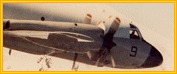
VP-5 P-3 Orion BUNO: 158923
VPNAVY Address VP-5 P2 Neptune BUNO: 131428
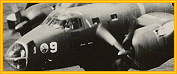
VP-5 P2 Neptune BUNO: 131428
****VPNAVY Has Been "On Station" For 13 Years as of December 1st, 2009!****  
Home Page
Updates
Notices
Active Duty
VP
Squadrons

VP
VPB
VP-AM
VP-HL
VP-ML
VP-MS
VPP
VP(P)
VP-MAU

VP
VPB
VPU
VP-MAU
Squadron
Awards

AEW
BarRonPac

AirBarSRon
Aircraft Scouting Force
Aircrew Wings
Air Wing Staff (AWS)
Allies
ASCAC
ASWOC
ATU
AVCM Donald M. Neal Aircraft Maintenance Award
Aviation Ratings
Beasley
Black Cats
CAPTAIN Arnold Jay Isbell Trophy
CASU
Catbird ETD
Chief Of Naval Operations Support
CMO
CPW
Crazy Cats
1st Radio Research Company

Enlisted Combat Aircrew RoH
FASRON
FAETU
FAW
FICPACFAC
Fleet Support Squadron
Flight Engineer
Glick
IFT
Last ASW Equiped Flying P2V Neptune
Mariner/Marlin Aircraft
MOCC
NADC
NADU
NAS
Naval Aircraft Torpedo Unit
NASA
NATS
Newsletters
NOAA
Notices
NRL
NWTS
OASU
Patch Swap
Identify
In Search Of

PMTC
PATSU
SAU
Shipmates
Site SEARCH
Tailcodes
Tenders
Terrorist Attack Claims Six U.S. Navy VP Personnel
Truculent Turtle
V-1/12 Pre-Flight
VAH
VAHM
VAP
VAW
VC
VCS
VD
VE
VGS
VH
VJ
VP
VPB
VP-AM
VP-HL
VP-ML
VP-MS
VPP
VP(P)
VP-MAU

VMD
VO
VP International
VP Links
VP Related Employment Opportunities
VPM
VP-MAU
VPU
VPW
VQ/VAQ
VR
VS
VT
VU
VW
VX/VXS
ZP//ZT/ZW/ZX
SITE
PAGES
Chatroom
Donations
E-Mail
Expenses
FAQ
Gift Corner
Glossary
Library
Logo History
Patches
Privacy
Profits
SPAM!
Statistics
WebMaster
Why VPNAVY

SUMMARY
PAGES
Aircraft
Books
Crew
Flight Simulator
History Link
ICQ
Logo
Mishap
Model
Movie
Museum
Recycled AC
Reunion

Shipmates
Site
$Donations$

History VP-28 HistoryHistory

Circa 1999

HistoryA BIT OF HISTORY: "...On June 13, 1999, three former VPers of the late 60’s vintage got to tour P-3A BUNO 150520 at the Western Aerospace Museum at the Oakland (CA) airport. Ken Kriner WOCOWBOY1@aol.com and Peter Lindberg plindberg@surfnetusa.com, formerly of VP-28 and VP-22 (1967-70) and Dennis Reilly Plumber869@aol.com of VP-9 (1966-69) joined ADC (Ret) Don Drake (VP-47, VP-91), who overseas the restoration of the aircraft for the museum. Don now works for Alaska airlines and has the "keys" for what could be one of the finest "museum" pieces around. In fact 150520 was the last P-3 to come through overhaul at Alameda depot maintenance before it was shut down. The aircraft was surplused to the museum despite the fact that it will be fully flyable. No rotting on a museum ramp for this bird; she’s in fine original configuration, less a sono rack and some sensor gear. She currently sports green primer but will get original Navy colors soon. 150520 is special to Ken and Pete because it was a VP-31 training aircraft at the time they came through VP-31, and was from the same block of aircraft they flew in VP-28 (150512-150519, 150521-150523). Anyone out there in VP Navy Land who was destined for PACFLT P-3As in the late 60’s would have at least a couple flights in this aircraft. After 30 years, it was like seeing an old friend..." Contributed by Peter Lindberg plindberg@surfnetusa.com [23JUN99]
P-3 BUNO:150520(forward/side view of a/c)
P-3 BUNO:150520(head on view)
P-3 BUNO:150520(Ken & Don in cockpit)


Circa 1992

HistoryA BIT OF HISTORY: Naval Aviation News Magazine "...Patrol Aviation In The Pacific In WWII - Naval Aviation News - July-August 1992.." WebSite: http://www.history.navy.mil/nan/backissues/1990s/1992/ja92.pdf [11NOV2004]

History - Tap To Enlarge ThumbnailHistory - Tap To Enlarge ThumbnailHistory - Tap To Enlarge ThumbnailHistory - Tap To Enlarge Thumbnail

Circa 1990

HistoryA BIT OF HISTORY: Naval Aviation March-April 1990 "...Modernization Under Way - Page 8 to 9 - Naval Aviation News - March-April 1990..." WebSite: http://www.history.navy.mil/nan/backissues/1990s/1990/ma90.pdf [22OCT2004]

History - Tap To Enlarge ThumbnailHistory - Tap To Enlarge Thumbnail

Circa 1969

HistoryA BIT OF HISTORY: Naval Aviation January 1969 "...On Patrol - Page 30 to 31 - Naval Aviation News - January 1969..." WebSite: http://www.history.navy.mil/nan/backissues/1960s/1969/jan69.pdf [16SEP2004]

History - Tap To Enlarge ThumbnailHistory - Tap To Enlarge Thumbnail

Circa 1968

HistoryA BIT OF HISTORY: Naval Aviation August 1968 "...On Patrol - Page 28 to 29 - Naval Aviation News - August 1968..." WebSite: http://www.history.navy.mil/nan/backissues/1960s/1968/aug68.pdf [15SEP2004]

History - Tap To Enlarge ThumbnailHistory - Tap To Enlarge Thumbnail

HistoryA BIT OF HISTORY: Naval Aviation June 1968 "...On Patrol - Page 30 to 31 - Naval Aviation News - June 1968..." WebSite: http://www.history.navy.mil/nan/backissues/1960s/1968/jun68.pdf [15SEP2004]

History - Tap To Enlarge ThumbnailHistory - Tap To Enlarge Thumbnail

Circa 1967

HistoryA BIT OF HISTORY: Naval Aviation September 1967 "...Fleet Air Wings - Page 28 to 29 - Naval Aviation News - September 1967..." WebSite: http://www.history.navy.mil/nan/backissues/1960s/1967/sep67.pdf [12SEP2004]

History - Tap To Enlarge ThumbnailHistory - Tap To Enlarge Thumbnail

HistoryA BIT OF HISTORY: Naval Aviation June 1967 "...Fleet Air Wings On Patrol - Page 28 to 29 - Naval Aviation News - June 1967..." WebSite: http://www.history.navy.mil/nan/backissues/1960s/1967/jun67.pdf [10SEP2004]

History - Tap To Enlarge ThumbnailHistory - Tap To Enlarge Thumbnail

HistoryA BIT OF HISTORY: Naval Aviation February 1967 "...Fleet Air Wings On Patrol - Page 30 to 31 - Naval Aviation News - February 1967..." WebSite: http://www.history.navy.mil/nan/backissues/1960s/1967/feb67.pdf [08SEP2004]

History - Tap To Enlarge ThumbnailHistory - Tap To Enlarge Thumbnail

HistoryA BIT OF HISTORY: Naval Aviation January 1967 "...Fleet Air Wings On Patrol - Page 28 to 29 - Naval Aviation News - January 1967..." WebSite: http://www.history.navy.mil/nan/backissues/1960s/1967/jan67.pdf [08SEP2004]

History - Tap To Enlarge ThumbnailHistory - Tap To Enlarge Thumbnail

HistoryA BIT OF HISTORY: "...VP-28 Squadron Awards..." Contributed by Mahlon K. Miller mkwsmiller@cox.net [23APR2001]

  • Armed Forces Expeditionary Medal
    15 Jan 69 – 15 Jun 69

  • Navy Unit Commendation
    31 Jan 67 – 08 Mar 67

  • Republic of Vietnam Meritorious Unit Citation (Gallantry)
    01 Feb 66 – 01 Jun 66
    01 Jan 69 – 28 Feb 69
    01 Apr 69 – 31 Jul 69

    HistoryA BIT OF HISTORY: RAAF Pix "...RAAF 10 Sqn with SP2H visited Hawaii for exercise "Hawaiian Grampus" in 1967, from Townsville, Australia. 10 Sqn CO Wing Cdr Rodd is greeted by Capt J Chapel of Fleet Air Wing Two, Capt W Matton Commander Fleet Air Wing Two, and Cdr E Lebiedz CO VP-28..." Contributed by Wynnum B. Graham wbg@bigpond.com [18OC98]


    Circa 1966

    HistoryA BIT OF HISTORY: "...First Row - Left to Right: Lt. Dave Wall was my skipper on crew #9, Ltjg Bayless, Navigator and AT1 Branch, Radar Crew #9 and Chief F. Blackstock, in charge of Material Control for the squadron. He made alot of things happen and worked hard to get what the shops needed to keep the birds up and hunting . Our Motto was ''Piece of Cake"..." Contributed by COOMES, Ron echoron2@aol.com [31MAR2005]

    History - Tap To Enlarge ThumbnailHistory - Tap To Enlarge ThumbnailHistory - Tap To Enlarge Thumbnail

    HistoryA BIT OF HISTORY: "...First Row - Left to Right: First four are 1966 Change-of-Command pictures of CDR Von Schrader (aka Von Seawall for hitting the wall at NS Sangley Point, Philippines) turning over the reins to CDR Lebiedz, CDR Von Schrader right after the change of command ceremonies in his office. I asked him if I could take the pix for posterity. He agreed, The Golden Gate pix was in Sept '67 going to NAS Moffett Field, California for some updated training on ARR-52 rx's and NS Sangley Point, Philippines..." Contributed by COOMES, Ron echoron2@aol.com [30MAR2005]

    History - Tap To Enlarge ThumbnailHistory - Tap To Enlarge ThumbnailHistory - Tap To Enlarge ThumbnailHistory - Tap To Enlarge ThumbnailHistory - Tap To Enlarge ThumbnailHistory - Tap To Enlarge ThumbnailHistory - Tap To Enlarge Thumbnail

    HistoryA BIT OF HISTORY: "...Shots of ''Sitka'' returning from patrol to NAS Adak, Alaska. And me putting on covers after flight..." Contributed by COOMES, Ron echoron2@aol.com [30MAR2005]

    History - Tap To Enlarge ThumbnailHistory - Tap To Enlarge ThumbnailHistory - Tap To Enlarge Thumbnail

    HistoryA BIT OF HISTORY: Naval Aviation December 1966 "...Fleet Air Wings On Patrol - Page 28 to 29 - Naval Aviation News - December 1966..." WebSite: http://www.history.navy.mil/nan/backissues/1960s/1966/dec66.pdf [07SEP2004]

    History - Tap To Enlarge ThumbnailHistory - Tap To Enlarge Thumbnail

    HistoryA BIT OF HISTORY: Naval Aviation September 1966 "...Fleet Air Wings On Patrol - Page 28 to 29 - Naval Aviation News - September 1966..." WebSite: http://www.history.navy.mil/nan/backissues/1960s/1966/sep66.pdf [06SEP2004]

    History - Tap To Enlarge ThumbnailHistory - Tap To Enlarge Thumbnail

    HistoryA BIT OF HISTORY: Naval Aviation August 1966 "...Fleet Air Wings On Patrol - Page 28 to 29 - Naval Aviation News - August 1966..." WebSite: http://www.history.navy.mil/nan/backissues/1960s/1966/aug66.pdf

    History - Tap To Enlarge ThumbnailHistory - Tap To Enlarge Thumbnail

    HistoryA BIT OF HISTORY: Naval Aviation June 1966 "...Fleet Air Wings On Patrol - Page 36 - Naval Aviation News - June 1966..." WebSite: http://www.history.navy.mil/nan/backissues/1960s/1966/jun66.pdf [05SEP2004]

    VP History ThumbnailCamera

    HistoryA BIT OF HISTORY: Naval Aviation April 1966 "...On Patrol With Fleet Air Wings - Page 22 to 23 - Naval Aviation News - April 1966..." WebSite: http://www.history.navy.mil/nan/backissues/1960s/1966/apr66.pdf [05SEP2004]

    History - Tap To Enlarge ThumbnailHistory - Tap To Enlarge Thumbnail

    HistoryA BIT OF HISTORY: Naval Aviation March 1966 "...Fleet Air Wings On Patrol - Page 36 to 37 - Naval Aviation News - March 1966..." WebSite: http://www.history.navy.mil/nan/backissues/1960s/1966/mar66.pdf [04SEP2004]

    History - Tap To Enlarge ThumbnailHistory - Tap To Enlarge Thumbnail

    Circa 1965

    HistoryA BIT OF HISTORY: Naval Aviation December 1965 "...On Patrol With Pacific Air Wings - Page 26 to 27 - Naval Aviation News - December 1965..." WebSite: http://www.history.navy.mil/nan/backissues/1960s/1965/dec65.pdf [03SEP2004]

    History - Tap To Enlarge ThumbnailHistory - Tap To Enlarge Thumbnail

    HistoryA BIT OF HISTORY: Naval Aviation October 1965 "...Pacific Air Wings On Patrol - Page 26 - Naval Aviation News - October 1965..." WebSite: http://www.history.navy.mil/nan/backissues/1960s/1965/oct65.pdf [02SEP2004]

    History - Tap To Enlarge ThumbnailHistory - Tap To Enlarge Thumbnail

    HistoryA BIT OF HISTORY: Naval Aviation June 1965 "...On Patrol With Pacific Air Wings - Page 26 to 27 - Naval Aviation News - June 1965..." WebSite: http://www.history.navy.mil/nan/backissues/1960s/1965/jun65.pdf [01SEP2004]

    History - Tap To Enlarge ThumbnailHistory - Tap To Enlarge Thumbnail

    HistoryA BIT OF HISTORY: Naval Aviation April 1965 "...On Patrol With Pacific Air Wings - Page 26 to 27 - Naval Aviation News - April 1965..." WebSite: http://www.history.navy.mil/nan/backissues/1960s/1965/apr65.pdf [31AUG2004]

    History - Tap To Enlarge ThumbnailHistory - Tap To Enlarge Thumbnail

    1964 - 1972
    Operation Market Time

    HistoryA BIT OF HISTORY: "...Article from Wikipedia about Operation Market time. It was written by VP-17's Capt. Brian McGuiness and mentions LT Norm Cook (VP-17). It not only mentions VP-17 but all the other "VP" squadrons that participated in Operation Market Time from 1964 - 1972..." Contributed by McLAUGHLIN, LT Bob banddmcl1964@msn.com [07JAN2009]

    Operation Market Time
    Wikipedia
    Operation Market Time


    Operation Market Time was the U.S. Navy's effort to stop troops and supplies from flowing by sea from North Vietnam to South Vietnam during the Vietnam War. It was one of four Navy duties begun after the Tonkin Gulf Incident, along with Operation Sea Dragon, Operation Sealords and naval gunfire support.

    When a trawler was intercepted landing arms and ammunition at Vung Ro Bay in northern Khanh Hoa Province on 16 February 1965 it provided the first tangible evidence of the North Vietnamese supply operation. This became known as the Vung Ro Bay Incident.

    Navy destroyers, ocean minesweepers PCF's (Swift boats)and United States Coast Guard cutters performed the operation. Also playing a key role in the interdictions were the Navy's patrol gunboats (PGs). The PG was uniquely suited for the job because of its ability to go from standard diesel propulsion to gas turbine (jet engine) propulsion in a matter of a few minutes. The lightweight aluminum and fiberglass ships were not only fast but highly maneuverable because of their variable pitch propellers. Most of the ships operated in the coastal waters from the Cambodian border around the south tip of Vietnam up north to Da Nang. Supply ships from the Service Force, such as oilers, would bring mail, movies, and fuel.

    Of the many vessels involved in Operation Market Time, one of the more notable was the USCGC Point Welcome (WPB-82329) which, on 11 August 1966, was brought under fire by a number of US Air Force planes. This incident of blue-on-blue killed two members of the cutter's crew (one of whom was the commanding officer) and wounded nearly everyone on board. A full account of the incident, along with the entire story of the Coast Guard's Market Time involvement, is related in Alex Larzelere's book, The Coast Guard at War: Vietnam, 1965-1975 (1997), available from the Naval Institute Press.

    Operation Market Time was established by the U. S. Joint Chiefs of Staff after the 1965 Vung Ro incident to blockade the vast South Vietnam coastline against North Vietnamese gun-running trawlers. The trawlers, usually 100-foot-long Chinese-built steel-hulled coastal freighters, could carry several tons of arms and ammunition in their hulls. Not flying a national ensign that would identify them, the ships would maneuver "innocently" out in the South China Sea, waiting for the cover of darkness to make high-speed runs to the South Vietnam coastline. If successful, the ships would off load their cargoes to waiting Viet Cong or North Vietnamese forces. To stop these potential infiltrations, Market Time was set up as a coordinated effort of long range patrol aircraft for broad reconnaissance, discovery and target following; and U.S. and allied surface combatants to intercept suspect ships that crossed inside South Vietnam's 12-mile coastal boundary. On the aviation side, some of the patrol squadrons that were involved and flying from South Vietnam, Thai, or Philippine bases were: VP-1, VP-2, VP-4, VP-16, VP-17, VP-26, VP-28, VP-40, VP-42, VP-46 and VP-50. The most significant action of Market Time occurred on Feb. 29-Mar. 1, 1968, when the North Vietnamese attempted a coordinated infiltration of four gun-running trawlers. Two of the four trawlers were destroyed by allied ships in gun battles, one trawler crew detonated charges on board their vessel to avoid capture, and the fourth trawler turned tail and retreated at high speed into the South China Sea. Lt. Norm Cook, the plane commander of a VP-17 P-2H Neptune patrol aircraft operating from Cam Ranh Bay, was awarded a Distinguished Flying Cross for discovering and following two of the four trawlers in the action. Market Time, which operated day and night, fair weather and foul, for eight and a half years, succeeded in denying the North Vietnamese a means of delivering tons of war materials into South Vietnam by sea.

    Circa 1962

    HistoryA BIT OF HISTORY: "...Funny encounter to describe from our Christmas Island deployment..." Contributed by WARNOCK, LT David agedav@charter.net [30AUG2010]

    We patrolled the area every day, whether a test was to go or not. If no test was scheduled, we did a daylight patrol. The command for the area was CJTF-8. The admiral had established a station about half way between the south tip of Hawaii and Christmas to serve as a navigation vessel for single-seat aircraft flying from the Honolulu area. Navigation aids were very sparse in the area. A ship was always assigned to that station, but no individual ship ever had to stay more than three days. Because of our logistical needs, the station vessel was often a tanker or a cargo vessel. In those days, those were commissioned naval vessels. The responsibility of the station vessel was to provide radio beacon service on certain frequencies, a radar beacon, TACAN on a particular channel, and voice radio communications on both a VHF and a UHF frequency. When we had the north sector for patrol, the station vessel was often the only vessel we saw.

    One day, when flying the north sector, we reported our first contact in the location where the station vessel should be. We still had to identify the vessel, either by electronic or visual means. The station was fifty miles off our track, and we detected the vessel at a range just under 200 nm. We immediately began to try to identify.

    The most likely ID would have been radar beacon, but it was silent. The ship's low frequency radio beacon was silent. her TACAN was silent. We were unable to raise her on the assigned VHF or UHF frequencies. As we turned to leave our track for a visual identification, we received a message from JTF-8 flight following to the effect: "Why have you not identified contact #1?" I instructed the radioman to reply: "Leaving track for visual identification of electronically silent ship." JTF-8: "Get photos"

    We did a standard ship rig pass at masthead altitude with the ship on our port side. The ship was an AOG (gasoline and oil tanker). She was under ballast and obviously on her way back from delivering her cargo. There was nobody on the signal bridge and nobody on the conning bridge. As the well deck came into view, I receive the surprise of my life. It appeared that the entire crew were sunning themselves on the well deck amidships.

    I was furious. Those were the waters in which Eddie Rickenbacker floated for forty days during WW II. That was a very, very bad place for a single seat aircraft to go down.

    We lit the jets and put the recips to military power. I executed a 2g (60 degree angle of bank) left turn across the bow of the tanker, starting a 270 degree turn. When I rolled wings level, my eyes were even with the well deck of the tanker, headed for her amidships. My airspeed was 300 knots. Nobody had moved on that deck. Even though I only had fuel tanks in the bomb bay, I opened the bomb bay doors. Then I pulled the aircraft just over the tanker's masthead and closed the bomb bay doors. I immediately called for rated power to save the reciprocating engines as we climbed to cruise altitude. The crew members with cameras had been taking photos as fast as they could.

    The captain of the ship called me on the UHF international distress frequency demanding my name rank and serial number. I refused to talk to him on that frequency. I put him on his primary UHF frequency. He asked the same question. I explained the we were not allowed to give that information in the plain, but CJTF-8 knew who I was. Then I asked him about his inoperative navigation and communications equipment. Each time I named a piece of equipment he had it turned on and then accused us of have had ours broken and fixing it in flight. I patiently explained for each piece of equipment that we only have one box, and we could not fix them in flight.

    The debriefing officers were exceptionally interested in that encounter and in the photos that we had taken. Next day, I saw the tanker at anchor with the fleet and the captain's gig alongside the flagship. I would have liked to have been a fly on the bulkhead in that meeting.

    HistoryA BIT OF HISTORY: VP-28 Crew ThumbnailCamera "...14 APR 62 -- NAS Barbers Point, Hawaii, CDR H. J. Williams, C.O., CDR L. A. Kurz, X.O..." Contributed by Ernest L. Grim, AFCM, USN (ret) ernieg@cox-internet.com

    HistoryA BIT OF HISTORY: Naval Aviation News January 1962 "...Five Squadrons Patrol China Coast - Page 15 - Naval Aviation News - January 1962..." WebSite: http://www.history.navy.mil/nan/backissues/1960s/1962/jan62.pdf [22AUG2004]

    VP History ThumbnailCamera

    HistoryA BIT OF HISTORY: "...Nuclear Testing on Christmas Island, 1962..." Contributed by CYRUS, AT2 Sam sam@mail.biotechintl.com [10APR2002]

    Nineteen sixty-two was a busy year for some of us in the US military. The temperature of the cold war was rising dangerously, and The USA was being frustrated in a number of activities in the international arena. Our relatively new President Kennedy had presided over the Bay of Pigs fiasco, had watched as the Berlin Wall was erected, and had been roughed up by Soviet Premier Kruschev in Vienna. With the economy down at home, the President’s ratings were abysmal. The Soviets were pressing at every turn.

    A particular annoyance was that they had resumed testing of nuclear weapons in violation of The Test Ban Treaty which had recently been negotiated. In response to that, President Kennedy announced in early 1962 that the United States would resume atmospheric testing of high-yield nuclear weapons related devices (funny, that!).

    I had arrived at Patrol Squadron 28 (VP-28), Barbers Point, Hawaii in October 1961 the week of my 20th birthday. VP squadrons were called ASW (Anti-Submarine Warfare) units, but were just as often assigned to intelligence missions, airborne surveillance, and to Search and Rescue operations. We flew the P2V Neptunes, predecessor of the P3 Orion which is still in use. I wanted to fly as a crew member and I set about satisfying the requirements for that assignment.

    One needed to be a Petty Officer to fly and I got my AT3 (Aviation Electronics Techinician Third Class) ranking in November of 1961. There was qualifying with a pistol on the range (For airborne sailors, that meant managing to loose off a few rounds without shooting yourself or someone else!), and there was Survival School (a considerably more rigorous affair). Other familiarization matters of a less formal nature were accomplished routinely, and by early 1962, I had qualified.

    I was assigned as understudy to one W. R. (Billy) Lynch, AT2, in the Captain’s Crew. Billy was due to be discharged shortly and I was expected to be his replacement as Radio Operator in the Skipper’s crew. Like most hi-tech jobs in the US military services, most of the time is spent training. We flew as crew to train new pilots, at the same time getting new crew members trained or more proficient, as the case might be. After some few flights with Billy, he signed off on my qualifications and shortly after that, we were deployed to Johnston Island, 700 miles southwest of Honolulu, to watch and support testing of some of the early ground based missiles. Then, in April, our crew was sent to Christmas Island near the Equator, some 1300 miles south of Honolulu. We guessed that the purpose of our assignment to Christmas Island was somehow associated with the upcoming nuclear testing.

    This was a big deal. It had been headline news for weeks and all over the world, people were protesting. It was to be, by far, the biggest operation involving nuclear weapons in history. We were somewhat in awe of whatever it was we were being sent to do. We knew from the newspapers that “H-Bombs” were going to be tested, but we really had only a vague idea what that meant. We thought maybe we were to be the tethered goats (in the final analysis, not too far from the truth).

    For enlisted personnel, this was made worse by the fact that, formally, we had been given almost no information. I was more fortunate than most in that our Plane Commander for this deployment, Lt. David Warnock (The Captain had an experienced second pilot who flew most of his crew’s operations), was a good communicator and he passed along enough to make some sense out of the jobs to which we were eventually assigned. Once we arrived at Christmas Island, we had seen our last newspaper for a while. We didn’t know it at the time, but they censored our mail to and from the island and for some future period.

    The rumor mill is a valuable source of information for enlisted men in the military services. In the Navy, this is called “scuttlebutt.” One would hear it said that “Scuttlebutt has it that.....” etc;. More often than not, scuttlebutt got it right and one learned quickly how to evaluate information received by this medium.

    For much of our information, we relied on the senior enlisted men in our crew, Hank Miller AT1 and Sam Bass AO1. Sam Bass was old, about 28. Hank was really old (late thirties). They seemed to be able to get accurate information from sources that were anything but obvious. Hank was the crew’s Chief Tech. Resembling a big, grinning bear, Hank had a lively intellect and a strong character. He knew nearly everything. Everybody (officers included) confided in Hank. In the barracks, we argued a lot about philosophy while Sam, Billy and I drank a lot of beer. I read Harold Robbins’ “The Carpetbaggers,” William James’ “Pragmatism,” and Taylor Caldwell’s “Prologue to Love” while there and Hank explained them to me. I was extremely fortunate to have those guys, along with Lt. Warnock as bosses in my crew.

    Life on Christmas Island for the enlisted men in general, was not unpleasant. We worked on only about half the days. The weather was tropical and always the same, so there were no doors on the barracks. The showers were outside stalls in which sea water fell by gravity from giant tanks nearby. One simply wrapped a towel about one’s middle and set off across the burning sands to shower in public, much like is seen in some of the old western movies.

    The food was excellent. They had made an extraordinary effort in this regard, so much so that the meals actually became boring. Even the food on the airplanes was good. Near the end, I wanted more than anything else, a baloney sandwich instead of the endless diet of steaks, hams and tropical fruits. I vowed that when I got back to Barber’s Point, that would be the first thing I would eat. I didn’t know it then, but you couldn’t get a baloney sandwich in Hawaii, either.

    With no doors on the barracks, critters could wander into the quarters. Christmas Island is heavily populated with giant Crabs---these characters have legs 12-14 inches long and they walk with them extended so that the body of the crab is that far from the ground---a truly menacing creature to contemplate, but as far as I know, pretty harmless. They were so populous that sometimes there would be enough of them on the runway that a pending takeoff would have to be delayed while they were thinned. They wandered into the barracks from time to time and even managed to get into a lower bunk once in a while (they may have had a little help in that!). There, they lurked, waiting for the assigned occupant to return. Good reason to drink in moderation!

    Any difficulties which arose were because of the need for something to do on the days while not flying or working on aircraft. The first thing one would think about on a tropical island would be that the beaches would offer a measure of distraction. Not true on Christmas Island. The beaches were rocky with coral formations that cut like a razor. The water was only knee deep out a long way and schools of sand sharks could always be seen from shore. On that tropical island, the ocean was inaccessible.

    The only formal entertainment on the island, of which I was aware, was daily bingo at the club. All male bingo with the average age of the players being in the early 20’s, and booze plentiful and cheap. Whew!

    Bingo finished early, so we played a lot of poker and pinochle in the barracks. There were no restrictions on bringing alcohol to the barracks, and almost everyone drank a lot on off-duty days. The usual derivatives from that occurred from time to time, but for the most part, harmony prevailed. As far as I knew, this lifestyle was normal for a bunch of sailors placed on an equatorial island in the middle of the Pacific. Life there did become a little tedious for the older guys (an older guy, except for Hank Miller and Sam Bass, was about 22). I read books voraciously, so I hardly noticed the tedium.

    One guy, Gene Challgren, didn’t drink and didn’t smoke, resisting any and all temptations to act like the rest of us. He was clean-cut, was good at his job, and except for not drinking and smoking, seemed to be normal. He devoted his entire time away from work to writing letters to some girl back in the Midwest, mailing two or three every day. I admired the guy and thought his liver and kidneys were probably in pretty good shape.

    There was a tribe of aborigines living somewhere nearby and theirs were the only women on the island The men worked in the commissary and in the caretaking of the grounds, earning a livelihood that was orders of magnitude greater than their customary lifestyle. Although contact was forbidden, there were some conversations that occurred between aborigine men and some of our guys. The natives were strictly forbidden to have any booze. They wanted booze. We had enough booze to float the Queen Mary from Memphis to New Orleans. As seen by some, this was a natural commercial opportunity. A sailor would supply a quantity of booze to a native and the native would promise to introduce the sailor to a maiden. I know that some liquor passed hands, but I don’t think the other part of any deal ever got consummated.

    (Toward the end of the deployment, some white woman dignitary did visit the island and made a speech about something or other, but enlisted personnel weren’t invited. We never knew what position she held or why she was brought there. Some of the guys thought it a bit demeaning that she had been sheltered from exposure to the enlisted ranks.....but most of us were ambivalent about the matter.....)

    One day I returned to the barracks from working on the flight line in the middle of the afternoon. I met Gene Challgren staggering and reeling around the corner of our building. His eyes were out of focus, his facial muscles slack, speech slurred, gait unmanageable. He had a half bottle of vodka in one hand and a lit cigarette in the other. I knew something had happened with that girl back home. Didn’t even need to ask. Sometime later that evening (after bingo I think), he was still ambulatory and I saw him trying to negotiate something or other with an aborigine.

    Whatever official information got to us came from our Plane Commanders. Official word came to them through the base radio or by military courier, and they passed pertinent material on to us in pre-flight briefings. They eventually told us that the USA would be detonating nuclear weapons and that it would be our job to keep any ships, boats and submarines from entering the area either by accident or by design. The manner in which this was to be accomplished would be to conduct reconnaissance flights on each day before there would be a blast. The flights each traversed the perimeter of one leaf of an imaginary four leaf clover with the island at its center. Search for errant surface craft was by radar and visual. The capabilities of the P2V-5 we flew that summer allowed us to easily cover a range out to a radius of about 900 miles with each of the four flights overlapping somewhat. Whenever we found an unauthorized ship in the area (I don’t think there were any authorized ships in the area), we identified them, took pictures and dropped leaflets in 7 languages telling them (I guess) to remove themselves.

    The British, under whose administration the island functioned at that time, flew high altitude surveillance in Canberra aircraft, but their function was more at monitoring and photographing the blasts than excluding wayward seagoing vessels.

    Our flights would take off at mid-afternoon on the day before a scheduled event. The nuclear devices were to be dropped from high flying aircraft (B-52’s) and would explode above the ocean somewhere near the island. The detonations were always scheduled for daybreak and all reconnaissance flights were required to be back before the blast could go forward. Each flight was 12-14 hours and there were never any delays in the drops because of patrol aircraft tardiness (although one of ours did drag in with both props feathered, barely making the runway on jets only!).

    There were loudspeakers everywhere on the island that anyone was likely to be. Countdown for a blast started at 24 hours with updates every hour at first; then every half hour, then every minute, then every half-minute etc; until in the last sixty seconds, every second.

    The procedure before a blast was to gather us into a designated compound---a fenced area maybe 150 yards in diameter. All the military personnel were together. There were probably 70-80 persons from our squadron on the island and a like number of other support and military personnel from the British and other American outfits. I don’t remember whether the aborigines were officially assigned with us or whether they were supposed to be gathered separately. A few of them, but certainly not all, were with us. All in all, there were probably 300 people who saw some of the events.

    For each blast, we were issued dark goggles, through which one could look directly at the noonday equatorial sun and barely be able to discern that there was some dim light there. As the event approached, we were instructed to seat ourselves on the ground, backs to the (intended) blast site, knees raised, arms on knees, face buried in arms. The count proceeding by seconds: 60, 59, 58..... By now, of course, the device had already left the bomb bay and the bomber was scurrying the other way. When the count reached 3, 2, 1, DETONATION!..., the flash appeared. Every time! With my back to the blast, my eyes closed and wearing nearly opaque glasses, my recollection is that when the flash occurred, I could plainly see the bones in my arms. There’s more to be said about this....

    After the flash, we would stand and look in the direction from which it had come. It was maybe 45 seconds, maybe more, before we got a low rumble followed by a blast of hot air. We felt the tremor underfoot. This would cause the ground to move (not shake---it actually moved laterally) causing us to stagger and sometimes fall. In the same time frame, the mushroom cloud would begin to form---truly one of the most provoking things one can witness. Many accounts have been written about the power, the fear-inspiring might of these things. They are all understatements.

    We exploded quite a number (more than 10, I think) of devices ranging in size up to a few megatons, maybe as much as 10 megatons (one megaton is 50 times the size of the yield over Hiroshima). As far as I know, I saw’em all. Billy left for discharge during our time there, so I got my baptism in real operations.

    They let us take pictures freely and some great images were captured of the mushrooms. Then when it was time to pack up and go home, they confiscated all photos, all film, cameras etc; They did a thorough body search when we got on our planes and I don’t think a single unofficial photographic record survived.

    We had worn dosimeters to measure the cumulative radiation we received while on the island. These things were black wafers about 1 cm. thick and the size of a silver dollar. They were otherwise non-descript, in that they had no serial numbers, no identification whatsoever. We swapped them around and any personalization there might have been (There wasn’t any!) was thereby lost. They were collected as we boarded our planes to leave the island. We were told that they would be sent off for analysis. In six weeks, or so, the results came back: All exposure within acceptable limits. Right! Those who believe that might want to look at a bridge I have for sale up in Brooklyn........

    When we returned to Hawaii, we were debriefed and essentially told not to say anything about the experience to anyone who hadn’t been on Christmas Island. This included sending anything in the mail to our families. So I wrote to my Mom and asked her to send me a baloney sandwich. Believe me, she knew something had happened.....

    Nevertheless, those of us who had been there, did a lot of talking amongst ourselves and the talk was, for the most part, as serious as anything I experienced in the Navy. We unanimously agreed on two things: We all thought we had seen the bones in our arms during the flashes; and we knew we had looked in the face of something that could produce universal death.

    Within a few months of our return, the Cuban missile crisis erupted. We were placed on alert---but that is another story. A month after that, we deployed to Iwakuni, Japan-----and I had started the year with Survival School......Whew!!

    A note or two: I may have been the youngest person there. If not, certainly I was one of the youngest. After separation from active duty in 1964, I did 7 years of full time university study with the principal field of study being Physics. The choice of Physics as a discipline was not influenced by my experiences on Christmas Island, and only when I was an advanced graduate student did I start to knowledgeably ponder explanations for some of the phenomena. While The Nobel Prize is probably safe, I can say that I am eminently qualified in this area of Nuclear Physics and I keep up with the literature. I do, now, understand much more about what happened on Christmas Island. Nevertheless, I have tried to make this flow as it did then---as a 20 year old saw things. The scientist can maybe write the next chapter.......

    HistoryA BIT OF HISTORY: "...I joined VP-28 (The Hawaiian Warriors) in 1962 at NAS Barbers Point, Hawaii. In the summer of 1962 we participated in the last atmospheric nuclear test as part of JTF-8. The squadron deployed aircraft and maintenance personnel to both Johnson and Christmas Islands amassing over 1600 flight hours in 1 month with 10 aircraft. At this time we were flying the SP2E. During my 3 year tour we made a couple of deployments to Iwakuni and NAF Misawa, Japan. After the gulf of Tonkin incident several aircraft moved from Iwakuni to Naval Station Sangley Point Republic of the Philippines. From here the squadron participated in Operation Market-Time, flying patrols off Vietnam. During my tour the squadron also flew the SP2H and the P3A..." Contributed by Ernest L. Grim, AFCM, USN (ret) ernieg@cox-internet.com


    Circa 1960

    HistoryA BIT OF HISTORY: "...(FASRON-111, VP-6, VP-22, VP-28, VP-45 and VP-49) - Naval Aeronautical Organization OPNAV NOTICE 05400 for Fiscal Year 1960 dated 1 February 1960 is: DECLASSIFIED per Office of Chief of Naval Operations on 1 February 1965 by Op-501 - Atlantic Fleet Support Stations..." WebSite: Naval Historical Center http://www.history.navy.mil/a-record/nao53-68/fy1960-feb60.pdf [13MAR2007]

    History - Tap To Enlarge ThumbnailHistory - Tap To Enlarge ThumbnailHistory - Tap To Enlarge Thumbnail

    HistoryA BIT OF HISTORY: Naval Aviation News October 1960 "...Eleven Flight Crews - Page 3 - Naval Aviation News - October 1960..." WebSite: http://www.history.navy.mil/nan/backissues/1960s/1960/oct60.pdf [18AUG2004]

    VP History ThumbnailCamera

    Circa 1959

    HistoryA BIT OF HISTORY: Shipmate Pix "...Circa 1957 - 1959..." Contributed by AEM2 Ronald P. Doran ron479usa@ameritech.net [11FEB98]

    HistoryA BIT OF HISTORY: Shipmate Pix "...Circa 1957 - 1959..." Contributed by AEM2 Ronald P. Doran ron479usa@ameritech.net [11FEB98]

    HistoryA BIT OF HISTORY: Shipmate Pix "...Circa 1957 - 1959..." Contributed by AEM2 Ronald P. Doran ron479usa@ameritech.net [11FEB98]

    HistoryA BIT OF HISTORY: Shipmate Pix "...Circa 1957 - 1959..." Contributed by AEM2 Ronald P. Doran ron479usa@ameritech.net [11FEB98]


    Circa 1958

    HistoryA BIT OF HISTORY: VP History ThumbnailCameraVP-28 History "...Found this photo of the new NAS Barbers Point, Hawaii Enlisted Mens Barricks which VP-28 moved into on our return from Operation Hardtack 1958. Nice new car bumpers on the cars..." Contributed by AEM2 Ronald P. Doran ron479usa@ameritech.net [09JUN2004]

    HistoryA BIT OF HISTORY: "...1958 CruiseBook: OPERATION HARDTACK is only one short chapter in the honored history of Patrol Squadron TWENTY EIGHT. As rich in tradition as the Navy itself, VP-28 was commissioned in 1928 and stationed at NAS Kaneohe Bay, Pearl Harbor, Hawaii, Territory of Hawaii. The "Hawaiian Warriors" flew PB4Y-l's on anti-submarine and ship surveillance training missions prior to World War II. Redesignated VPB-108 the "Warriors" took their "Liberators" into the Pacific theater of operations in 1943. During the war years the Squadron made an impressive record supporting invasions and naval operations in the Central Pacific. Flying 731 combat missions, pilots of VPB-108 developed the low-level bombing techniques that are standard tactical practice today. The Squadron sank or damaged at least 200 Japanese ships. As reward for their contributions to final victory, ten Squadron aircraft flew in low formation over Truk on V-J Day as participants in the surrender ceremonies. In the years that followed the Japanese surrender, VPB-108 returned to Hawaii and was again designated VP-28. Flying the P4Y-2 "Privateer" the "Hawaiian Warriors" deployed periodically to advanced bases at Guam, Hwajalein, and Okinawa. Responding to the war call once again in 1950, VP-28 swung into action by flying patrols in and around the Taiwan straits during the Korean War. Based at Itami, Japan for an extended tour, the "Warriors" patrolled the waters off North Korea and along the Communist-held coast of China. Working closely with the United States Marine Corps, Patrol Squadron TWENTY EIGHT helped perfect night flare dropping techniques that proved amazingly effective against the "human sea" tactics employed by huge masses of attacking North Korean and Chinese Communists troops. The Squadron was rewarded the Korean Presidential Unit Citation for outstanding performance of duty. P2V Neptunes replaced the old "Privateers" in 1952 and the Squadron returned to Barbers Point. Since that time, VP-28 has conducted extensive training in Anti-Submarine warfare, mining and long-range reconnaissance in the Hawaiian area. Frequent deployments to our nations far-flung Defense outposts have been valuable in guaranteeing the operational readiness so avidly sought after by all fleet units. In the past six years the "Warriors" have operated twice from Iwakuni, Japan and twice from an advanced base at NAS Kodiak, Alaska. On their last deployment to NAS Kodiak, Alaska in 1956, VP-28 flew in support of our DEW line supply fleet, conducted search and rescue-mercy missions and acted as a sentinel patrolling one of the most vital approaches to the North American continent. Patrol Squadron TWENTY EIGHT justly deserves its place in the long and proud history of Naval Aviation. In order to maintain a firm posture for defense and to retain our position as leader of the free world in its struggle with Communism, our nation has again conducted a series of nuclear tests overseas. Because vast nuclear stockpiles are not enough to check the advance of communist in the worlds peripheral areas and because our potential enemy has openly demonstrated his technological prowess and scientific acumen, as well as his declared intention to use these powers to destroy us, we in the free world have been forced to develop more refined nuclear and thermonuclear weapons------ devices which can be employed rapidly and decisively in any given tactical or strategic situation. Patrol Squadron TWENTY EIGHT has played a large part in assuring the successful completion of these 1958 tests. Working together with other units of the Navy and Air Force, VP-28 Neptunes have constantly and efficiently patrolled a large ocean area in a concentrated effort to prevent any stray ships and aircraft from wandering into the danger area and to provide early warning on shot days for all persons located within the operating area. We can be justly be proud of our latest achievements; they will stand as contributions to our country's determined bid to preserve its national substance and the integrity of the entire free world..." Contributed by Charley McCoskey pumpertwo@aol.com

    HistoryA BIT OF HISTORY: VP History ThumbnailCameraVP-28 History "...Spring of 1958 - VP-28 sign in front of Hanger 111 (Dallas)..." Contributed by DORAN, AEM2 Ronald P. ron479usa@ameritech.net [21DEC2002]


    Circa 1956

    HistoryA BIT OF HISTORY: History ThumbnailCameraVP-56 Cruisebook Cover "...NAS Kodiak, Alaska 1956..." WebSite: PhotoBucket http://media.photobucket.com/ [14SEP2009]

    HistoryA BIT OF HISTORY: Naval Aviation News October 1956 "...Ice Floes Ahead! - Page 1 to 5 - Naval Aviation News - October 1956..." WebSite: http://www.history.navy.mil/nan/backissues/1950s/1956/oct56.pdf [09AUG2004]

    History - Tap To Enlarge ThumbnailHistory - Tap To Enlarge ThumbnailHistory - Tap To Enlarge ThumbnailHistory - Tap To Enlarge ThumbnailHistory - Tap To Enlarge Thumbnail

    HistoryA BIT OF HISTORY: Naval Aviation News April 1956 "...Patrols Are Their Business - Page 35 - Naval Aviation News - April 1956..." WebSite: http://www.history.navy.mil/nan/backissues/1950s/1956/apr56.pdf [09AUG2004]

    VP History ThumbnailCamera

    HistoryA BIT OF HISTORY: VP History ThumbnailCameraVP-28 History "...VP-28 sign outside the hanger winter of 1956, right after this they put up the new sign with the Warrier on it. Had a snow ball in my hands which at that time were only 19 years old..." Contributed by DORAN, AEM2 Ronald P. ron479usa@ameritech.net [15MAR2004]

    HistoryA BIT OF HISTORY: VP History ThumbnailCameraVP-28 History "...MATS to Hawaii this is door 3 to immigration, old photo, NAS Barbers Point, Hawaii..." Contributed by DORAN, AEM2 Ronald P. ron479usa@ameritech.net [15MAR2004]

    HistoryA BIT OF HISTORY: "...1956 NAS Kodiak, Alaska Cruisebook..." Contributed by Edwin Trefry edtref@earthlink.net [01JUN2001]

    Patrol Squadron Twenty Eight (VP-28) has well deserved its place in the long and honorable history of Naval Aviation. Formed in the trying and difficult times of 1943, at the height of battle, Patrol Squadron Twenty Eight (VP-28) went to service with P4Y 'Liberators' in the Pacific Theatre. While in combat, the pilots of VB-l08 developed the low-level bombing techniques that are standard tactical practice today. After careful planning, one of the pilots, skimming the 'Pistol Packin' Mamma' just above the waves to avoid Japanese radar, practically reduced the island stronghold of Mille to a shambles in a single pass over the runway. Caught completely by surprise, the enemy had no time even to pull off the ir gun covers before the plane had thoroughly strafed, bombed, and leveled the base and gone on to sink a Japanese supply ship in the harbor with his remaining two bombs. The day of the low-level surprise attack was at hand, devised bv the pilots and men of VB-l08.

    'Liberator's' to the utmost for in the latter five months of 1945 VPB-l08 flew 731 combat missions, sank or damaged more than 200 enemy ships and shot down three Japanese aircraft. Soon after, on V-J day, ten aircraft of VPB-l08 flew low over Truk in formation as part of the surrender ceremonies. They had more than won the honor to participate in the surrender of the "Pacific Gibraltar". After World War II, the squadron returned to Hawaii and conducted advance base operations on Guam, Kwajalein, and Okinawa. The squadron was redesignated VP-28 on the First of September, 1948.

    Called again to action in 1949, at the beginning of the Korean conflict, VP-28 flew patrols covering the waters in and around the Formosa Straits. The squadron returned briefly to Hawaii to train new personnel, then re-deployed to Itami, Japan, maintaining day and night vigilance over North Korea and along the Com- munist-held China Coast. Later, working closely with units of Marine Land Forces, Patrol Squadron Twenty Eight (VP-28)helped develop night flare dropping techniques that proved particularly effective against the night time 'human sea', tactics used by the massed attacking Communist troops. As a result of outstanding performance of duty, Patrol Squadron Twenty Eight (VP-28) received the Korean Presidential Unit Citation.

    In 1952, after near ly ten years res idence in the Hawaiian Islands, Patrol Squadron Twenty Eight (VP-28) adopted a "new look" by exchanging their old and honorable P4Y's which had done such long anddependable service for the newer P2V "NEPTUNES", along range reconnaissance and anti-submarine patrol plane. The following year, in recognition of their beautiful home base and their long term of residence there, VP-28 changed its name to the "Hawaiian Warrior" squadron.

    During the present tour in Kodiak, the men and planes of the "Hawaiian Warrior" squadron have flown in the Alaskan-Aleutian area in all kinds of weather, safeguarding our far Northern Defense Perimeter. In addition, they have also conducted search and rescue mercy missions, training, and ice I reconnaissance patrols far into the Arctic North of Alaska.

    HistoryA BIT OF HISTORY: "00JUN56--...all aircraft were P-2V5's , when I arrived at NAS Kodiak, Alaska June 1956 I think 9 aircraft had guns on them and 3 had bubble noses and the stinger at the tail section for MAD and ECM antennas. They sent me to aerial gunnery school and I was for a short time a deck turret gunner, twin 50's, what a joy to shoot. Had twin 50's in the nose and twin 20mm in the tail, twin 50's as deck guns, the Navy discovered that the guns were no good against jets, we played war games, I would see a jet over my sholder and by the time I swung the turret around to face him, he had a kill on his camera and I never got a shot at him. Also went to escape and evasion school, what an experience..." Contributed by AEM2 Ronald P. Doran ron479usa@ameritech.net [02FEB98]


    Circa 1952

    HistoryA BIT OF HISTORY: "...FASRON-110, FASRON-112, FASRON-114, FASRON-117, FASRON-118, FASRON-119, FASRON-120, FASRON-885, FASRON-895, VP-1, VP-2, VP-4, VP-6, VP-9, VP-22, VP-28, VP-29, VP-40, VP-42, VP-46, VP-47, VP-731, VP-772, VP-871, VP-892 and VP-931) - Naval Aeronautical Organization OPNAV NOTICE 05400 for Fiscal Year 1953 dated 1 October 1952 is: DECLASSIFIED per Office of Chief of Naval Operations on 1 February 1965 by Op-501..." WebSite: Naval Historical Center http://www.history.navy.mil/a-record/nao53-68/fy1953-oct52.pdf [14MAR2007]

    History - Tap To Enlarge ThumbnailHistory - Tap To Enlarge ThumbnailHistory - Tap To Enlarge Thumbnail

    HistoryA BIT OF HISTORY: "...FAW-1, FAW-2, FAW-4, FAW-6, FAW-14, VP-1, VP-2, VP-4, VP-6, VP-9, VP-22, VP-28, VP-40, VP-42, VP-46, VP-47 and VP-871) - Naval Aeronautical Organization OPNAV NOTICE 05400 for Fiscal Year 1953 dated 1 October 1952 is: DECLASSIFIED per Office of Chief of Naval Operations on 1 February 1965 by Op-501..." WebSite: Naval Historical Center http://www.history.navy.mil/a-record/nao53-68/fy1953-oct52.pdf [14MAR2007]

    History - Tap To Enlarge ThumbnailHistory - Tap To Enlarge ThumbnailHistory - Tap To Enlarge Thumbnail

    HistoryA BIT OF HISTORY: Naval Aviation News December 1952 "...VP Commanding Officers - Page 16 - Naval Aviation News - December 1952..." WebSite: http://www.history.navy.mil/nan/backissues/1950s/1952/dec52.pdf [28JUL2004]

    VP History Thumbnail

    HistoryA BIT OF HISTORY: "...20SEP52 - A US Navy PB4Y-2S, of VP-28, was attacked by two Chinese MiG-15s off the coast of China. One of the PLAAF pilots was Zhongdao He. The USN aircraft was able to safely return to NAF Naha, Okinawa, Japan..." Website: Aircraft Downed During the Cold War and Thereafter http://www.silent-warriors.com/shootdown_list.html [20FEB2003]

    HistoryA BIT OF HISTORY: "...23NOV52 - A US Navy PB4Y-2S, of VP-28, was attacked, but not damaged, by a Chinese MiG-15 off of Shanghai China..." Website: Aircraft Downed During the Cold War and Thereafter http://www.silent-warriors.com/shootdown_list.html [20FEB2003]

    HistoryA BIT OF HISTORY: "KOREA--ARRIVED: 14JUL50 DEPARTED: 30NOV52 TAIL CODE: CF AIRCRAFT: P4Y-2/2S" http://www.history.navy.mil/branches/koreaob.htm


    Circa 1951

    HistoryA BIT OF HISTORY: History ThumbnailCameraVP-28 "...VP-28 - April 14, 1951 - UFO Tracking...Publication Number: T1206 - Publication Title: Project Blue Book, 1947-1969 - Publisher: NARA - Year: [ILLEGIBLE] - Month: [ILLEGIBLE] - Month Season Number: [ILLEGIBLE] - Location: [ILLEGIBLE] - Incident Number: [BLANK] - WebSite: http://www.footnote.com/..." Forwarded by Stephen Miller miller.s@adelphia.net [14AUG2008]

    HistoryA BIT OF HISTORY: History ThumbnailCameraVP-28 "...VP-28 - April 14, 1951 - UFO Tracking...Publication Number: T1206 - Publication Title: Project Blue Book, 1947-1969 - Publisher: NARA - Year: [ILLEGIBLE] - Month: [ILLEGIBLE] - Month Season Number: [ILLEGIBLE] - Location: [ILLEGIBLE] - Incident Number: [BLANK] - WebSite: http://www.footnote.com/..." Forwarded by Stephen Miller miller.s@adelphia.net [14AUG2008]

    HistoryA BIT OF HISTORY: VP-28 Pictures "...VP-28 arriving at NAS Agana, Guam sometine 1951. Officers are: CO VP-28; CO FASRON-111, CMD Marshall; XO FASRON LCMD Mann..." Contributed by Jim Garnsey jgarnse1@twny.rr.com [15JAN2001]

    HistoryA BIT OF HISTORY: VP-28 Pictures "...VP-28 arriving at NAS Agana, Guam sometine 1951. Officers are: CO VP-28; CO FASRON-111, CMD Marshall; XO FASRON LCMD Mann..." Contributed by Jim Garnsey jgarnse1@twny.rr.com [15JAN2001]

    HistoryA BIT OF HISTORY: VP-28 Pictures "...VP-28 CF#4 heading for parking spot at NAS Agana, Guam sometine 1951..." Contributed by Jim Garnsey jgarnse1@twny.rr.com [15JAN2001]

    HistoryA BIT OF HISTORY: VP-28 Pictures "...VP-28 CF#4 heading for parking spot at NAS Agana, Guam sometine 1951..." Contributed by Jim Garnsey jgarnse1@twny.rr.com [15JAN2001]

    HistoryA BIT OF HISTORY: "...Itami Air Base, Itami, Japan in 1951, during the Korean War, flying the PB4Y-2 PRIVATEER. Kanji Aranishi, the International Representative for the city of Itami, Japan set up a web site at my request to show what it looks like today. I sent him several photographs of what it looked like in 1951. He has set the website up to show then & now. OSAKA (ITAMI)AIRPORT TODAY http://www2.osk.3web.ne.jp/~aranishi/itmbase.htm..." Contributed by Jim Miller Patron28@aol.com [16DEC98]

    HistoryA BIT OF HISTORY: "...VP-28, based at Itami 5APRIL51-9OCT51, aircraft-nine P4Y-2, CO - CDR C. S. Minter. VADM Charles S. Minter, Jr., USN (Ret.). If you need VADM Minter's address, please e-mail me. I am a researcher seeking information from PATRONS on the Soviet submarines based at Port Arthur, China (now called Lushun, China) during the years 1950 through 1951. Any information would be a great help in my research! I am still trying to locate information on Knave 206 and Knave 210 ( one land based aircraft that came out on the morning of July 29, 1951, then the second aircraft in the afternoon to relieve the first, to aid the ships attacking the submarine contact ), I would be most greatful!..." Contributed by Al March a499march@aol.com [12DEC98]

    HistoryA BIT OF HISTORY: "5APRIL51-9OCT51--Based at Itami. Aircraft: Nine P4Y-2's. CO: CDR C. S. Minter....Allison E. March" a499march@aol.com


    Circa 1950

    HistoryA BIT OF HISTORY: "...VP-28 "White Hat" Enlisted Personnel NAS Barbers Point, Hawaii 19 December 1950..." Contributed by MILLER, James C. Sr. Patron28@aol.com (VP-28 Squadron Historian) [14FEB2009]

    History ThumbnailCamera


    FRONT ROW: AOAN C. W. Eastman, AT1 G. D. Adams, AT3 K. T. Wilson, AO3 W. J. Belletsky, AD2 C. A. Horn, YNSN R. R. Hamilton, AN A. A. Mintz, AN N. Nicastro, AO1 L. H. Barnes, AM1 Wilbur, ABAN R. O. Dalton and AL3 D. L. Klotz.

    BACK ROW: AD1 W. H. Stobing, ADAN R. Knopik, AL3 B. W. Edney, AOAN R. P. Sperier, AO3 J. A. Fitzgerald, AD3 T. W. Hutson, AD1 B. G. Zinn, AN D. W. Freeman, AD1 R. L. Mannon and AE3 T. H. Olson.

    VP-28 "White Hat" Enlisted Personnel taken just outside their hanger at NAS Barbers Point, Hawaii, on 19 December 1950, shortly after returning from NAF Naha, Okinawa, Japan, where they had been patrolling the waters off of the coast of Korea.

    VP-28 was stationed at NAS Agana, Guam in January of 1950, for their normal six (6) month WestPac.

    They were scheduled to be relieved and return to NAS Barbers Point, Hawaii in June of 1950, when the Korean War began on 25 June 1950. Shortly after 25 June, VP-28 was moved up to NAF Naha, Okinawa, Japan to begin patrolling the waters off Korea until reserve Patrol Squadrons could be activated and relieve them, which did not take place until September 1950.

    VP-28 flew the PB4Y-2 PRIVATEER, and later during the Korean War most of the same squadron personnel would return to the Korean Theater and were stationed at Itami, Japan in April of 1951. Operating out of Itami and bases in South Korea VP-28 participated in Flare Dropping missions over North Korea in conjunction with Marine Night Fighter Squadron VMF(n) 513, which flew the F4U Corsair and the F7F. VP-28 returned to NAS Barbers Point, Hawaii in September of 1951, with the exception of four (4) planes & crews left behind to train the relieving squadron. The last four (4) returned to NAS Barbers Point, Hawaii in December 1951.

    HistoryA BIT OF HISTORY: "...INVASION PATROL: THE SEVENTH FLEET IN CHINESE WATERS - by Dr. Edward J. Marolda - Naval Historical Center..." Navy Historical Center WebSite: http://www.history.navy.mil/colloquia/cch3c.htm [07SEP2005]

    Operating from Buckner Bay, the Seventh Fleet would take a day to arrive off the west coast of Taiwan. Naval forces in Korean waters would not be available for at least two days. That, of course, assumed they were not involved in heavy combat operations or engaged in evacuating U.N. forces from Korea, very real possibilities in 1950 and 1951.

    In this circumstance, early warning and interception of an invasion force was absolutely vital. Accordingly, steps were taken to establish U.S. air, submarine, and sea patrols of the strait. Operationally, this could only be accomplished through the use of the anchorages, ports, and shore facilities of Taiwan and the nearby Pescadore Islands. Cooperation with Nationalist authorities was implicit.

    To improve coordination and communications for the prospective air patrol, during the second week of July Admiral Struble and the commanding officers of two units, VP-28 and VP-46, conferred in Taipei with top military leaders of the Nationalist armed forces.

    On July 16, patrol aircraft of FAW-1 began reconnaissance missions in the strait. On that day, VP-28, which flew nine PB4Y Privateers from NAF Naha, Okinawa, Japan, inaugurated a daily surveillance of the northern part of the strait and along the nearby China coast. The following day, VP-46, with nine PBM-5 Mariner flying boats, kicked of f patrols of the strait's southern sector from the Pescadore Islands, where seaplane tender Suisun deployed on the 17th. Routinely, patrols were only flown from land bases or secure anchorages during the winter months. Throughout 1950 and 1951, one seaplane and one land-based squadron carried out the round-the-clock patrol of the strait.

    The emergency nature of the 1950 patrol was clearly reflected in the way it was set up and carried out. Lieutenant Commander Maurice F. Weisner, the Commanding Officer of VP-46, and a future Commander in Chief, U.S. Pacific Fleet, related in a post-mission report that the patrol units had a difficult time operating in the strait. Day and night, in foul weather and good, his PBMs flew 14-hour circuits just off the "deck." During the winter monsoon, winds of gale-force strength were common.

    HistoryA BIT OF HISTORY: Naval Aviation News June 1950 "...PB4Y's FInd Disabled Ship - Page 18 - Naval Aviation News - June 1950..." WebSite: http://www.history.navy.mil/nan/backissues/1950s/1950/jun50.pdf [20JUL2004]

    VP History ThumbnailCamera

    HistoryA BIT OF HISTORY: Naval Aviation News February 1950 "...'Night Eye' Planes Active - Page 10 - Naval Aviation News - February 1950..." WebSite: http://www.history.navy.mil/nan/backissues/1950s/1950/feb50.pdf [19JUL2004]

    VP History Thumbnail

    HistoryA BIT OF HISTORY: "...Patrol Squadrons In The Korean War By LCDR Rick Burgess, USN (Retired) - Naval Aviation News July-August 2002..." Contributed by Mike Yared mikeyared@yahoo.com [25JAN2003]
    VP History ThumbnailCameraPatrol Squadrons In The Korean War Page 1 of 4
    VP History ThumbnailCameraPatrol Squadrons In The Korean War Page 2 of 4
    VP History ThumbnailCameraPatrol Squadrons In The Korean War Page 3 of 4
    VP History ThumbnailCameraPatrol Squadrons In The Korean War Page 4 of 4


    Circa 1949

    HistoryA BIT OF HISTORY: Naval Aviation News February 1949 "...33 AF Men Saved By Navy - Page 10 - Naval Aviation News - February 1949..." WebSite: http://www.history.navy.mil/nan/backissues/1940s/1949/feb49.pdf [16JUL2004]

    HistoryCamera

    HistoryA BIT OF HISTORY: "... NAS Agana, Guam is in the Marianas Islands, and was under the command of Commander Fleet Air Wing ONE. Units stationed at The Naval Air Station included the Fleet All Service Squadron ONE EIGHTEEN, (FASRON 118). On Jan 5, 1949, Patrol Squadron TWENTY-EIGHT, (VP-28), Home Based at NAF Kadena, Okinawa, Japan, was deployed to NAS Agana, Guam, M.I. for six (6) months of Advance Base Operations. VP-28 had a compliment of nine (9) PB4Y-2 PRIVATEER's. Commanding Officer Of VP-28 was CDR Frederick L CURTIS, 77811/1310, USN. Executive Officer Of VP-28 was LCDR Leslie D. Davis, 1310, USN On 10 Jan 1949, three (3) of VP-28's PB4Y-2 PRIVATEER's were deployed to NAF Naha, Okinawa, Japan for search & rescue, typhoon reconnaissance & possible airlift in the event of trouble in the China Revolution. The following bases were visited by all crews of VP-28: Manila; Tachikawa, Japan; Itazuke, Japan; Shangai, China; & Tsingtao, China. Information on the Air Facilities were compiled by Fleet Air Wing ONE on the facts gathered by the crews on these flights and all of the Squadron was familiarized with the bases in the event of future operations from the area. VP-28 Squadron Awards: 1. Pacific Area Battle Efficiency Pennant for Patrol Squadrons, Competitive Year 1949. 2. Commander Air Force, Pacific Fleet, Patrol Squadron Safety Award for 1949. 3. NAS Agana, Guam, M.I., Intramural Softball League Champions of 1949. On 10 Jul 1949, VP-28 departed NAS Agana, Guam, M.I. for NAS Barbers Point, Hawaii, Oahu, T.H., our new Home Base Of Operations. NAS Kaneohe Bay, Hawaii, our previous Home Base, had been put on auxilary standby, and all Navy Squadrons transferred to NAS Barbers Point, Hawaii. VP-28 was relieved at NAS Agana by Patrol Squadron TWENTY-TWO, (VP-22) Squadron Personnel of VP-28, other than flight crews, boarded the USS Andromeda, AKA-l5, in Apra Harbor Guam on 9 Jul 1949, and returned to Pearl Harbor on 18 Jul 1949, and were transported to NAS Barbers Point, Hawaii..." Contributed by James C. Miller, Sr. Patron28@aol.com [24JUN98]


    Circa 1948 - 1969

    HistoryA BIT OF HISTORY: "Dictionary of American Naval Aviation Squadrons CD-ROM: Dictionary of American Naval Aviation Squadrons Vol. 2 Stock No. 008-046-00195-2 The History of VP, VPB, VP(HL), and VP(AM) Naval Historical Center, Department Of The Navy, Washington, D. C...." [15JUN2000]
    Get Adobe Reader
    Open VP History Adobe FileCHAPTER 3 Patrol Squadron (VP) Histories VP-28 506B


    Circa 1948

    HistoryA BIT OF HISTORY: UNIT: VP-28 PREVIOUS DES: VP-HL-8 NAME: Hawaiian Warriors TAIL CODE: CF/QC ACTIVATED: 1948 DEACTIVATED: 10-1-69 TYPICAL LOCATION(S): Naha
    Books"Title: Lockheed P2V Neptune An Illustrated History by Wayne Mutza wmutza@wi.rr.com...A Schiffer Military History Book...ISBN: 0-7643-0151-9...286 pages full of pictures and history!

    HistoryA BIT OF HISTORY: "1948--I joined VP-28 in 1948 at NAS Kaneohe Bay, Pearl Harbor, Hawaii, the CO was CDR F. L. Curtis and the XO was LCDR Leslie D. Davis. We had a compliment of nine (9) PB4Y-2 PRIVATEER Aircraft. In January 1949 we were deployed to NAS Agana, Guam for six (6) months, relieving VP-22, one of our sister squadrons at our home base of NAS Kaneohe Bay, Pearl Harbor, Hawaii. Our other sister squadron was VP-25, the "Bat" squadron. On 10 Jul 1949 the squadron to NAS Barbers Point, Hawaii. On 22 Jul CDR F.L. Curtis turned over command to LCDR C. F. Skuzinski. 2 Feb 1950 the squadron again was deployed to NAS Agana, Guam for six (6) months of adfvance base operations. Due to the activity in Korea on 25 Jun 1950 our deployment back to NAS Barbers Point, Hawaii was delayed until Sep. 12 Sep 1950 CDR C. S. Minter, Jr relieved CDR Skuzinski as CO of VP-28. 28 Mar 1951 the squadron was deployed for WestPac, and its new base -- Itami Air Base, in Southern Honshu, Japan. Sep 1951 the squadron deployed back to NAS Barbers Point, Hawaii, leaving behind three (3) crews, "Detachment Able", to operate out of NAS Atsugi, Japan and rotate one crew at a time out of K-1 in Korea. On 15 Dec the three (3) Detachment Able" rreturned to NAS Barbers Point, Hawaii and joined the rest of the squadron. 8 Feb 1952, CDR Minter was relieved by LCDR C. B. McAfee, who was promoted to CDR on 13 Mar 1952. I left the squadron in May 1952 for a short stay of a month in FASRON 117, as the squadron was preparing to deploy to Okinawa, and I was scheduled to be discharged in Jun 1952. The lineage for Patrol Squadron Twenty-Eight, VP-28 is as follows from the Department Of The Navy Historical Center Washington Navy Yard, 901 M Street SE, Washington DC 20374-5060: Established as VB-108 1 Jul 1943 / Redesignated VPB-108 1 Oct 1944 / Redesignated VP-108 15 May 1946 / Redesignated VP-HL-8 15 Nov 1946 / Redesignated VP-28 1 Sep 1948 / Disestablished 1 Oct 1969..." Contributed by James C. Miller, Sr. Patron28@aol.com


    Circa 1945

    HistoryA BIT OF HISTORY: "...02AUG45 - PV (FAW-18), flown by a relief crew from VPB-28, en route from Saipan to Jinamoc, Philippine Islands, makes initial sighting of survivors from sunken heavy cruiser Indianapolis (CA-35) around 11°32'N, 133°34'E.25 ..." HyperWar http://www.ibiblio.org/hyperwar/USN/USN-Chron/USN-Chron-1945.html [11SEP2005]

    HistoryA BIT OF HISTORY: "...11MAR45 - PBM-3d (VPB-28) attacks Japanese convoy in South China Sea, sinking water carrier Wayo Maru about 40 miles southeast of Macao, 21°31'N, 112°28'E..." HyperWar http://www.ibiblio.org/hyperwar/USN/USN-Chron/USN-Chron-1945.html [11SEP2005]

    HistoryA BIT OF HISTORY: Shipmate Pix Contributed by John Lucas john.lucas@netzero.net [13JAN2002]

    HistoryA BIT OF HISTORY: "...VPB-28 was split into two detachments, with one remaining at Lingayen Gulf aboard Barataria (AVP 33) consisting of six planes and eight crews, and the other at the Jinamoc Seaplane Base, San Pedro Bay, Leyte Gulf, Philippines. The Jinamoc detachment, with five aircraft and nine crews, began flying two antisubmarine patrols daily east of Samar, Leyte, and Mindanao..." WebSite: http://www.history.navy.mil/avh-vol2/chap3-8.pdf [18OCT2004]

    HistoryA BIT OF HISTORY: "...22 Sep 1945: The detachment at NAB Sangley Point, Philippines, joined the detachment at Jinamoc Seaplane Base, San Pedro Bay, Leyte Gulf, Philippines, placing the operational control of VPB-28 under FAW-10...." WebSite: http://www.history.navy.mil/avh-vol2/chap3-8.pdf [18OCT2004]

    HistoryA BIT OF HISTORY: "...From 1945 to 1969, U.S. Navy aircraft were involved in a number of aerial incidents with forces of the Soviet Union, People’s Republic of China, North Korea, and Czechoslovakia. These incidents resulted in the loss of eight Navy aircraft and one Coast Guard aircraft, eighty-one Navy, Marine Corps, and Coast Guard aviators and crewman, and several aircraft damaged and crewmen wounded and injured. The list below, compiled from official and unofficial sources, does not include aircraft lost in direct action in the Korean and Vietnam wars, nor aircraft shot down by Chinese forces in the vicinity of Vietnam in connection with that war..." Naval Historical Center, Department Of The Navy, Washington, D. C http://www.history.navy.mil/branches/dictvol2.htm [06MAY2001]

  • 20 Sep 1952 P4Y-2S VP-28
    Aircraft attacked by two Chinese MiG-15s off the coast of China, but able to return safely to NAF Naha, Okinawa, Japan.

  • 20 Sep 1952 P4Y-2S VP-28
    Aircraft attacked by two Chinese MiG-15s off the coast of China, but able to return safely to NAF Naha, Okinawa, Japan.

  • 23 Nov 1952 P4Y-2S VP-28
    Attacked without result by a Chinese MiG-15 off Shanghai, China.

    HistoryA BIT OF HISTORY: "...VPB-28 Squadron Awards..." Contributed by Mahlon K. Miller mkwsmiller@cox.net [23APR2001]

  • Navy Unit Commendation
    01 Mar 45 – 23 Apr 45

    HistoryA BIT OF HISTORY: "...Action Report states this is VP-28. Mentions no PBYs but correspondence of 1945-Dec-03 says "Well done to the Black Cats on their recent successes."..." NARA - Record Group 9NS-313-94-01 321762 Box 6 of 21, Folder 131 http://www.pby.com


    Circa 1944 - 1949

    HistoryA BIT OF HISTORY: History ThumbnailCameraPB4Y-2 Squadron Assignments "...PB4Y-2 Squadron Assignments 1944 - 1949 by W. T. Larkins 5-11-1984. A review of the aircraft history cards for the 740 aircraft 59350-60009 and 66245-66324 allows the following squadrons with one or more aircraft. Unfortunately the original assignment on many in 1944 is simply "PAC" for Pacific area. No card was found to verify VB-200 as the first squadron delivery or any Marine Corps squadrons. Squadrons listed include VP-12, VP-21, VP-22, VP-23, VP-25, VP-26, VP-27, VP-28, VP-29, VPB-100, VPB-101, VPB-10, VPB-102, VPB-104, VPB-106, VPB-107, VPB-108, VPB-109, VPB-111, VPB-114, VPB-115, VPB-116, VPB-117, VPB-118, VPB-119, VPB-120, VPB-121, VPB-122, VPB-123, VPB-124, VPB-143, VPB-197, VPB-200, VP-HL-1, VP-HL-2, VP-HL-4, VP-HL-6, VP-HL-7, VP-HL-8, VP-HL-9, VP-HL-10, VP-HL-11, VP-HL-12, VP-HL-13, VPM-1, VPW-1, VPW-2, VPW-3, VX-1 and VX-2..." Contributed by Bill Larkins wtl@earthlink.net [01AUG2010]


    Circa 1944

    HistoryA BIT OF HISTORY: "...VP-28 History from Herb Merritt's Records...The information I've given is a small portion of all that Herb's diaries..." Contributed by Herb Merritt c/o His Wife Barbara Merritt bmerritt350@mac.com [15JAN2001]

    The squadron was formed in July and August, 1944, at Harvey Point (Hertford, North Carolina).

    The crew embarked from San Francisco on November 15th, landed in Hawaii on the 23rd, were transported to Kaneohe Bay, Oahu, and were there until January 23, 1945. They flew patrols all of that month.

    On January 23rd, Herb's plane flew first to Johnston Island; they were next on Ebeye, Kwajalein atol, for two days, then to Saipan for one day, then to Ulithi for two days, then to Leyte for two days, and finally to Linguyan Gulf for nine days. Next they went to Mindoro, on February 8th, and were ther for nineteendya, then back to Linguyan Gulf, to Cabilition Island. They remained there from February 27th until April 23rd.

    Then they were in Leyte (Jinamoc) for a week(April 23-30). They were sent to manila Bay for four days,(Ma1-4), and then back to Linguyan Gulf for twenty days (May 4-24), followed by another ten days in Manila Bay.

    On June 3, they were in Cavite for two days(June 3-5), then four days in Mindanao(June 5-9), then back to Linguyan Gulf for twenty-five days (June 9-July 4).

    Next they were in Manila Bay for 15 days(Jul4-19), and last, in Cavite for thirty days

    July 19-August 18 - The Squadron flew fifty-three continuous days of black cat attacks on Japanese shipping in the South China Sea and the Formosa Strait. They were credited with 126,660 tons of shipping sunk or damaged.

    Herb claimed in his diary that the only other squadron with a better record, (over 200,000 tons) had taken eighteen months and three tours to run up their score.

    Herb flew thirty missions with plane three in the squadron; they lost one man, Buddy Boyle, who was killed on March 8 when their plane was hit by enemy fire while they were black catting in the Formosa Strait.

    I have pictures of the cemetary where he is buried and of his grave. Herb indicates its location as Santa Barbara; I have searched my map of the Philippines and can find no Santa Barbara listed, so I'm guessing it's the name of the cemetary, not the town.

    The crew flew from Linguyan to visit his grave, so it must be somewhere in the Philippines, maybe Samar? It's definitely a military cemetary.


    Circa 1943

    History"1943 - 26 Years Pass in Review - 1969" Contributed by Peter Lindberg plindberg@surfnetusa.com

    1943 - 26 Years Pass in Review - 1969

    "The Pointer" Fri., Oct. 3, 1969

    The VP-28 Hawaiian Warriors compiled a long and distinguished record of service since its commissioning on July 1, 1943, as Bombing Squadron 108. The squadron fought valiantly throughout two wars, and until its deactivation Wednesday, patrolled the vast reaches of the Pacific, projecting the Navy's mission of seapower for peace -- ever ready to perform its primary mission, anti-submarine warfare.

    World War II

    VB-108 went to war in the Southwest Pacific during 1943 flying PB4Y-1 aircraft. These long range bombers were an -adaptation of the famous Consolidated Liberator which had proven its worth in the skies over Europe.

    The early Hawaiian Warriors became expert at low level bombing, and developed the delivery techniques that became standard practice. During the last five months of 1945 alone, the pilots of VB-108 flew 731 combat missions--sinking or damaging more than 200 enemy ships.

    At the end of the war the squadron returned to Hawaii. From its base in the Islands, it conducted advanced base operations from numerous Pacific Islands--including Kwajalein, NAS Agana, Guam and Okinawa.

    On Dec. 1, 1948, the squadron was re-designated as VP-28.

    Early in 1949, the Hawaiian Warriors again deployed to the Western Pacific. During the Korean War, P4Y-2 Privateers of VP-28 ranged far over the Sea of Japan, the Taiwan Straits,- and the Yellow Sea. Numerous patrols were flown along the strongly defended coast of Communist China.

    Working closely with the U.S. Marines during this period, the Hawaiian Warriors helped to perfect the night flare dropping techniques that proved amazingly effective against the "human wave" attacks of the Communist troops. For its effort and its outstanding performance of duty, the squadron was awarded the Korean Presidential Unit Citation.

    New P2 Neptunes

    In 1952 the Hawaiian Warriors returned home to Barbers Point. During that year, the squadron traded it's war-weary planes for the newer Lockheed P2V Neptunes.

    Equipped with these new aircraft, the squadron flew many hours from its home base becoming proficient in the multiple missions of anti-submarine . warfare, maritime patrol or reconnaissance, aerial mining, and search and rescue. Periodically, the Hawaiian Warriors deployed to advance bases scattered around the rim of the vast Pacific-NAS Kodiak, Alaska; lwakuni, Japan; Naha, Okinawa.

    The spring of 1958 saw the squadron selected to participate in Operation Hardtack as a part of the joint Army-Navy-Air Force-Atomic Energy Commission team which conducted nuclear tests from bases in the Marshall Islands.

    Declared winner of the Pacific Fleet's battle efficiency competition in the fall of 1960, the Warriors were awarded the coveted "E" as the best of the Pacific Fleet's land-based patrol squadrons for that competitive period. Additionally, the Capt Arnold J. Isbell Trophy for Excellence in Anti-submarine Warfare was presented to them.

    Early in 1961, the Warriors again deployed. From bases in Japan, they flew patrols in support of the U.S. 7th Fleet operating in Far Eastern waters. For their superior performance of duty and the outstanding results achieved on the deployment, the squadron was commended by the Commander, Seventh Fleet; the Commander, Taiwan Force; and Commander Fleet Air Wing Six.

    Nuclear Test Support

    As a member of the Joint Task Force Eight team in 1962, the squadron flew missions in support of the nuclear tests conducted from Christmas and Johnston Islands in the Pacific.

    Later, they amassed a total of some 5,000 flying hours and passed the 58,000 accident-free flying hours mark during a six-month deployment to MCAS lwakuni which began in November of 1962.

    The Hawaiian Warriors returned to Barbers Point and completed the transition to the newer SP2H Neptune aircraft by January 1964. During this period, they hosted numerous reserve and foreign patrol squadron detachments, seeking always to improve the tactics and techniques that constitute the art of anti-submarine warfare. Crews from both Canadian Forces and Royal Australian Air Forces were hosted, with the resulting exchange of ideas, and of friendships.

    Gulf of Tonkin

    Operationally ready once again, the squadron deployed to Japan in May 1964. Flying in support of 7th Fleet units, they participated in the Gulf of Tonkin crises. Following the initial North Vietnamese torpedo boat attacks, the squadron flew a record 1,608 hours in the month of August alone--an average of 134 flight hours per crew.

    As a result of this outstanding performance despite limited support, VP-28 was commended by Com 7th Fleet. Subsequently, the Armed Forces Expeditionary Medal was authorized for flight crew members who flew missions into the Tonkin Gulf.

    The transformation of the Hawaiian Warriors into today's Lockheed P3 Orion - equipped squadron began upon returning to Barbers Point in October 1964. By April of 1965, the transition was complete. The nine new Orions were ready and the crew aircraft and their highly trained crews made a significant contribution to the ASW readiness of the Pacific Fleet.

    In July of that year, two Hawaiian Warrior crews flew their Orions "down under" to participate in a joint exercise -- LONGEX 65 -- and to acquaint the officials of both Australia and New Zealand with the capabilities of the mighty P3AOrion

    Safety Record Still Intact

    October 1965 found the squadron deployed to Sangley Point, Philippines. Operating as a unit of the 7th Fleet once again, the Hawaiian Warriors flew Operation Market Time missions, designed to deny the use of the water supply routes to South Vietnam to the Viet Cong. ASW patrols in support of 7th feet attack carriers were also flown. The seven-month deployment saw the squadron amass over 8,500 flight hours - with the perfect safety record still unblemished.

    Returning home to Hawaii in June, 1966, the squadron participated in the numerous operations, and ever present training and readiness exercises which constitute "routine MidPac operations." Detachments were soon dispatched to such islands as Midway, Canton, Guam, Wake, and Kwajalein -- wherever needed to support fleet operations. Tile far-ranging Orions literally covered the Pacific as the training cycle progressed toward the next deployment.

    For classified operations in the spring of 1967 -- operations under the Command of Commander, Anti-Submarine Warfare Forces, Pacific and of the highest national security interest -- the squadron was recommended for the Navy Unit Commendation for sustained outstanding performance of duty.

    Late in May 1967, the Hawaiian Warriors deployed to NAS Adak, Alaska in the Aleutian Islands. Flying ocean surveillance patrols, shipping reconnaissance, and other missions in the extreme and unpredictable Aleutian weather soon became routine for the squadron. Frequent ice patrols took the Hawaiian Warriors above the Arctic Circle into Polar ice regions. Operating from bases at NAS Adak, Alaska, NAS Kodiak, Alaska, and Shemya, the squadron was able to fly more than 1,000 hours monthly in support of the operational missions assigned Commander, Alaskan Sea Frontier while maintaining one of the higher readiness standings among Pacific Fleet P3 Orion squadrons.

    Returning in December 1967, the Hawaiian Warriors once again began "routine MidPac" operations under the operational control of Commander, Hawaiian Sea Frontier, and Commander Fleet Air Wing Two.

    The squadron operated throughout the Pacific during the entire year of 1968, flying from the West Coast to Guam, from Alaska to far south of Hawaii.

    From January to July of this year, the Hawaiian Warriors flew in the Western Pacific, temporarily based at Naha, Okinawa. During this deployment, VP-28 crews flew more than 6,500 hours in support of "Operation Market Time" in South Vietnam.

    In addition, the squadron conducted operations from lwakuni, Japan; Tainan, Taiwan; Guam; Sangley Point, Philippines; and Cam Ranh Bay, South Vietnam.

    RAdm W. T. Rapp, Commander Patrol Forces, Seventh Fleet, singled out VP-28 commanding officer, Cdr Harvey Gray, Jr., and his crewmen for praise on their departure, noting that, "from beginning to end the deployment of VP-28 .... has been impressive and an unqualified success."

    During the deployment, the Hawaiian Warriors conducted exploration-in the search for new and effective tactics of anti-submarine warfare.

    Patrol Squadron 28, this week, became history after 26 years of service to the United States. Aloha.


    Circa 1940

    HistoryA BIT OF HISTORY: VP History ThumbnailCameraVP-28 Postcard "...Circa 1940..." Contributed by John Lucas JohnLucas@netzero.com [28AUG2005]


    Patrol Aviation in the Pacific in WW II

    HistoryA BIT OF HISTORY: "...Patrol Aviation in the Pacific in WW II - Part 2 - By Capt. Albert L. Raithel, Jr., USN (Ret.)...This Squadron Mentioned...Naval Historical Center ADOBE Download File: http://www.history.navy.mil/download/ww2-20.pdf [25MAY2003]
    Get Adobe Reader
    Open VP History Adobe FilePatrol Aviation in the Pacific in WW II - Part 2 2049KB


    Circa Korean War
    Not All Korean War History Posted Here - Check Korean War Years With Appropriate Squadrons

    HistoryA BIT OF HISTORY: "...Patrol Squadron Korean War Deployments - 1950 Deployments - 1951 Deployments - 1952 Deployments - 1953 Deployments..." WebSite: Naval Historical Center http://www.history.navy.mil/a-korea/vp-deploy.htm [26MAY2007]

        VP-1

          Deployed to: NAF Naha, Okinawa, Japan
          Date In: 19 Aug 1950
          Date Out: 13 Nov 1950
          Patrol Area: Formosa Straits
          Aircraft: P2V-3/3W
          Losses: None
          Detachment Location: None

          Deployed to: NAF Naha, Okinawa, Japan
          Date In: Apr 1951
          Date Out: 29 Aug 1951
          Patrol Area: Korean coast
          Aircraft: P2V-3
          Losses: None
          Detachment Location: None

          Deployed to: NAF Naha, Okinawa, Japan
          Date In: 29 Mar 1952
          Date Out: 5 Oct 1952
          Patrol Area: Korean coast
          Aircraft: P2V-3
          Losses: None
          Detachment Location: None

          Deployed to: NAF Naha, Okinawa, Japan
          Date In: 27 May 1953
          Date Out: 1 Dec 1953
          Patrol Area: Korean coast
          Aircraft: P2V-5
          Losses: None
          Detachment Location: None

        VP-2

          Deployed to: Detachment only
          Detachment Location: NAF Naha, Okinawa, Japan
          Detachment Date In: 1 Aug 1951
          Detachment Date Out: 2 Dec 1951
          Patrol Area: East China Sea; Yellow Sea
          Aircraft: P2V-3W
          Losses: None

        VP-6

          Deployed to: Johnson AFB
          Date In: 7 Jul 1950
          Date Out: 6 Aug 1950
          Patrol Area: Yellow Sea

          Deployed to: Tachikawa AFB
          Date In: 7 Aug 1950
          Date Out: 12 Feb 1951
          Patrol Area: Korean coastline; Sea of Japan
          Aircraft: P2V-3/3Wbr>Losses: None
          Detachment Location: NAS Atsugi, Japan
          Detachment In: 5 Jan 1951
          Detachment Out: 12 Feb 1951
          Patrol Area: Yellow Sea; Korean coastline

          Deployed to: NAS Atsugi, Japan
          Date In: 1 Aug 1951
          Date Out: 14 Jan 1952
          Patrol Area: Yellow Sea; Sea of Japan; Tsushima Straits
          Aircraft: P2V-3/3W
          Losses: P2V-3 on 16 Aug 1951, crew rescued P2V on 6 Nov 1951, 10 KIA (combat)
          Detachment Location: None

        VP-7

          Deployed to: NAS Iwakuni, Japan
          Date In: 28 Jun 1953
          Date Out: 27 Jul 1953
          Patrol Area: Sea of Japan; Yellow Sea
          Aircraft: P2V-5
          Losses: None
          Detachment Location: None

        VP-9

          Deployed to: NAS Iwakuni, Japan
          Date In: 27 Jun 1952
          Date Out: 16 Nov 1952
          Patrol Area: Sea of Japan
          Aircraft: P4Y-2S
          Losses: None
          Detachment Location: Pusan
          Detachment Date In: Jul 1952
          Detachment Date Out: 3 Jan 1953
          Patrol Area: Inland Korea

        VP-17

          Deployed to: NAS Iwakuni, Japan
          Date In: 1 Feb 1953
          Date Out: 30 Jun 1953
          Patrol Area: Sea of Japan; Yellow Sea
          Aircraft: P4Y-2/2s
          Losses: None
          Detachment Location: None

        VP-22

          Deployed to: NAF Naha, Okinawa, Japan
          Date In: 4 Nov 1950
          Date Out: 1 May 1951
          Patrol Area: Chinese mainland; Formosa
          Aircraft: P2V-4
          Losses: P2V, 21 Jan 1951 (non-combat)
          Detachment Location: None
          VP-22

          Deployed to: NAS Atsugi, Japan
          Date In: 1 Dec 1951
          Date Out: 31 May 1952
          Patrol Area: Tsushima Straits; Sea of Japan
          Aircraft: P4Y-2S
          Losses: None
          Detachment Location: None
          VP-22

          Deployed to: NAS Atsugi, Japan
          Date In: 30 Nov 1952
          Date Out: 31 May 1953
          Patrol Area: North and South China Sea
          Aircraft: P2V-5
          Losses: P2V-5, 18 Jan 1953 (combat), 7 rescued, 4 KIA and 2 POW (combat related)
          P2V-5, 31 Jan 1953 (non-combat)
          Detachment Location: None

        VP-28

          Deployed to: NAF Naha, Okinawa, Japan
          Date In: 16 Jul 1950
          Date Out: 7 Aug 1950
          Patrol Area: Foochow; Shanghai
          Aircraft: PB4Y-2S
          Losses: None
          Detachment Location: NAF Agana
          Detachment Date In: Jan 1950
          Detachment Date Out: 7 Aug 1950
          VP-28

          Deployed to: Tachikawa AFB
          Date In: 1 Apr 1951
          Date Out: 9 Oct 1951
          Patrol Area: Yellow Sea; Tsushima Straits
          Aircraft: PB4Y-2S
          Losses: None
          Detachment Location: Itami AFB
          Detachment Date In: 24 Apr 1951
          Detachment Date Out: 30 Apr 1951
          Patrol Area: Japanese coast, ASW ops.
          Detachment Location: Kimpo AFB
          Detachment Date In: 1 Oct 1951
          Detachment Date Out: 13 Dec 1951
          Patrol Area: Inland Korea
          VP-28

          Deployed to: NAF Itami
          Date In: 1 Jun 1952
          Date Out: 2 Dec 1952
          Patrol Area: North Korean coast; China coast
          Aircraft: P2V-3/P4Y-2/2S
          Losses: None
          Detachment Location: None

        VP-29

          Deployed to: NAS Atsugi, Japan
          Date In: 27 Sep 1952
          Date Out: 1 Apr 1953
          Patrol Area: Sea of Japan; Korean coast
          Aircraft: P2V-5/6
          Losses: None
          Detachment Location: None

        VP-40

          Deployed to: NAS Iwakuni, Japan
          Suisun (AVP 53), 11 Apr 1951–late 1951
          Date In: 9 Jun 1951
          Date Out: 13 Dec 1951
          Patrol Area: Yellow Sea; Tsushima Straits
          Aircraft: PBM-5/5S
          Losses: None
          Detachment Location: None
          VP-40

          Deployed to: NS Sangley Point, Philippines
          Date In: 2 Sep 1952
          Date Out: 28 Mar 1953
          Patrol Area: South China Sea; Formosa Straits
          Aircraft: PBM-5/5S
          Losses: None
          Detachment Location: Pescadores
          Detachment Date In: 2 Sep 1952
          Detachment Date Out: 28 Mar 1953
          Patrol Area: South China Sea and East China Sea
          Detachment Location: NAF Naha, Okinawa, Japan
          Detachment Date In: 2 Sep 1952
          Detachment Date Out: 28 Mar 1953
          Patrol Area: East China Sea; Yellow Sea

        VP-42

          Deployed to: NAS Iwakuni, Japan
          Date In: 19 Jul 1950
          Date Out: 10 Aug 1950
          Patrol Area: Korean coast

          Deployed to: NAS Yokosuka
          Date In: 11–31 Aug 1950
          Date Out: 1 Sep 1950
          Patrol Area: Tsushima Straits; Sea of Japan

          Deployed to: NAS Iwakuni, Japan
          Pine Island (AV 13), Aug 1950–Dec 1950
          Curtiss (AV 4), 1 Nov 1950–1 Dec 1950
          USS Gardiners Bay (AVP-39), 18 Oct 1950–27 Feb 1951
          Suisun (AVP 53), 11 Apr 1951–15 Jul 1951
          Date In: 1 Sep 1950
          Date Out: 9 Apr 1951
          Patrol Area: Yellow Sea
          Aircraft: PBM-5
          Losses: PBM-5, 7 Jan 1951 (non-combat)
          Detachment Location: Inchon
          USS Gardiners Bay (AVP-39), 3–13 Oct 1950
          Detachment Date In: 3 Oct 1950
          Detachment Date Out: 17 Oct 1950
          Patrol Area: Korean waters
          Detachment Location: Chinhae
          USS Gardiners Bay (AVP-39), 13–18 Oct 1950
          Detachment Date In: 14 Oct 1950
          Detachment Date Out: 18 Oct 1950
          Patrol Area: Korean waters; Yellow Sea

          Deployed to: NAS Iwakuni, Japan
          Date In: 7 Dec 1951
          Date Out: 6 Jun 1952
          Patrol Area: Korean coast
          Aircraft: P4Y-2
          Losses: None
          Detachment Location: Chinhae
          Detachment Date In: 15 Mar 52
          Detachment Date Out: Apr 1952
          Patrol Area: Inland Korea

        VP-46

          Deployed to: Pescadores Islands
          Suisun (AVP 53) 30 Jul 1950–6 Mar 1951
          Date In: 31 Jul 1950
          Date Out: 6 Feb 1951
          Patrol Area: Formosa Straits; China

          Deployed to: NS Sangley Point, Philippines
          Date In: 1 Dec 1950
          Date Out: 6 Feb 1951
          Patrol Area: Night sector searches
          Aircraft: PBM-5
          Losses: None
          Detachment Location: Buckner Bay
          USS Salisbury Sound (AV-13), 1 Nov 1950–6 Mar 1951
          Detachment Date In: 1 Nov 1950
          Detachment Date Out: 6 Feb 1951
          Detachment Location: NS Sangley Point, Philippines
          Detachment Date In: 31 Jul 1950
          Detachment Date Out: 6 Feb 1951
          Patrol Area: Courier flights to Okinawa

          Deployed to: NAS Iwakuni, Japan
          Floyds Bay (AVP 40), 26 Sep 1951–early 1952
          USS Gardiners Bay (AVP-39), 26 Sep 1951–early 1952
          Date In: 30 Sep 1951
          Date Out: 2 Apr 1952
          Patrol Area: Korean coast
          Aircraft: PBM-5S/5S2
          Losses: None
          Detachment Location: Chinhae
          Suisun (AVP 53)
          Detachment Date In: Sep 1951
          Detachment Date Out: 2 Apr 1952
          Patrol Area: Korean coast

          Deployed to: NAS Iwakuni, Japan
          Kenneth Whiting (AV 14)
          Date In: 1 Mar 1953
          Date Out: 27 Jul 1953
          Patrol Area: Formosa Straits; east coast of Korea
          Aircraft: PBM-5S2
          Losses: None
          Detachment Location: None

        VP-47

          Deployed to: NAS Iwakuni, Japan
          USS Gardiners Bay (AVP-39), Jul 1950–1 Oct 1950
          Date In: 31 Jul 1950
          Date Out: 16 Oct 1950
          Patrol Area: Chosin Straits

          Deployed to: Chinhae/Inchon
          USS Gardiners Bay (AVP-39), 3–13 Oct 1950
          Patrol Area: Korean waters
          Date In: 16 Oct 1950
          Date Out: 15 Nov 1950

          Deployed to: NAF Yokosuka
          Date In: 16 Nov 1950
          Date Out: 1 Jan 1951
          Patrol Area: Sea of Japan; eastern Korean coast
          Aircraft: PBM-5
          Losses: None
          Detachment Location: None

          Deployed to: Pescadores Island
          Pine Island (AVP 12)
          Date In: 1 Aug 1951
          Date Out: 4 Mar 1952
          Patrol Area: Yellow Sea
          Aircraft: PBM-5
          Losses: None
          Detachment Location: NS Sangley Point, Philippines
          USS Salisbury Sound (AV-13)
          Detachment Date In: 26 Jul 1951
          Detachment Date Out: 4 Mar 1952
          Patrol Area: China Sea
          Detachment Location: Buckner Bay
          USS Gardiners Bay (AVP-39)
          Corson (AVP 37)
          Detachment In: 26 Jul 1951
          Detachment Date Out: 4 Mar 1952
          Patrol Area: China Sea
          1952 Deployments
          VP-47

          Deployed to: NAS Iwakuni, Japan
          Kenneth Whiting (AV 14)
          USS Gardiners Bay (AVP-39)
          Date In: 22 Nov 1952
          Date Out: 31 May 1953
          Patrol Area: Yellow Sea; Sea of Japan
          Aircraft: PBM-5
          Losses: None
          Detachment Location: Fukuoka
          Corson (AVP 37)
          Detachment Date In: Dec 1952
          Detachment Date Out: 31 May 1953
          Patrol Area: Sea of Japan

        VP-48

          Deployed to: NAS Iwakuni, Japan
          Kenneth Whiting (AV 14)
          USS Gardiners Bay (AVP-39)
          Date In: Jul 1953
          Date Out: Dec 1953
          Patrol Area: Yellow Sea
          Aircraft: PBM-5S2
          Losses: PBM-5 on 30 Jul 1953 (non-combat), 5 rescued, 10 killed in the crash
          Detachment Location: None

        VP-50

        VP-57

          Deployed to: NAS Atsugi, Japan
          Date In: 28 Mar 1953
          Date Out: 27 Jul 1953
          Patrol Area: Sea of Japan; Yellow Sea
          Aircraft: P2V-5
          Losses: None
          Detachment Location: None

        VP-731

          Deployed to: Buckner Bay
          USS Salisbury Sound (AV-13), 1 Nov 1950–6 Mar 1951
          Suisun (AVP 53), 6 Mar 1951–13 Aug 1951
          Date In: 7 Feb 1951
          Date Out: 13 Aug 1951
          Patrol Area: Formosa Straits; China coast
          Aircraft: PBM-5
          Losses: None
          Detachment Location: NS Sangley Point, Philippines
          USS Salisbury Sound (AV-13), 13 Mar 1951–18 Oct 1951
          Detachment Date In: 7 Feb 1951
          Detachment Date Out: 13 Aug 1951
          Patrol Area: Formosa coast; China coast
          Detachment Location: Hong Kong
          Detachment Date In: 7 Feb 1951
          Detachment Date Out: 13 Aug 1951
          Patrol Area: Courier Flights

          Deployed to: NAS Iwakuni, Japan
          Kenneth Whiting (AV 14)
          USS Gardiners Bay (AVP-39)
          Date In: 1 Jun 1952
          Date Out: 8 Dec 1952
          Patrol Area: Korean coast; Formosa Straits
          Aircraft: PBM-5S2
          Losses: PBM damaged on 31 Jul 1952, 2 KIA and 2 WIA (combat related)
          Detachment Location: None

        VP-772

          Deployed to: NAS Atsugi, Japan
          Date In: 31 Jan 51
          Date Out: 3 Aug 1951
          Sea Patrol Area: Yellow; Tsushima Straits
          Aircraft: P4Y-2
          Losses: None
          Detachment Location: K-1, Pusan
          Detachment Date In: 12 Jun 1951
          Detachment Date Out: 3 Aug 1951
          Patrol Area: Inland Korea

        VP-871

          Deployed to: NAS Atsugi, Japan
          Date In: 1 Dec 1951
          Date Out: 7 Jul 1952
          Patrol Area: Sea of Japan
          Aircraft: P4Y-2S
          Losses: None
          Detachment Location: Kimpo AFB
          Detachment Date In: 12 Dec 1951
          Detachment Date Out: 7 Jul 1952
          Patrol Area: Inland Korea

        VP-892

          Deployed to: NAS Iwakuni, Japan
          Curtiss (AV 4) thru 30 Dec 1950
          Pine Island (AV 12), Dec 1950–mid-1951
          USS Gardiners Bay (AVP-39), 18 Oct 1950–13 Apr 1951
          Suisun (AVP 53), 11 Apr 1951 – Late 1951
          Date In: 13 Dec 1950
          Date Out: 9 Jun 1951
          Patrol Area: Yellow Sea, night patrols
          Aircraft: PBM-5
          Losses: None
          Detachment Location: None
          1951 Deployments

          Deployed to: NS Sangley Point, Philippines
          USS Salisbury Sound (AV-13)
          Date In: 1 Mar 1952
          Date Out: 12 Sep 1952
          Patrol Area: China Sea
          Aircraft: PBM-5S/S2
          Losses: None
          Detachment Location: None
          1953 Deployments

    HistoryA BIT OF HISTORY: "...Patrol squadrons in the Korean War - Naval Aviation News, July-August, 2002 by Rick Burgess..." http://www.findarticles.com/p/articles/mi_m0IAX/is_5_84/ai_90332255 [29MAR2005]

    Because most of the combat action of the KOREAN WAR took place over the Korean peninsula, the bulk of the Navy's aerial contribution to the war took the form of carrier-based tactical aircraft. For Navy patrol squadrons (VP), the war was fought primarily on the peripheries of the main front, mostly in sea-control and sea-denial missions, and other roles such as mine hunting.

    The Korean War was one hot spot of many along the Asian landmass attracting the attention of VP squadrons in the early 1950s. The broader Cold War was in full chill. The Soviet Union had tested its first nuclear weapons in 1949, and its large submarine fleet presented a credible threat to the Navy's carrier and amphibious task forces. Also in 1949, the Communist Chinese People's Liberation Army forces had pushed the Chinese Nationalist forces off the Asian mainland across the Formosa Strait onto Formosa (now Taiwan). French colonial forces in Indochina were embattled by an increasingly strong Viet Minh force led by Ho Chi Minh. From the Bering Strait to Singapore, Navy patrol planes had much to monitor.

    Although the U.S. Seventh Fleet's carrier task forces were committed to the Korean area of operations, the fleet still was charged with the protection of Formosa. The fleet was able to maintain routine surveillance of the Formosa Strait with patrol aircraft, which made it impossible for the Communist Chinese to launch a surprise invasion of the island.

    In the Korean area of operations, VP squadrons participated in the blockade of North Korea, keeping merchant shipping and fishing fleets under surveillance and deterring hostile submarine activity. In addition, patrol aircraft hunted and destroyed mines, dropped flares for air strikes, and conducted weather reconnaissance and search-and-rescue operations.

    At the beginning of the Korean War, Pacific Fleet VP squadrons were equipped with three heavily armed aircraft types. Martin PBM-5/5S/5S2 Mariners were the only flying boats in active patrol squadrons (the P5M Marlin had not yet entered service.) Seaplanes were increasingly being displaced by land-based patrol bombers, such as the four-engine Consolidated Privateer P4Y-2/2S/2B, a holdover from WW II; and versions of the new twin-engine Lockheed Neptune (P2V2/3/3W/4/5), successor to the post-WWII PV-2 Harpoon patrol bomber.

    The Pacific Fleet was equipped with only nine VP squadrons in June 1950, having disestablished four squadrons in the first half of the year. VP squadrons were based at NAS Whidbey Island, Washington; NAS North Island, San Diego, California; and NAS Barbers Point, Hawaii. They deployed to NAF Yokosuka, Japan; NS Sangley Point, Philippines.; NAS Kodiak, Alaska; and NAS Agana, Guam. By the end of 1950, seven reserve VP squadrons were activated, five of which were assigned to the Pacific Fleet. By the end of 1951, two more active duty VP squadrons were established in the Pacific Fleet, and two more reserve squadrons were activated to augment them. NAS Alameda, California, and NAS Seattle, Washington, accommodated some of the new squadrons. Only one Atlantic Fleet patrol squadron, VP-7 at NAS Quonset Point, Rhode Island, was deployed to the war zone, arriving less than one month before the truce on 30 June 1953.

    When the war broke out in 1950, Fleet Air Wing FAW-1 at Guam controlled squadrons deployed to the western Pacific. In July 1950 FAW-1 moved to Naha, Okinawa, to control patrols over the Formosa Strait using one land-based and one flying boat squadron. FAW-6 was established at Atsugi, Japan, to coordinate patrols in the Yellow Sea and Sea of Japan. Eventually the typical strength of FAW-6 included three land-plane squadrons and two flying boat squadrons, as well as two squadrons of Royal Air Force Sunderland flying boats. These command structures remained in place throughout the war, except during a short period when they were relieved by FAW-2 and FAW-14, respectively.

    Only eight patrol planes--PBMs assigned to VP-46 and the squadron it was relieving, VP-47--patrolled the Far East when the North Korean invasion began, while VP-28's PB4Ys were deployed to NAS Agana, Guam. Soon, VP-47 was regrouped and retained on deployment, VP-6's P2V-3s arrived at Johnson Air Base near Tokyo, Japan, and VP-42's PBMs staged at Iwakuni, Japan. VP-28 staged to NAF Naha, Okinawa, Japan and began daily patrols of the Formosa Strait and the coast of China. Other squadrons rotated in turn, and also deployed to far-flung bases and anchorages such as Hong Kong; the Pescadores, Buckner Bay and NAF Kadena, Okinawa, Japan; Tachikawa and Itami in Japan; and NAS Kodiak, Alaska and Shemya in the Aleutians.

    As the North Korean invasion pushed south, VP-6's Neptunes were used on three occasions to provide naval gunfire spotting for United Nations warships on the western coast of South Korea. The squadron's P2V-3s, armed with 20mm cannon, bombs and rockets, also launched many attacks themselves against North Korean targets along the northeast shore.

    On 29 July 1950, two crews destroyed a railroad train with their rockets and guns. On 13 August, crews sank three boats and two barges engaged in minelaying near Chinnampo, and damaged two surface craft near Wonsan. One VP-6 Neptune was damaged in the attack. An attack on a patrol boat near Chinnampo on 16 August was fatal to another VP-6 aircraft, which ditched after taking fire. The crew was rescued by the Royal Navy cruiser HMS Kenya. Patrol planes were prohibited thereafter from undertaking attack missions over Korea. VP-6 became the only patrol squadron awarded the Navy Unit Citation during the Korean War.

    Patrol planes--PBMs, P2Vs and Sunderlands--were used extensively in mine hunting, particularly in the harbors of Inchon and Wonsan. This tedious activity required the PBMs to fly low and slow, close enough to detonate a moored mine with machine gunfire, but high enough to avoid the mine's explosion. P2Vs dropped depth charges to wipe out magnetic mines.

    In 1951 VP squadrons were pressed into another role, this time over land, dropping illumination flares in support of air strikes. Known as Firefly missions, they helped deny the night to enemy supply movements. Admiral Arthur W. Radford suggested the use of P4Y-2 Privateers as flare ships to replace the more vulnerable R4D Skytrains in illuminating targets for Marine Corps F4U-5N Corsair and F7F-3N Tigercat night hecklers. One P4Y from VP-772 was modified For the mission and proved highly successful, and three more P4Ys from VP-772 and VP-28 were assigned as "Lamp Lighters" (later operated by successive squadrons). During a typical mission, the P4Y would rendezvous with four attack aircraft, search for truck convoys and illuminate the targets for the attack aircraft.

    Although United Nations forces were successful in maintaining air superiority over most of the Korean peninsula, lumbering patrol aircraft had a few encounters with enemy aircraft. A VP-42 Mariner was damaged on 11 May 1952 by a MiG-15 fighter over the Yellow Sea, and on 31 July 1952 a VP-731 PBM was seriously damaged by gunfire from a MiG-15, which killed two crewmen and injured two others.

    Flights off China and the Soviet Union, far from protective cover, were more dangerous. VP-28 P4Ys were attacked over the Formosa Strait on 26 July by an F-51 Mustang in North Korean markings, and on 20 September and 22 November 1950 by MiG-15s, all without result. A VP-42 PBM was lost to unknown causes in the southern Formosa Strait on 5 November. On 6 November 1951 a VP-6 P2V-3W was shot down, with no survivors, by Soviet fighters near Vladivostok. On 18 January 1953 Chinese antiaircraft batteries shot down a VP-22 P2V off Swatow. A Coast Guard PBM-5G picked up the survivors but crashed on takeoff, resulting in the loss of 11 fliers, including 7 from the P2V. The survivors were rescued by a Navy ship. Further such aircraft incidents and losses occurred in the years after the Korean truce.

    One daring P2V crew amazingly survived a series of eight or nine intentional overflights of the Soviet Union's Kamchatka peninsula between April and June 1952. A VP-931 P2V-3W--modified with special electronic intelligence equipment in its nose and flown by a handpicked crew--flew in radio silence over the peninsula at 15,000 feet in search of military installations. When military sites were detected, an Air Force RB-50 flying above and behind the P2V photographed the sites. The snoopers were intercepted on two missions by Soviet MiG fighters but apparently never were fired upon. Fortunately, the recently declassified operations never required the services of the Air Force SB-17 rescue plane assigned to the missions. This VP-931 (later VP-57) crew also performed a daring search and rescue flight in July 1953 over Vladivostok harbor for the crew of an RB-50 that was shot down by Soviet fighters. A U.S. destroyer rescued one of the crewmen.

    Land-based patrol planes saw greater use than flying boats in the Korean War, proving to be more efficient. In Korea, land-based patrol planes flew 12 sorties for every 9 flown by flying boats.

    As with U.S. forces in general, patrol aviation maintained a high level of presence in the Far East after the Korean War. Its operations increasingly focused on peripheral reconnaissance of the Soviet Union and China, particularly surveillance of the growing Soviet submarine force and vigilance against Chinese sabre-rattling against Formosa.

    U.S. Navy Patrol Squadrons in the Korean War

    Squadron    Aircraft    Tail Code    Home Port

    HistoryA BIT OF HISTORY: "...During the Korean War I was stationed at Itami Air Force Base near Osaka Japan. I was a flight radioman in crew number one flying with CDR. C. S. MINTER the C.O. of the squadron. We flew flare drop missions over North Korea to light up truck convoys for night fighter planes from the marine first air wing. Our call sign over korea was 'FAT FACE ONE'..." Contributed by JERRELL CLEMENTS (CLEM) Vp28@aol.com

    HistoryA BIT OF HISTORY: "...Air Classics Volume 18, Number 1 January 1982 "Old Man Of The Sea" By Robert L. Trimble...." "Old Man Of The Sea" By Robert L. Trimble (Squadrons mentioned: VP-6, VP-17, VP-22, VP-26, VP-28, VP-42, VP-47, VP-48, VP-731, VP-772, and FAW-1) [15JUN2000]
    Get Adobe Reader
    Open VP History Adobe FileAir Classics Volume 18, Number 1 January 1982 4,064KB


    Circa Unknown
    Can you identify the Month and or Year?

    HistoryA BIT OF HISTORY: "...VPB-28 operated mainly out of the Philippine Islands to seek out Japanese oil tankers sailing up the coast of China. The squadron was credited with sinking 128,000 tons of such vessels..." Contributed by Ivan "Ike" Moehle imoehle@compuserve.com

    HistoryA BIT OF HISTORY: "...The Privateer flew numerous patrol missions during the Korean War in search of North Korean or Chinese seaborne infiltrators. Privateers from VP-28, VP-772, and VP-871 flew flare missions in support of Marine Corps F7F Tigercat and F4U-5N Corsair night fighters. They carried up to 250 high-intensity parachute flares, enough to provide target illumination for several teams of attack aircraft during a single night sortie. ." http://www.csd.uwo.ca:80/~pettypi/elevon/baugher_us/b024-37.html


    Return
    "VP-28 Summary Page"

    Selection Page

    All profit goes towards maintaining VPNAVY. Thanks! Nevins
    VPNAVY gets a   VPNAVY gets a "percentage" for every item purchased by the associates listed below!  VPNAVY gets a
    VPNAVY Site Donations VPNAVY is a Military Best Associate - Squadron Patches, etc. VPNAVY is a B and D Associate - Hats, Shirts, etc.
    VPNAVY Copyrighted © 1996 - 2009