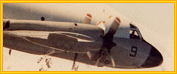
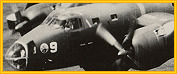
VP-54 History
Circa 1992
A BIT OF HISTORY: "...Patrol Aviation In The Pacific In WWII - Naval Aviation News - July-August 1992.." WebSite: http://www.history.navy.mil/nan/backissues/1990s/1992/ja92.pdf [11NOV2004]
Circa 1990
A BIT OF HISTORY: "...To Keep Us Out Of World War II? - Page 18 to 27 - Naval Aviation News - January-February 1990..." WebSite: http://www.history.navy.mil/nan/backissues/1990s/1990/jf90.pdf [22OCT2004]
A BIT OF HISTORY: "...History - Change-Of-Command - Page 7, 21 and 30 - Naval Aviation News - January-February 1990..." WebSite: http://www.history.navy.mil/nan/backissues/1990s/1990/jf90.pdf [22OCT2004]

Circa 1982
A BIT OF HISTORY: "...The Black Cats - Page 10 to 11 - Naval Aviation News - October 1982..." WebSite: http://www.history.navy.mil/nan/backissues/1980s/1982/oct82.pdf [16OCT2004]
Circa 1972
A BIT OF HISTORY: "...Beer Bottles, Bombs And Battles - Page 22 to 27 - Naval Aviation News - June 1972..." WebSite: http://www.history.navy.mil/nan/backissues/1970s/1972/jun72.pdf [27SEP2004]
Circa 1945
A BIT OF HISTORY:  VPB-54 History "...Returned Letter!..." WebSite: EBay http://cgi.ebay.com/ [13JUL2008]
Circa 1944
A BIT OF HISTORY: "...VP-54 May through July 1944 on Midway..." Forwarded by ADC William Hubert BARRERA's Daughter Dee deeanddory@aol.com..." [Updated 25MAR2007 | 24MAR2007]
A BIT OF HISTORY: "...Location of U. S. Naval Aircraft - Dated 11 Jan 1944..." WebSite: Naval Historical Center http://www.history.navy.mil/ [29SEP2006]
VP SQUADRONS MENTIONED
VD-1, VD-2, VD-3 and VD-4
VJ-1, VJ-2, VJ-3, VJ-4, VJ-5, VJ-7, VJ-8, VJ-9, VJ-10, VJ-11, VJ-12, VJ-13, VJ-14, VJ-15, and VJ-16
VP-6 Coast Guard
VP-11, VP-12, VP-13, VP-14, VP-15, VP-16, VP-17, VP-18 and VP-19
VP-20, VP-23 and VP-24
VP-32, VP-33 and VP-34
VP-43, VP-44 and VP-45
VP-52 and VP-54
VP-61 and VP-62
VP-71, VP-72, VP-73 and VP-74
VP-81 and VP-84
VP-91, VP-92 and VP-94
VP-101, VP-102, VP-103, VP-104, VP-105, VP-106, VP-107, VP-108 and VP-109
VP-110, VP-111, VP-112, VP-113, VP-115, VP-116 and VP-117
VP-126, VP-127, VP-128 and VP-129
VP-130, VP-131, VP-132, VP-133, VP-134, VP-135, VP-136, VP-137, VP-138 and VP-139
VP-140, VP-141, VP-142, VP-143, VP-144, VP-145, VP-146, VP-147, VP-148 and VP-149
VP-150 and VP-151
VP-201, VP-203, VP-204, VP-205, VP-208 and VP-209
VP-210, VP-211, VP-212, VP-213, VP-214, VP-215 and VP-216
A BIT OF HISTORY: "...September 4, 1944, Group ONE, Fleet Air Wing TWO was established, consisting of VP-54, VP-44, VB-148, Patsu 1-7, Patsu 1-9, and Patsu 1-11. The group was placed under administrative control of ComAirSoPac.. Operational control of the individual units remained as before. ComPatron 54 assumed additional duty as commanding officer of the group..." http://www.fortunecity.com/millenium/redwood/372/part5.htm [09DEC2000]
Circa 1943
A BIT OF HISTORY: "...Location of U. S. Naval Aircraft - Dated 31 May 1943..." WebSite: Naval Historical Center http://www.history.navy.mil/ [02OCT2006]
VP SQUADRONS MENTIONED
CASU
PATSU
VD-1, VD-2 and VD-3
VJ-1, VJ-2, VJ-3, VJ-4, VJ-5, VJ-7 and VJ-10
VP-1
VP-11, VP-12, VP-13, VP-14 and VP-15
VP-23
VP-32, VP-33 and VP-34
VP-43, VP-44 and VP-45
VP-52, VP-53 and VP-54
VP-61, VP-62 and VP-63
VP-71, VP-72, VP-73 and VP-74
VP-81 and VP-84
VP-91, VP-92 and VP-94
VP-101, VP-102, VP-103, VP-104, VP-105, VP-106, VP-107, VP-108 and VP-109
VP-125, VP-126, VP-127 and VP-128
VP-130, VP-131, VP-132, VP-133, VP-134, VP-135, VP-136, VP-137, VP-138 and VP-139
VP-140, VP-142, VP-144 and VP-146
VP-201, VP-202, VP-203, VP-204, VP-205, VP-206, VP-207, VP-208 and VP-209
VP-210, VP-211 and VP-212
A BIT OF HISTORY: "...Location of U. S. Naval Aircraft - Dated 16 Jan 1943..." WebSite: Naval Historical Center http://www.history.navy.mil/ [01OCT2006]
VP SQUADRONS MENTIONED
CASU and PATSU
VJ-1, VJ-2, VJ-3, VJ-4, VJ-5, VJ-6, VJ-7 and VJ-8
VP-6 Coast Guard
VP-3
VP-11 and VP-12
VP-23 and VP-24
VP-31, VP-32, VP-33 and VP-34
VP-41, VP-42, VP-43 and VP-44
VP-51, VP-52, VP-53 and VP-54
VP-61, VP-62 and VP-63
VP-71, VP-72, VP-73 and VP-74
VP-81, VP-82, VP-83 and VP-84
VP-91, VP-92VP-93, and VP-94
VP-101, VP-102, VP-103, VP-104, VP-105, VP-106, VP-107, VP-108 and VP-109
VP-110
VP-127, VP-128 and VP-129
VP-131, VP-132, VP-133 and VP-134
VP-200, VP-201, VP-202, VP-203, VP-204, VP-205, VP-206, VP-207, VP-208 and VP-209
VP-210, VP-211, VP-210, and VP-216
A BIT OF HISTORY: "...Location of U. S. Naval Aircraft - Dated 09 Nov 1943..." WebSite: Naval Historical Center http://www.history.navy.mil/ [01OCT2006]
VP SQUADRONS MENTIONED
CASU and PATSU
VD-1, VD-2, VD-3 and VD-4
VJ-1, VJ-2, VJ-3, VJ-4, VJ-5, VJ-15, and VJ-16
VP-6 Coast Guard
VP-1
VP-11, VP-12, VP-13, VP-14, VP-15 and VP-16
VP-23 and VP-24
VP-32, VP-33 and VP-34
VP-43, VP-44 and VP-45
VP-52, VP-53 and VP-54
VP-61, VP-62 and VP-63
VP-71, VP-72, VP-73 and VP-74
VP-81 and VP-84
VP-91, VP-92 and VP-94
VP-101, VP-102, VP-103, VP-104, VP-105, VP-106, VP-107, VP-108 and VP-109
VP-110, VP-111, VP-112, VP-113, VP-114, VP-115 and VP-116
VP-125, VP-126, VP-127, VP-128 and VP-129
VP-130, VP-131, VP-132, VP-133, VP-134, VP-135, VP-136, VP-137, VP-138 and VP-139
VP-140, VP-141, VP-142, VP-143, VP-144, VP-145, VP-146, VP-147, VP-148 and VP-149
VP-150
VP-201, VP-202, VP-203, VP-204, VP-205, VP-206, VP-207, VP-208 and VP-209
VP-210, VP-211, VP-212, VP-213, VP-214, VP-215 and VP-216
A BIT OF HISTORY: "...Location of U. S. Naval Aircraft - Dated 09 Feb 1943..." WebSite: Naval Historical Center http://www.history.navy.mil/ [28SEP2006]
VP SQUADRONS MENTIONED
VJ-1, VJ-2, VJ-3, VJ-7 and VJ-8
VP-11, VP-12, VP-13 and VP-14
VP-23 and VP-24
VP-31, VP-32, VP-33 and VP-34
VP-41, VP-42, VP-43 and VP-44
VP-61, VP-62, and VP-63
VP-71, VP-72, VP-73 and VP-74
VP-81, VP-82, VP-83 and VP-84
VP-91, VP-92, VP-93 and VP-94
VP-101
VP-127, VP-128 and VP-129
VP-130, VP-132, VP-133 and VP-134
VP-201, VP-202, VP-203, VP-205, VP-206, VP-207, VP-208 and VP-209,
VP-210, VP-211 and VP-212
A BIT OF HISTORY:  VP-54 History "...Circa 1943..." Contributed by John Lucas john.lucas@netzero.net [21MAR2003]
Circa 1942 - 1945
A BIT OF HISTORY: Naval Historical Center, Department Of The Navy, Washington, D. C http://www.history.navy.mil/branches/dictvol2.htm [28APR2001]

VPB-54 207KB
Squadron History: VPB-54
Lineage
Established as Patrol Squadron FIFTY FOUR
(VP-54) on 15 November 1942.
Redesignated Patrol Bombing Squadron FIFTY FOUR (VPB-54) on 1 October 1944.
Disestablished on 7 April 1945.
Squadron Insignia and Nickname
Although there is no record of any official insignia on file, a February 1943
photograph of the squadron commanding officer standing next to a VP-54 Catalina shows an
insignia of a snarling black cat crouched on top of a bomb. Members of the squadron state
that a full moon served as a background for the design. Colors: moon background, orange;
cat and bomb, black with white outlining; cats tongue, red; teeth and whiskers,
white.
Nickname: Black Cats, 19421945.
Chronology of Significant Events
15 Nov 194212 Feb 1943: VP-54 was established at NAS Kaneohe, Hawaii, as a
seaplane squadron flying the PBY-5A Catalina under the operational control of FAW-2.
Formation and training of the squadron continued through 11 February 1943. Although 12
aircraft was the normal complement for a squadron, 18 aircraft were on board by the end of
the year. On 12 February 1943, VP-54 was ordered to convert to a night flying unit with
two weeks training time prior to transfer to the combat zone.
1 Mar 1943: The first element of aircraft de-parted NAS Kaneohe for NOB Espiritu
Santo, with the last aircraft arriving in early April. During this period of operations
the squadron came under the operational control of FAW-1. While en route, four aircraft
were caught at NAF Canton Island in a surprise night raid by Japanese Mitsubishi G4M1 Navy
Type 1 (Betty) attack bombers. All four Catalinas were destroyed.
11 Mar 1943: VP-54 began sending its aircraft to Henderson Field, Guadalcanal,
relieving VP-12. Its duties were to conduct antishipping patrols in the Solomons area in
support of the forces occupying the island and Dumbo missions in support of downed
aircrews. The initial landings on Guadalcanal had been made on 7 August 1942, encountering
strong Japanese resistance. The island was not declared secure until 9 February 1943.
Patrol tracks included Russell Island, the southwest coast of Santa Isobel and the
northern tip of Malaita and Savo Island.
5 Aug 1943: During the Rendova and Munda Island campaigns in the Solomons, the
Japanese attempted to remove as many of their ground forces as possible from isolated
garrisons. VP-54 conducted numerous antishipping attacks on transports during this period.
7 Sep 1943: VP-54 was based at NAB Henderson Field, Guadalcanal, with seven
aircraft, NOB Espiritu Santo with one aircraft and Noumea with three aircraft.
7 Oct 1943: VP-54 provided support for the forces attacking Vella Lavella,
Solomons.
1 Nov 1943: VP-54 was tasked with providing anti-submarine coverage, search
missions and air coverage at the beginning of the Bougainville campaign. By the end of the
campaign the squadrons tour of duty drew to a close. Since arriving in the combat
theater the squadron had recovered 52 personnel from the water, including downed pilots
and survivors of ship sinkings.
20 Nov 1943: VP-54 was relieved and flew its aircraft to Sidney, Australia. The
aircraft remained at Sidney while the squadron personnel were returned to the U.S. aboard
ship. After a period of home leave, a cadre of personnel were given orders to report to
NAS San Diego, Calif., for reforming the squadron.
6 Feb 1944: VP-54 was reformed at NAS San Diego, Calif., under the operational
control of FAW-14, with new PBY-5A aircraft to replace the ones left in Australia. By May
the squadron had fully integrated its new personnel and equipment and was ready for
re-deployment.
20 May 1944: VP-54 departed NAS San Diego in elements of three aircraft, with the
last arriving at NAS Kaneohe, Hawaii, on 21 May 1944. The remainder of the squadron and
its assets were sent to Hawaii aboard Breton (CVE 10). Upon arrival at NAS Kaneohe
the squadron came under the operational control of FAW-2.
28 May 1944: A detachment of six aircraft and nine crews was deployed to Midway
Island until 2 July 1944, conducting routine operational patrols. The remaining squadron
assets at NAS Kaneohe continued to perform routine patrols in Hawaiian waters.
8 Jul 1944: VP-54 deployed to Guadalcanal in three-plane sections, leaving NAS
Kaneohe every other day. The first section arrived at Espiritu Santo on 12 July,
continuing on to Carney Field, Guadalcanal, to relieve VP-81. During this period the
squadron came under the operational control of FAW-1.
31 Jul 1944: VP-54 was relocated to Luganville Airfield, Espiritu Santo, relieving
VP-12. A detachment of four PBY-5As was maintained at Henderson Field, Guadalcanal, for
duty with the 2nd Marine Air Wing through 10 September 1944. The squadron aircraft at
Luganville conducted routine ASW patrols and Dumbo searches.
13 Sep 1944: VP-54 deployed 13 aircraft and 15 crews to Emirau. Two aircraft were
sent to Funafuti. Both detachments returned to Espiritu Santo on 21 September 1944.
22 Sep 1944: Long-range navigation over large areas of the ocean was difficult for
large aircraft with a full time navigator and extremely difficult for single-seat
fighters. The Navy was frequently called upon by the Army Air Forces to provide seaplane
escorts for fighter groups making long transits between island bases. The presence of
amphibious Navy aircraft also ensured a quick rescue in the event of ditching. VP-54
conducted such a mission on 22 September, escorting the Western Caroline Air Force from
Emirau to Peleliu Island, staging through Hollandia and Owi.
24 Sep 1944: A three-aircraft element was sent on a night search for enemy shipping
in the passage north of Peleliu.
1 Oct 1944: VP-54 was redesignated VPB-54. On this date, the squadron provided an
escort for Marine squadrons being transferred from Emirau to Palau.
4 Nov 1944: A detachment of six aircraft and crews remained at Peleliu Island,
Palau, for Dumbo missions. The other seven squadron aircraft remained at Espiritu Santo.
10 Nov 1944: VPB-54 was relieved by RNZAF Squadron No. 5, but lacking further
orders remained at Espiritu Santo until mid-December.
1223 Dec 1944: The seven aircraft of the Espiritu Santo detachment of VPB-54
were relocated to the island of Los Negros. On 23 December 1944, the detachment relieved
VPB-34 for air-sea rescue and evacuation work. Tender support at Leyte Gulf was provided
by Orca (AVP 49) under the operational control of FAW-10.
27 Dec 194410 Jan 1945: VPB-23 relieved the squadrons Peleliu
detachment, but its aircraft were too worn out to be able to rejoin the squadron at Leyte
Gulf. The six aircraft were first flown to Woendi for overhaul on 1 January 1945. The work
was completed a week later and the detachment flew into Leyte on 10 January 1945. Upon
arrival the detachment was put aboard Tangier (AV 8), while the remaining five
aircraft and eight crews of the former Leyte detachment departed aboard Orca (AVP
49) for duty in Lingayen Gulf.
22 Jan 1945: The six aircraft and crews aboard Tangier (AV 8) were relocated
to San Carlos (AVP 51) and continued operations in the Leyte Gulf.
14 Feb 1945: The Lingayen Gulf detachment was relieved by VPB-17 and then returned
to Leyte Gulf to rejoin the rest of the squadron. Currituck (AV 7) provided this
group tender support.
17 Feb 1945: VPB-54s tour of duty formally concluded with its relief at Leyte
Gulf by VPB-17. Three of the squadron aircraft were flown to Manus Island for
transportation to the U.S. The remaining crews departed from Samar Island via NATS,
returning to the continental U.S. The support staff and ground crews boarded Wharton (AP
7) for return to the States.
24 Feb13 Mar 1945: The commanding officer and aircrew personnel reported to
COMFAIRALAMEDA and FAW-8 at NAS Alameda, Calif.. On 13 March 1945, prior to the arrival of
the ground crews and support staff, all personnel were given reassignment orders sending
them to other squadrons.
7 Apr 1945: VPB-54 was disestablished at NAS Alameda, Calif.
Home Port Assignments
| Location |
Date
of Assignment |
| NAS Kaneohe,
Hawaii |
15 Nov 1942 |
| NAS San Diego, Calif. |
Dec 1943 |
| NAS Kaneohe, Hawaii |
21 May 1944 |
| NAS Alameda, Calif. |
24 Feb 1945 |
Commanding Officers
| Name |
Date
Assumed Command |
| LT Carl W. Schoenweiss |
15 Nov 1942 |
| LCDR Kenneth J. Sanger |
6 Feb 1944 |
Aircraft Assignment
| Type of Aircraft |
Date
Type First Received |
| PBY-5A |
15 Nov 1942 |
Major Overseas Deployments
| Date of Departure |
Date
of Return |
Wing
|
Base
of Operations |
Type
of Aircraft |
Area
of Operations |
| 1 Mar 1943 |
* |
FAW-1 |
Espiritu Santo |
PBY-5A |
SoPac |
| 11 Mar 1943 |
* |
FAW-1 |
Guadalcanal |
PBY-5A |
SoPac |
| 20 Nov 1943 |
Dec 1943 |
FAW-2 |
Sidney |
PBY-5A |
SoPac |
| 20 May 1944 |
* |
FAW-2 |
Kaneohe |
PBY-5A |
SoPac |
| 28 May 1944 |
* |
FAW-2 |
Midway |
PBY-5A |
SoPac |
| 12 Jul 1944 |
* |
FAW-1 |
Guadalcanal |
PBY-5A |
SoPac |
| 31 Jul 1944 |
* |
FAW-1 |
Espiritu Santo |
PBY-5A |
SoPac |
| 13 Sep 1944 |
* |
FAW-2 |
Emirau |
PBY-5A |
SoPac |
| 4 Nov 1944 |
* |
FAW-2 |
Peleliu |
PBY-5A |
SoPac |
| 12 Dec 1944 |
* |
FAW-10 |
Los Negros |
PBY-5A |
SoPac |
|
|
|
Orca (AVP 49) |
|
|
| 10 Jan 1945 |
* |
FAW-10 |
Leyte |
PBY-5A |
SoPac |
|
|
|
Tangier (AV 8) |
|
|
|
|
|
San Carlos (AVP 51) |
|
|
| 10 Jan 1945 |
* |
FAW-10 |
Lingayen |
PBY-5A |
SoPac |
|
|
|
Orca (AVP 49) |
|
|
| 14 Feb 1945 |
17 Feb 1945 |
FAW-10 |
Leyte |
PBY-5A |
SoPac |
|
|
|
Currituck (AV 7) |
|
|
Continued combat deployment in the Pacific, moving from base to base.
Wing Assignments
| Wing |
Tail
Code |
Assignment
Date |
| FAW-2 |
|
15 Nov 1942 |
| FAW-1 |
|
1 Mar 1943 |
| FAW-14 |
|
Dec 1943 |
| FAW-2 |
|
20 May 1944 |
| FAW-1 |
|
8 Jul 1944 |
| FAW-2 |
|
4 Sep 1944 |
| FAW-10 |
|
12 Dec 1944 |
| FAW-8 |
|
24 Feb 1945 |
Unit Awards Received
| Unit Award |
Inclusive
Date Covering |
Unit
Award |
|
None on record. |
|
Circa 1942
A BIT OF HISTORY: "...Op-40-A-KB - (SC)A6-4/VZ - January 6, 1942 - Location of U. S. Naval Aircraft..." WebSite: Naval Historical Center http://www.history.navy.mil/ [23SEP2006]
VP SQUADRONS MENTIONED
VP-11, VP-12 and VP-14
VP-23 and VP-24
VP-31, VP-32, VP-33 and VP-34
VP-41, VP-42, VP-43 and VP-44
VP-51, VP-52, VP-53 and VP-54
VP-61, VP-62, VP-63
VP-71, VP-72, VP-73 and VP-74
VP-81 and VP-83
VP-91, VP-92 and VP-94
VP-101
VP-201, VP-202, VP-203, VP-204, VP-205, VP-206, VP-207, VP-208, VP-209, VP-210, VP-211 and VP-212
Circa 1941
A BIT OF HISTORY: "......Squadrons/Patrol Wings Mentioned: VP-54, VP-54, VP-71, VP-72, VP-73, VP-74, CPW-5 and CPW-7..." http://www.exreps.com/ [23JUL2009]
MIT radar receiver laboratory 1941
In mid 1941, a PBY-2 aircraft 54-P-10, BuNo 0456 belonging to VP-54, was equipped with the first operational radar aboard a US Navy aircraft. The ASV radar equipment used long separate transmitting and receiving antennas mounted on insulated stub supports along the forward hull of the PBY.
The British had already put ASV Mark II on their Consolidated Catalina flying boat patrol aircraft, so it was straightforward to mount it on US Navy Catalina’s. The installation was completed at NAS Anacostia, Washington, D.C. NAS Anacostia, Washington, D.C. was the site of the Fleet Air Tactical Unit.
They conducted experiments with new aircraft and equipment in order to determine their practical application and tactical employment. NAS Anacostia, Washington, D.C. was a primary training base for naval aviation and the home of all Navy flight test operations until overcrowding caused that mission to be moved in 1943 to NAS Patuxent River, Maryland. At the time of the radar installation, VP-54 was assigned to CPW-5, stationed at NAS Norfolk, Virginia.
The VP-54 aircraft was most likely selected because the squadron had aircraft available in the area and was also experienced with working with the British RAF. VP-54 had conducted neutrality patrols in the Atlantic daily, weather permitting, from Newport to Nova Scotia in June 1939 to February 1941, and also from Bermuda, B.W.I. in September 1940 to January 1941.
VP-54 PBY BUNO 54-P-10. The first operational radar on a U. S. Navy PBY-2 is shown 9 June 1941 at NAS Anacostia, Washington, D.C.
Commander J. V. Carney, Senior Support Force Staff Officer, reported on 18 July 1941 that British type ASV radar has been installed in one PBY-5 Catalina each of VP-71, VP-72, and VP-73 and two PBM-1's of VP-74. Initial installation of identification equipment (IFF) was made about the same time. In mid-September, radar was issued for five additional PBM-1's of VP-74 and one PBY-5 of VP-71, and shortly thereafter for other aircraft in CPW-7 squadrons. Thereby CPW-7 became the first operational Wing of the U.S. Navy to be supplied with radar-equipped aircraft. Its squadrons operated from NAS Norfolk, Virginia, NAS Quonset Point, Rhode Island and advanced bases on Greenland, NAS Argentia, Newfoundland, Canada and NAS Keflavik, Iceland during the last months of the neutrality patrol. Radar introduced both aircrew and ground personnel to a whole new capability for Navy airborne operations. The early installations were awkward due to their long separate transmitting and receiving antennas mounted on insulated stub supports along the forward hull of the PBYs.
ASV Mark II Antennas installed by General Electric on a PBY-5A Catalina at the Consolidated Aircraft Factory, 11 Feb 1942.
A BIT OF HISTORY:  VP-54 PBY BUNO: 54-P-10 "The first operational radar on a U. S. Navy plane is shown 9 June 1941 at NAS Anacostia, Washington, D.C.. One of the antennas is shown strung on spikes on the port side of the fuselage." "Cause a PBY Don't Fly That High," by Captain William E. Scarborough, U. S. Navy (Retired), U. S. Naval Institute "Proceedings" - April 1978
"...The PBY shown in the picture (plane #10) is from the first tour in the Solomons. The second tour used PBY5A's which arrived already painted a full flat black..." Contributed by Tom Doty nocone1@ix.netcom.com WebSite: http://www.fortunecity.com/millenium/redwood/372/cover.htm [16SEP99]
A BIT OF HISTORY: "...CAPTAIN ARNOLD JAY ISBELL..." http://www.ranger95.com/navy/navy_ship/combat_ship/destroyers/background/arnold_j_isbell_dd_869_bak.htm [26MAR2005]
Arnold J. Isbell—born on 22 September 1899 in Quimby, Iowa—entered the Naval Academy on 24 July 1917 and graduated on 3 June 1920 (a year ahead of schedule due to acceleration of midshipman training during World War I) with class 21A of the Class of 1921. Isbell then served successive tours of duty in Melville (AD-2), Bath (AK-4), and the fast minelayers Ingraham (DM-9) and Burns (DM-11) before beginning flight instruction at the NAS Pensacola, Florida, on 30 June 1923. He then briefly served as an instructor there before reporting to Observation Squadron 1, based in the minelayer Aroostook (CM-3) which was then serving as an aircraft tender in November 1924. In March of the following year, he was transferred to the aviation unit of the battleship Tennessee (BB-43). Following two years of postgraduate work in ordnance back at the Naval Academy between the summers of 1926 and 1928, he received further flight instruction at Washington, D.C., under the supervision of the post graduate school, before going to sea with Torpedo Squadron IB in aircraft carrier Lexington (CV—2).
Isbell then served in the Aviation Ordnance Section of the Bureau of Ordnance (BuOrd) in Washington before reporting to Newport News, Va., on 16 September 1933 to participate in the fitting out of the Navy's first aircraft carrier to be built as such from the keel up, Ranger (CV-4). Following a brief tour of duty in that ship, he served from 6 June 1934 to 9 June 1936 in carrier Saratoga (CV-3) as gunnery officer on the staff of Rear Admiral (later Vice Admiral) Henry V. Butler, Commander, Aircraft, Battle Force.
Isbell subsequently flew as executive officer of VP-7F based in aircraft tender USS Wright (AV-1) from 9 June 1936 to 1 June 1937 before commanding one of the five squadrons of the Aviation Training Department at NAS Pensacola, Florida, VN-4D8. While at Pensacola, he won the coveted Schiff Trophy, "emblematic of maximum safety in aircraft operation."
In the early summer of 1939, Lt. Comdr. Isbell assumed command of VP-11 (later redesignated VP-54). The German invasion of Poland on 1 September 1939 found VP-54 based at NAS Norfolk, Virginia; engaged in biennial maintenance of its dozen PBY—2 flying boats. Eight days later, a detachment of six planes departed NAS Norfolk, Virginia and arrived at Newport, R.I., their assigned base, that same day. The entire squadron resumed operations on NAS Norfolk, Virginia on 14 November 1939, relieving VP-53 on the Middle Atlantic Patrol.
During one of the flights his squadron conducted in the initial selection and survey of Army and Navy base sites in Newfoundland in the autumn of 1940—sites obtained in the "destroyers-for-bases" deal of the summer before—Isbell found himself in the path of a hurricane. In an attempt to evade the storm, Isbell skillfully maneuvered his aircraft in the murk until exceptionally strong headwinds forced him to make an emergency night landing on Prince Edward Island. Isbell took off before daybreak, despite fog and violent winds, and reached his destination without mishap. After completing his inspection over uninhabited regions and seacoast areas, Isbell returned to Newfoundland to carry out an aerial survey of Argentina, a place soon to become famous as the site of the "Atlantic Charter" conference. Isbell's expert airmanship and tenacious devotion to completing his mission resulted in his receiving the air medal.
Relieved of command of VP-54 on 15 April 1941, Isbell then served successive tours of duty in a staff capacity—first for Commander, Patrol Wing, Support Force (16 April-2 October 1941) as that command's planes escorted North Atlantic convoys; then as chief of staff and aide for Rear Admirals E. D. McWhorter and A. D. Bernhard, Commander, Patrol Wings, Atlantic Fleet (3 October 1941-11 June 1942)—before assuming command of NAS, Sitka, Alaska, on 5 June 1942. Promoted to captain during his time in the Aleutians, Isbell then served briefly in BuOrd before assuming command of the escort carrier Card (CVE-11) on 17 April 1943.
For the next year, Card ranged the essential lifeline across the Atlantic to North Africa, earning together with her escorting destroyers, a Presidential Unit Citation under the resourceful "Buster" Isbell, who believed firmly in the potential of the CVE, maintaining that such a ship, together with her escorts, "could most effectively whip the submarine menace—as an independent offensive group rather than as a mere tag-along protector of a single convoy." Isbell used the year he commanded Card wisely to vindicate his belief. As antisubmarine task group commander between 27 July and 9 November 1943, Isbell developed his escort carrier-destroyer unit into a powerful combat force, refining tactics to meet the operational demands imposed by a wily and tenacious foe and wresting the initiative from his hands. Card sought out the enemy undersea craft with relentless determination m a vigorous offensive and struck with a devastating coordinated action that destroyed eight U-boats between 7 August and 31 October 1943.
Detached from Card on 9 March 1944, Isbell—who had been awarded a Legion of Merit for his important work in Card—took his intimate knowledge of combatting U-boats to Washington, where he served in the 10th Fleet—a shipless "fleet" set up to research and develop tactics for antisubmarine warfare. Following this tour of shore duty—which lasted into 1945—Isbell was slated to receive command of a fast carrier. On 26 February 1945, he was ordered to the Pacific for temporary duty in Franklin (CV-13). On 13 March 1945, further orders directed him to relieve Capt. Thomas S. Combs as commanding officer of Yorktovm (CV-10). However, Capt. Isbell perished when a Japanese plane scored two bomb hits that touched off a conflagration in Franklin—the carrier in which he was embarked as a passenger—off Kyushu on 19 March 1945.
Circa 1940
A BIT OF HISTORY: "...16NOV40 - PBYs (VP-54) inaugurate flight operations from Bermuda; seaplane tender (destroyer) George E. Badger (AVD-3) provides support..." WebSite: HyperWar http://www.ibiblio.org/hyperwar/USN/USN-Chron/USN-Chron-1940.html [15SEP2005]
A BIT OF HISTORY: "...The Neutrality Patrol - To Keep Us Out of World War II - Part 1 of 2 by Capt. William E. Scarborough, USN(Ret.)...Naval Aviation News March-April 1990 Page 18 through Page 23..." [24NOV2000]
 VP-52-P-7 VP-52 In February 1941, VP-52 was at San Juan, P.R., and flew a survey party to British Guiana to inspect a "destroyers-for-bases" site for future naval air station. No. 7 is moored for an overnight stop on the Essequebo River, upstream from Georgetown. On September l, 1939, the German invasion of Poland began a long anticipated and feared WW II. Declarations of war against Germany by Britain and France two days later showed that the war would undoubtedly expand to all of Europe a repeat of the beginning of WW I in 1914. The Allies would again be dependent on support by the United States for supplies and munitions which could reach them only aboard ships crossing the Atlantic. Germany would surely make every effort to halt such trafftc by U-boat and surface raider attacks and the Atlantic would again, as it had in WW I, become a major battleground. It was a foregone conclusion that the war in the Atlantic would endanger the neutrality of the United States, and the Navy moved promptly to minimize the threat.
The day war began in Europe the Chief of Naval Operations (CNO) informed U.S. forces that German U-boats were ready to begin operations in Atlantic shipping lanes, and reports indicated thata dozen German merchant ships were being armed as raiders. The advisory noted that neutral merchantmen, including U.S. flag ships, could expect similar actions by the British and that it was the duty of the U.S., as a neutral, to prevent such activities in our territorial waters and to assure no interference with our rights on the high seas. The Neutrality Act of 1935, made further restrictive by amendment in 1937, forbade arms exports, either direct or by transhipment. to any belligerent and was looked upon by isolationist groups as the best insurance against U.S. involvement in a European war.
At Coast Guard Air Station, Charleston, the Coast Guard flew Douglas RD-4, Grumman J2F-2, and Fairchild J2K-2 aircraft on coastal and inshore patrols. In return for shared facilities, VP-52 provided copilots for RD and J2K flights. Building at bottom center was a converted warehouse for squadron shops and offices. President Franklin D. Roosevelt issued his first proclamation of neutrality on September 5, 1939, declaring in part that any use of U.S. territorial waters for hostile operations would be regarded as unfriendly, offensive, and a violation of U.S. neutrality.
The Navy had initiated action on September 4, by CNO dispatch to Commander, Atlantic Squadron, directing establishment of air and ship patrols to observe and report by classified means movement of warships of the belligerents within designated areas. The patrol would cover an area bounded on the north by a line east from Boston to latitude 42-30, longitude 65; south to latitude 19; then around the the windward and leeward islands to Trinidad.
The next day CNO amplified his directive by ordering classified contact reports on foreign men-of-war approaching or leaving the U.S. East Coast or the eastern boundary of the Caribbean. Ships sighted by the patrols, both air and surface, were to be identified by name, nationality, estimated tonnage, color, and markings, and were to be photographed whenever possible. Course and speed were to be estimated and all information was to be recorded and reported on return to base.
 VP-15-P-7 VP-15 VP-15 (later redesignated VP-53 and VP-73) P2Y-2 off Breezy Point, NAS Norfolk, Virginia, Spring 1939. Neutrality Patrol star on bow was not authorized until March 19, 1940.
On September 6, Commander, Atlantic Squadron reported to CNO that the patrol was operating and by the 20th, when a revised Atlantic Squadron OpOrder (20-39) became effective, Atlantic coastal waters from Nova Scotia, Canada, to the Lesser Antilles, West Indies, were under daily surveillance by surface and air patrols. Forces involved were primarily patrol planes from Patrol Squadron VP-51 (12 PBY-1s), VP-52 (6 P2Y-2s), VP-53 (12 P2Ys), and VP-54 (12 PBY-2s) of Patrol Wing (PatWing) 5 and VP-33 (12 PBY-3s) of PatWing-3, plus four Seaplane Tenders assigned to the PatWings.
Surface forces were battleships and cruisers of the Atlantic Squadron and their attached OS2U and SOC aircraft of Observation Squadron (VO) 5 and Cruiser Scouting Squadron (VCS) 7, Ranger (CV-4) with her air group and Wasp (CV-7), which was not yet in commission. Forty destroyers plus an undetermined number of old destroyers (to be recommissioned) and about 15 old submarines were the assigned surface forces.
Aircraft patrols were initiated by the patrol squadrons, deployed to assigned Neutrality Patrol bases - most of them ill-equipped to support aircraft and crews for flight operations at the level required for daily patrols. General orders to the patrols stressed safety of the operations, avoidance of nonneutral acts, and the exercise of care in approaching vessels to avoid actions which might be interpreted as hostile.
 VP-52-P-10 VP-52 VP-52-P-10, Spring 1941. These PBY-5's were transferred from San Diego-based VP-14 in January 1941. To expedite operations and conserve funds. VP-14 markings (black stipes on tail) were retained and only squadron numbers changed.
VP-51: Deployed PBY-1 s to San Juan, P.R., departing NAS Norfolk, Virginia, on September 12, with first patrols flown on the 13th. The squadron utilized seaplane facilities, including ramp and hangar, of Pan American Airways at the San Juan airport, housing crew and supporting activities in tents on the airport. Ttle site utilized was the area on which the future Naval Air Station (NAS), San Juan would be built, construction starting in 1940. VP-51's patrols covered harbors and shipping lanes in the West Indies from Puerto Rico to Trinidad, with special attention to the southern approaches to the Caribbean through the Lesser Antilles.
VP-52 and VP-53: Both continued flying P2Ys from home port NAS Norfolk, Virginia, patrolling mid-Atlantic coastal shipping lanes, coordinating operations with Atlantic Squadron destroyers. VP-53 had returned to NAS Norfolk, Virginia September 1 after a regular summer deployment to Annapolis, Md., for midshipman aviation training.
VP-54: Based at NAS Norfolk, Virginia deployed a detachment of PBY-2s to Newport, R.I., operating from the Naval Torpedo Factory Air Facility on Gould Island in Narragansett Bay, R.I. Daily searches were coordinated with destroyer surface patrols in the assigned offshore areas.
VP-33: Deployed PBY-3s from NAS Coco Solo, Panama, Canal Zone, to NAS Guantanamo Bay, Cuba. Patrols covered the area from Guantanamo to San Juan, coordinated with VP-51, destroyers, and the cruisers Tuscaloosa (CA-37) and San Francisco (CA-38), Cruisers Ouincy (CA-39) and Vincennes (CA-44): Patrolled sea approaches between Norfolk and Newport. Battleship Division 5 and Ranger were based at Norfolk as a reserve force.
Experience during the first month of operations dictated changes in the deployment of the forces to improve coverage of the assigned areas.
VP-52 moved to the U.S. Coast Guard air station located on the Cooper River in the Charleston, S.C., navy yard in December. Renovation and modification of existing buildings provided facilities to house crew and squadron administrative and maintenance activities. The air station supplied a seaplane ramp, aircraft parking area, and shared space in a small hangar. Officers were quartered in the Coast Guard BOO. Moving the squadron proved a major exercise in itself.
VP-52 had been home-ported at NAS Norfolk, Virginia since it was first commissioned as VP-14 on November 1, 1935, when the station was NAS Hampton Roads. As a self-supported squadron, a full allowance of maintenance equipment, spares, records, and myriad other authorized and unauthorized odds and ends accumulated required packing and loading aboard railroad cars for the move south. The operation was further complicated by a full schedule of training flights in addition to daily patrols of the assigned areas offshore.
VP-33's initial move to NAS Guantanamo Bay, Cuba posed problems similar to those of VP-52, somewhat diminished by the in-place facilities of the fully operational naval station there. However, the October move of the VP-33 detachment to Naval Station, Key West, Fla., long out of service and moth-balled, demanded much effort by the plane crews and their support personnel. Key West businesses and the population in general were so pleased by the arrival of the PBYs and several submarines that a celebration, including a parade on the main street, was staged! A VP-33 contingent turned out for the event. The Key West detachment flew regular patrols from Dry Tortugas to Miami, Fla., and to the Yucatan Peninsula in Mexico, covering the Florida Straits and the Yucatan Channel.
In November 1939, VP-53 exchanged P2Ys for a mixed bag of older model PBYs-3 PBY-1s, 3 PBY-2s, and 3 PBY-3s. In February 1940, the squadron moved to Key West, remaining there until April 1941 when it returned to NAS Norfolk, Virginia and exchanged the old PBYs for new PBY-5s.
CGAS Charleston hanger shared with VP-52 for major P2Y maintenance. Coast Guard aircraft in photo, left to right: J2K, J2F, RD, and two J2Fs.
Also in October of that year, Ranger and her air group had joined the Cruiser Division (CruDiv) 7 ships and their VCS-7 SOCs to form a strike group with long-range search capability, on standby to fill gaps in the areas covered by the regular patrols. In November, a surface patrol of destroyers was established in the Gulf of Mexico to track shipping in that area. The Navy patrol effort was expanded by Coast Guard surface and aircraft coverage of inshore areas and cooperation by exchange of information, assuring complete area coverage and recording of all contacts.
On October 16, Commander, Atlantic Squadron expanded his earlier orders to the patrol forces with the issuance of OpOrder 24-39. In addition to reporting foreign men-of-war, "suspicious" vessels were to be noted and both they and men-of-war were to be tracked until their actions were considered satisfactory. All units of the Atlantic Squadron were included in the task organiza;tion but the major portion of the patrol activity was conducted by the patrol squadrons and destroyers, the latter primarily responsible for developing (visually checking at close range) contacts made by aircraft. Employment of the battleships was minimized and the ships of CruDiv-7 were soon withdrawn from the patrol for other duties.
The scope of Neutrality Patrol operations gradually expanded during 1940. Concurrently, the aircrews normally required training in all aspects of patrol plane operations - tactics, instruments, navigation, gunnery, bombing, etc. For example, VP-52 deployed detachments from Charleston to advanced bases such as Parris Island and Winyah Bay (both in S.C.) for operations with the aircraft tenders Owl (AM-2) in August and Thrush (AVP-3) in October. In addition to regular patrols, a normal schedule of training flights was flown from the advanced bases.
In spite of the increasing tempo of operations and the resulting workload, the effort proved well worth its costs; the experience markedly enhanced the readiness of Neutrality Patrol squadrons for the tasks that lay a scant year ahead in WW II. br> The war in Europe during 1940 saw the apparently invincible German forces defeat France and threaten to bring Britain to her knees by the blitz on her cities and the success of the U-boat actions in the Atlantic. The specter of a British defeat and the danger to the United States of such an event were obvious and dictated further expansion of the forces in the Atlantic. In the famous destroyers-for-bases agreement negotiated by President Roosevelt and Winston Churchill in September 1940, sites for bases in the Atlantic and Caribbean were exchanged for 50 WW I destroyers. Two of the sites, Argentia, Newfoundland, and Bermuda, presented rent-free as a "gift" for 99 years, would become key elements in the Battle of the Atlan- tic. Six other sites, in the Bahamas, Jamaica, St. Lucia, Antigua, and British Guiana, were leased, rent-free for the same period.
Both air and surface elements of the patrol force expanded during 1940 as the scope of the operation grew. Pat-Wing 5 at NAS Norfolk, Virginia commissioned VP-55 on August 1 and VP-56 on October 1. Both were to be equipped with PBM-1 s but problems with the new planes delayed deliveries and severely restricted squadron training. Eventually, the squadrons would be merged into a single command, designated VP-74, with all early production PBMs assigned. On November l, 1940, the Atlantic Squadron was redesignated Patrol Force, Atlantic Fleet and on December 17, then-Rear Admiral Ernest J. King relieved Rear Admiral Hayne Ellis as Commander, Patrol Force. On February l, 1941, the augmented and reorganized patrol forces were established under Admiral King as the U.S. Atlantic Fleet.
This force reorganization included establishment of task forces responsible for operations in specific sectors of the Atlantic. Task Force 1 com posed of battleships, cruisers, and destroyers -covered the trade routes to northern Europe. Task Force 2 - aircraft carriers, cruisers, and destroyers -patrolled the central North Atlantic. Task Force 3 - cruisers, destroyers, and mine craft - was based at San Juan and Guantanamo to cover the South Atlantic. Task Force 4 was Support Force, Atlantic Fleet, under Rear Admiral A. L. Bristol, established on March 1, 1941. The support force included destroyers and the patrol wing, with VP-51, VP-52, VP-55, and VP-56, and the tenders Albemarle (A V -5) and George E. Badger (AVD-3) attached. On April 5, VP53 rejoined the wing at NAS Norfolk, Virginia and, during the month, exchanged its old model PBYs for new PBY-5s. The establishing directive for the support force required preparation of the force for service in high latitudes and em- phasized training in antisubmarine warfare, protection of shipping, and defense against air, submarine, and surface raider attack. Primary mission of the force was operations from North Atlantic bases to prevent Axis forces from interfering with the shipment of war material from the United States to Great Britain.
Other air and surface forces originally operating with the Neutrality Patrol were subsequently designated Task Force 6 and elements based north of the Gulf and Caribbean became the Northern Patrol. The mission of the Northern Patrol, operating from bases at Norfolk, Bermuda, Narragansett Bay and Argentia, would be to investigate reports of potential enemy vessels and other non-American activity in the North Atlantic. This task gave the PatWing Support Force major responsibility for the advance of Naval Aviation to the north and east to insure safe passage of war materials to Britain.
 VP-53-P-9 VP-53 Courtesy of Fred C. Dickey. Prior to establishment of the Pat-Wing Support Force, a number of squadron redeployments were directed. VP-54 moved to NAS Bermuda, based on the tender George E. Badger and began Neutrality Patrol operations on November 15, 1940. In December, VP-52 exchanged its P2Y- 25 (last of the model in fleet service) for PBY-5s. The P2Ys were ferried from Charleston to Pensacola for use there in the training squadron. Replacement PBY-5s were ferried cross-country from San Diego by VP-14 and delivered to VP-52 at NAS Pensacola, Florida during January. VP-52 flew the new planes, as received, to its old home port, NAS Norfolk. The move from Charleston was essential as the facilities there could not support PBY operations.
On February l, 1941, VP-52 was transferred to San Juan for what proved to be a brief taste of tropical operations. The squadron joined VP-51 on still-unfinished NAS San Juan, sharing the Neutrality Patrols through the West Indies to Trinidad. In addition to the patrols there were mail runs and survey flights to island sites of the new stations being built under the destroyers-for-bases agreement. At the end of February, VP-52 was ordered back to NAS Norfolk, Virginia and, on March 3, all planes departed for the return. For the remainder of the month, the squadron flew patrols and convoy escort and contine. VP-53 was ordered to move from NAS Norfolk, Virginia to NAS Quonset Point, Rhode Island. Construction of the base at Argentia, another of the destroyers-for-bases sites, had not yet begun.
The deployment of VP-52 would be the first move toward im- plementing the mission of the Northern Patrol of the Support Force. The major North Atlantic shipping lanes would now be within range of the PBYs for convoy escort.
Albemarle arrived at Argentia on May 15, with VP-52's ground crew and squadron gear onboard. Preparations for aircraft operations were begun with a seaplane mooring area designated and buoys laid in the southwestern end of Placentia Harbor near the ship anchorage. This operating area was adjacent to the peninsula on which NAS Argentia, Newfoundland, Canada would eventually be built.
After an attempt on May 18, aborted because of below-minimums weather in Argentia, all 12 VP-52 planes arrived on May 20. The weather was again marginal but, utilizing Albemarle's radio beacon, all aircraft made instrument approaches and safe landings. The next day, the weather was excellent and all crews were scheduled for and flew area familiariza- tion flights. This proved most fortunate because the weather was below minimums on the following two days and, on the 24th, the squadron was ordered to fly a major operation -one of the least- known events in pre-WW II Naval Aviation history.
Circa 1939
A BIT OF HISTORY: "...14SEP39 - Atlantic Squadron Neutrality Patrol assets deployed this date: destroyers Davis (DD-395), Jouett (DD-396), Benham (DD-397) and Ellet (DD-398) operate between Halifax, Nova Scotia, and Placentia Bay, Newfoundland (Grand Banks Patrol); destroyers Hamilton (DD-141) and Leary (DD-158) operate off Georges Shoals; Goff (DD 247) and Hopkins (DD-249) and PBY-2s (VP-54), supported by minesweeper [small seaplane tender] Owl (AM-2) operate out of Narragansett Bay; destroyers Decatur (DD-341), Barry (DD-248), Reuben James (DD-245) and auxiliary [high speed transport] Manley (AG-28), with shore-based VP-52 and VP-53 (P2Y-2s) operate out of Chesapeake Bay; destroyers Babbitt (DD-128) and Claxton (DD-140) patrol the Florida Straits; heavy cruisers San Francisco (CA-38) and Tuscaloosa (CA-37), destroyers Truxtun (DD-229), Simpson (DD-221), Broome (DD-220) and Borie (DD-215) and patrol squadrons VP-33 (PBY-3s) and VP-51 (PBY-1s), supported by small seaplane tenders Lapwing (AVP-1), Thrush (AVP-3) and Gannet (AVP-8) watch the Caribbean and the Atlantic side of the Lesser Antilles; heavy cruisers Quincy (CA-39) and Vincennes (CA-44) operate off Cape Hatteras, North Carolina; held in reserve in Hampton Roads is a striking force consisting of carrier Ranger (CV-4) (her embarked air group consisting of squadrons VB-4, VF-4, VS-41 and VS-42) and battleships New York (BB-34) and Texas (BB-35). Arkansas (BB-33) and gunnery training ship (ex-» battleship) Wyoming (AG-17) are carrying out training cruise for USNR midshipmen. The destroyers find the going rough on the Grand Banks; they will be replaced by 327-foot Coast Guard cutters that will be administratively assigned to Destroyer Division 18..." WebSite: HyperWar http://www.ibiblio.org/hyperwar/USN/USN-Chron/USN-Chron-1939.html [14SEP2005]
Circa 1938
A BIT OF HISTORY: "...History of PATROL SQUADRON-11F, PATROL SQUADRON-54, PATROL SQUADRON-51, VB-101, PATSU 1-2, and CASU F-56" WebSite: http://www.geocities.com/Pentagon/Quarters/6439/ Contributed by John Lemley jhlemley54@hotmail.com via George Winter pbycat@bellsouth.net [20MAR99]
History of PATROL SQUADRON-11F, PATROL SQUADRON-54, PATROL SQUADRON-51, VB-101, PATSU 1-2, and CASU F-56
Patron Squadron ELEVEN F(VP-11-F) was commissioned in Hanger #68 at Naval Air Station(North Island), San Diego, California on July 1, 1936. Laverne A. Pope, Commanding, Commander A. Mills as Executive Officer. A nucleus of 20 enlisted men transferred from the USS Wright to the new squadron. Some are named below; BEYER, George M. Sea2c CHRIST, J. E. Sea2c COPPIN, Billy Sea2c EALEY, P. H. Sea2c GILLIAM, Jack Sea2c GIORDANO, J. P. Sea2c HART, H. L. Sea2c KANZIGG, W. L. Sea2c LAKE, Martin W. Sea2c REID, S. E. Sea2c SLOAN, J. V. L. Sea2c TOTZ, H. A. Sea2c
At the commissioning, this squadron was equipped with the following types of Patrol Seaplanes:Hall PH Consolidated P2Y Martin PM-1 The above mentioned planes were used for training of both flight and maintenance personnel until the dawn of the Consolidated PBY-1 in late 1936. (This plane was later Known as the famous "Catalina" of World War II fame.) VP-11F was issued 12 new PBY-1 aircraft in late 1936. These planes were used to check out flight crews and maintenance personnel in this new aircraft. On April 12 & 13, 1937, VP-11F flew these 12 planes to NAS Ford Island, Pearl Harbor, Hawaii. The ground personnel arrived at NAS Ford Island, Pearl Harbor, Hawaii some time later on the USS LANGLEY and the USS Wright where the entire squadron tended by the USS LANGLEY (Commanded by Captain A. H. Douglas) and the USS Wright (Commanded by Commander Marc A. Mitscher) and the USS PELICAN (Commanded by Lieutenant A. P. Storrs) engaged in Fleet Problem 17 in the Midway and French Frigate Shoals area. After completion of Fleet Problem 17, the 12 PBY-1 aircraft were then turned over to VP-8F at NAS Ford Island, Pearl Harbor, Hawaii and all of VP-11F personnel (both ground and flight personnel) returned to San Diego on the USS LANGLEY and the USS Wright via San Francisco in June 1937. Upon arrival at San Diego, this squadron was issued 12 new PBY-2 aircraft. (These 12 PBY-2 aircraft were the only PBY-type to be equipped with Curtiss Electric Propellers.) About June of 1937, VP-11F became host squadron for an airborne radio operations school which came under the able instructorship of John Wendhab, RM1c. The primary mission of this school was to supply airborne radio operations for Patrol Wing One. After returning from Fleet Problem 17, VP-11F continued operating from the Naval Air Station, North Island until Fleet Problem 18 commenced on February 3,1938 with a tragic collision of two PBY-2 aircraft of VP-11F. This happened off the Southern California Coast of the night of February 3,1938 at 2037 hours, killing all but 3 of the both crews. 11-P-3 was flown by Lieutenant E.G. Cooper, 11-p-4 was flown by Lieutenant C.B. Hutchins. Eleven officers and men perished, three survived, namely: Vernon O. Hatfield,ACMM [NAP], D.B. McKay, ACMM, and L.S. Carpenter, AMM2c. VP-11F, a part of Patrol Wing One, continued operating from North Island until Fleet Problem 19 commenced on June 26, 1938. One of VP-11F's aircraft, 11-P-2, piloted by Lieutenant JG George Hughes crash landed at sea, 2 miles off Point Loma with minimum damage to the aircraft and no serious injuries to the crew. The plane was towed back to North Island for repair at the A&R Department. Another plane was substituted and the flight for Seattle continued with the two planes that turned back to aid Lieutenant Hughes and 11-P-2. Patrol Wing One operated with its tenders in Alaska from 26 June 1938 to 9 August 1938 in the Sitka and Kodiak areas. VP-11 carried on routine squadron operations from the San Diego area until Fleet Problem 20 commenced in late December 1938. VP-11 and sister squadrons took off from San Diego for FAB Coco Solo, C. Z. on January 10, 1939. Patrol Wing One operated briefly from NAS Coco Solo and then the whole wing flew to San Juan, P. R. VP-11 had the senior Patrol Squadron Commander, namely: Rossmore D. Lyon. His seniority gave his squadron the privilege of living on the beach in a tent camp called "Rancho Rossmore". The other squadrons of Patrol Wing One didn't fare so good as they had to live on the USS Wright. All aircraft operated from seaplane buoys for the month or so the Wing operated out of San Juan. Fleet Problem 20 ended in the Newport R. I. area. The Wing arrived at NAS Norfolk and it was there that VP-11 and VP-12 was ordered to stay in Norfolk as a part of Patrol Wing Five under the command of Y'all Griffin. VP-7 and VP-9 would fly back to the West Coast and be a part of Patrol Wing One at San Diego. VP-11 became VP-54 and VP-12 became VP-51 and was transferred to San Juan, P.R. for duty. VP-54 stayed in Norfolk as a part of Patrol Wing Five. In June 1939, 4 planes of VP-54 were transferred to Gould Island (Newport, R.I.) to run a neutrality patrol daily (weather permitting) from Newport to Nova Scotia. On Gould Island the facilities were: Hanger and seaplane ramps, barracks, Weather Station and Radio Station. This detachment was commanded by Lieutenant L. B. Southerland (Senior Aviator, Fleet Air Detachment, Newport, R. I.) In September 1940, three of VP-54's PBY-2 aircraft were sent as a detachment to Bermuda, B.W.I., to run a neutrality patrol daily. In February 1941, the Newport Detachment was dissolved. Planes and crews transferred to NAS Norfolk. VP-51 is commanded by Lieutenant Commander Arnold J. Isbell. The second group relieved the first group in the Bermuda Detachment on January 15, 1941. (Neutrality Patrol).(VP-54 is now VP-51 as of June 1941) The third group relieved the second group in the Bermuda Detachment on April 22, 1941. (Neutrality Patrol). On June 25, 1941, six VP-51 plane crews left Norfolk via train for San Diego to accept and ferry 6 new PBY-5 aircraft to NAS Norfolk. This ferry trip was completed on July 18, 1941. The fourth group relieved the third group of planes in Bermuda with new PBY-5 aircraft on August 18, 1941. The fifth group relieved the fourth group of planes in Bermuda on October 17, 1941. The sixth group relieved the fifth group of planes in Bermuda on November 18, 1941. December 7, 1941 --- Squadron received orders to load all squadron gear and personnel and proceed to NAS; Norfolk. On December 9, 1941 this detachment of 6 PBY-5 aircraft took off for Norfolk and they encountered their first experience with the "Bermuda Triangle" as the formation ran into a most violent storm for an hour or so. A down draft took us from about 6000 feet to 500 feet in a frightening short time. All radio communication was out. The planes hit the North Carolina Coast between Cherry Point and Elizabeth City. The formation landed at Norfolk intact. VP-51 was completely assembled for the first time in years. All 12 planes recieved a 120 hour check. The entire squadron departed NAS Norfolk on December 11,1941 for Pensacola. Departed Pensacola December 13,1941 for Corpus Christi. Departed Corpis Cristi December 14, 1941 for San Diego. Departed San Diego December 15, 1941 for Alameda. Departed Alameda for Kaneohe Bay, T.H. on December 20th and December 21st. Flight time: 19.2 hours. VP-51 was the first VP squadron to leave the continental limits of the United States after December 7,1941 and was the first VP squadron to land at Kaneoha Bay after the Japanese attack on Pearl Harbor. On December 25,1941 the squadron was ordered to NAS Ford Island, Pearl Harbor, Hawaii where VP-51 gave up their 12 PBY-5 planes to VP-22 who were ordered to Australia , and VP-51 accepted 22 PBY-3 aircraft from VP-22. VP-22 flew and maintained the 22 PBY-3 planes for a period from December 25,1941 to June 1942. From June 1942 to October 1942 VP-51 was the first and only squadron to operate it's planes simultaneously in three diffrent areas of the Pacific Theatre --- all being combat areas at the time: Midway, Dutch Harbor, Fiji and Espiritu Santos. May 1942 --- 6 plane crews were ordered to the United States to pick up and ferry 6 new PBY-5 aircraft to NAS Ford Island, Pearl Harbor, Hawaii. The 6 plane crews, and skipper , Lieutenant Commander D.T. Day, was transported from Hawaii to Alameda via the USS HENDERSON. While this ferry group was in California , Dutch Harbor in the Aleutians was raided by the Japanese. The group's orders were modified and this group and its planes were sent to Dutch Harbor for the purpose of patrol and bombing missions against the Japanese forces in that area. VP-51's base was Dutch Harbor (when it could find it in the foul weather). About a month after our arrival at Dutch Harbor, a suitable base was made for us at Sand Point, Alaska which we occupied for the remainder fo the time there. VP-51 operated from this advance base for about 2 months doing mostly patrol and bombing missions against the Japanese forces on Kiska Island. Most missions against Kiska Island were made from Nazon Bay (about 7 flying hours by PBY from Kiska). The USS CASCO tended VP-51 at Nazon Bay. The planes here were operated from seaplane buoys. June 3, 1942 --- Two planes (PBY-3) of VP-51 made the first torpedo attacks on the Japanese Fleet then attacking Midway Island. August 7,1942 --- A plane of VP-51 was the only plane to make contact with the Tenth Fleet under command of Admiral Kinkaid. This lone plane preceded the Tenth Fleet into Kiska Bay acting as a weather relay and anti-submarine patrol. August 20, 1942 ---At Kodiak, Alaska VP-51 Detachment was relieved of all duty involving flying. All of VP-51's PBY-5 aircraft were turned over to the squadron at Kodiak. VP-51 personnel was issued orders to report to NAS San Diego and accept 6 new PBY-5A aircraft to be ferried to NAS Ford Island, Pearl Harbor, Hawaii VP-51's Skipper, Lieutenant Commander D.T. Day, was transfered to Admiral Gehres' Staff in the Aleutians and about September 1,1942, Leiutenant Commander William A. Moffett Jr became Skipper of VP-51. Around the 1st of September VP-51 personnel reported in at NAS San Diego and accepted 6 new PBY-5A aircraft for ferring to NAS Ford Island, Pearl Harbor, Hawaii. On September 6, 1942 the 6 PBY-5A's landed at NAS Ford Island, Pearl Harbor, Hawaii, Flight Time approximately 19.0 hours. September 27,1942 --- VP-51 was returned to NAS Barbers Point, T.H., and around October 1,1942, VP-51 received 3 PB4Y-1 aircraft (USAF B-24-D) for training of pilots and crew members. VP-51 was the first naval combat squadron to receive PB4Y-1 aircraft and was the first to take them into combat against the enemy. Around January 1,1943--- VP-51 received 13 new PB4Y-1 aircraft. The original 3 planes used for training were transfered to NAS Kaneohe. On January 15, 1943 VP-51 departed Barbers Point for Palmyra. January 16, 1943 they departed Palmyra for Canton. January 17, 1943 departed Canton for Nandi and on January 18, 1943 departed Nandi for Espiritu Santo. Flight crews and planes of VP-51 landed on bomber strip 2 on Espiritu Santo on January 18.1943. VP-51's first bombing mission was flown in this area on January 23,1943. Between January 27,1943 and February 10, 1943 ,seven patrol missions were completed. Among these were VP-51's participation in the Battle of Rennell Island. A PB4Y-1 (51-P-1) ran anti-submarine patrol for 8 hours for the crippled USS CHICAGO that was torpedoed by enemy "Bettys" during the night of January 29,1943. The CHICAGO was being towed by a tug. Late in the afternoon of January 30.1943, 51-P-1 was relieved of patrol by a PBY-5 on station. Later a group of Japanese torpedo planes attacked and sank the CHICAGO and badly damaged the USS LA VALLETTE. The next day on station, a different situation appeared as the tug that was towing the CHICAGO the day before now had the USS LA VALLETTE in tow. The next day,February 14,1943, off the coast of Southern Bougainville Island. nine PB4Y-1 aircraft fully armed, bombs and ammunition, bombed and sank a large enemy transport and a destroyer from 22,000 feet altitude. After the flack came 50 to 60 enemy fighters from Kahili airfield to intercept the bombers and their cover. The top cover consisted of 4 Army P-38's and the lower cover consisting of Navy F6F's and Marine Corps Corsairs (F4U). The Marine Corsair was in combat for the first time in this mission. Two PB4Y-1 Bombers -- 101-B-3 and 101-B-4 and entire crews were shot down. The entire top cover was destroyed and six of the lower cover aircraft were destroyed. It was reported by observers that the enemy lost 26 aircraft in this fight. This "skirmish" was named in most military history books as the "Saint Valentines Day Massacre". The losses for both sides were very heavy for the day. The patrol and bombing missions described above were rather typical of operations carried out by VB-101 over the next six months,until the squadron was relieved by VB-104. During the period, January 1943 to September 1943,VP-51 alias VB-101 maintained the highest aircraft availability schedule of any VP squadron in the Guadalcanal area operating the same equipment. During this period not one aircraft was lost due to maintenance. VP-51 alias VB-101 was the first squadron to use their PATSU as an integral part of the operating squadron, training and employing PATSU personnel as replacement combat crews. VP-51 was the first operating squadron to conduct a complete mobile course on the PB4Y-1 aircraft using working "mock ups" made from actual parts salvaged from damaged aircraft. The school trained over 850 Army, Navy, and Marine Corps Personnel in the maintenance and operations of the PB4Y-1 aircraft in areas still under bombing attack. VP-51 became VB-101 around February 1, 1943. This squadron chalked up 7 1/2 months of combat flying (550 hours). Finally it is felt that VP-51 alias VB-101 commanded by Lieutenant Commander William A. Moffett Jr , deserves the final first in that this squadron has contributed in lives and effort above and beyond the normal call of duty, to this date has not been cited of commended for a job "Well Done". Combat squadrons were supposed to be relieved after six months of combat flying. This squadron did 7 1/2 months, January 18,1943 to September 1, 1943, before being relieved. September 1943 : Not much has been said about PATSU 1-2, which was the Service Unit for VB-101 and was made up former VP-54 and VP-51 personnel. Most of these men were ground maintenance personnel. Lieutenant W.W. Suydan was first Officer in Charge. Later the unit was commanded by Lieutenant H.E. Wood. PATSU 1-2 was formed about the same time VP-51 was re-designated VB-101. The unit moved from Hawaii to the south Pacific in early 1943 as the Service Unit for VB-101. Their Headquarters was at Espiritu Santo with advance units sent up to Henderson Field on Guadacanal to service VB-101 and VB-104, maintaining twenty-four PB4Y-1s. This was an around-the-clock job for all hands. The high availability of VB-101's aircraft was due to the expertise of the maintenance personnel of PATSU 1-2. WebSite: http://www.geocities.com/Pentagon/Quarters/6439/ Contributed by John Lemley jhlemley54@hotmail.com via George Winter pbycat@bellsouth.net [20MAR99]
Patrol Aviation in the Pacific in WW II
A BIT OF HISTORY: "...The Neutrality Patrol: To Keep Us Out of World War II? Part 1 of 2 - By Capt. William E. Scarborough, USN(Ret.) - Naval Aviation News March - April 1990...This Squadron Mentioned...Naval Historical Center ADOBE Download File: http://www.history.navy.mil/download/ww2-4.pdf [27MAY2003]

The Neutrality Patrol: To Keep Us Out of World War II? - Part 1 of 2 1926KB
A BIT OF HISTORY: "...The Neutrality Patrol: To Keep Us Out of World War II? Part 2 of 2 - By Capt. William E. Scarborough, USN(Ret.) - Naval Aviation News March - April 1990...This Squadron Mentioned...Naval Historical Center ADOBE Download File: http://www.history.navy.mil/download/ww2-5.pdf [27MAY2003]

The Neutrality Patrol: To Keep Us Out of World War II? - Part 2 of 2 2020KB
Circa Unknown Can you identify the Month and or Year?
A BIT OF HISTORY:  VP-54 History Contributed by John Lucas john.lucas@netzero.net [21MAR2003]
A BIT OF HISTORY:  VP-54 PBY BUNO: Unknown "...VP-54 (54-P-10) PBY-2 on the ground, date unknown. Photo from the TailHook Association http://www.tailhook.org/..." Contributed by Mahlon K. Miller mkwsmiller@cox.net [25OCT2001]
A BIT OF HISTORY: "...I have finally scanned and transcribed the contents of the VP-54/VPB-54 War Diary, as was released by R.O. "Blankie" Blankenship at one of the past Reunions. You can access it at: http://www.fortunecity.com/millenium/redwood/372/cover.htm. The diary contains a complete chronology and account of the squadron actions from 1939-1945 and includes complete muster listings of enlisted men and officers for both the 1st and 2nd tours in the Solomon Islands. Also shown is the squadron logo (scanned a lapel pin) for VP-54 - with a Black Cat riding on a bomb. There are still a couple of misspellings in the diary, but I will fix them soon. Be sure to vote for my site when you are there...Thomas Doty nocone1@ix.netcom.com..." [Link Updated 05NOV98 | 07AUG98]
A BIT OF HISTORY:  VP-54 Logo Contributed by Thomas Doty nocone1@ix.netcom.com WebSite: http://www.fortunecity.com/millenium/redwood/372/cover.htm [04JAN98]
 "VP-54 Summary Page"
All profit goes towards maintaining VPNAVY. Thanks! Nevins
VPNAVY gets a "percentage" for every item purchased by the associates listed below!
|
|